Let's have a
Quick Chat
with you!
Quick Chat
with you!
You have our ear and we can't wait to hear about your idea! Share your details here and we will make sure to schedule a coffee date with you soon.




What if technology knows that you are frightened or bored or ecstatic, and adapts in real-time in your game? We don’t have to read science fiction anymore. Now that emotion artificial intelligence has been integrated into immersive gameplay, VR gameplay is about to be personalized, adaptive, and exciting beyond belief. In the latest Australian technology insights, it is noted that demand for innovative VR experiences has exploded by 34 percent since 2025 and is propelling investment and innovation. Choose our trusted software development partner for seamless AI and VR integration.
It is also becoming a competitive advantage to any virtual reality app development company in Australia to incorporate emotional responsiveness using AI. In the meantime, through the advancement of artificial intelligence software development, the games can read our faces, tones, and biofeedback.
In this Australian-based blog, we will cover how a virtual reality app development company in Australia can utilize emotion AI technology, the tools an artificial intelligence software development company is turning to, and how it is redefining player engagement in the Australian gaming market.
This blog is written with startups, tech founders, and the gaming industry in mind, focusing on the bleeding edge of virtual reality. When you engage with a cross-platform app development company or you want the strength of an artificial intelligence software development company, this blog will give helpful insight into how emotion tracking in VR will be developed throughout the levels of artificial general intelligence enhancement.
It is essential to learn how a cross-platform app development company and an artificial intelligence software development company can work together, whether you are creating the next generation game or upgrading the user interaction models.
As virtual reality (VR) maintains its functionality in transforming how we interact with our digital entertainment, the application of a highly competitive trend is restructuring its industry: Real-Time Emotion Detection in VR Games with Artificial Intelligence (AI). Facial expressions, subtle tones of voice, and biometrics can be read through this AI-powered invention in real-time, and games can be bio-adjusted to immersion as never before.
To a modern artificial intelligence app development company, the introduction of AI in VR gaming can be seen not only as a technological milestone but also as a virgin ground for user interaction. This trend in technology is fast taking shape in Australia, with companies trying to stretch the limits of their digital engagement. As the country increasingly focuses on artificial intelligence app development and blockchain technology, Australia is turning into a futuristic hub of gaming activity as well.
High digital penetration, advanced businesses, and ethical principles are propelling Australia to become a global hub in immersive tech.
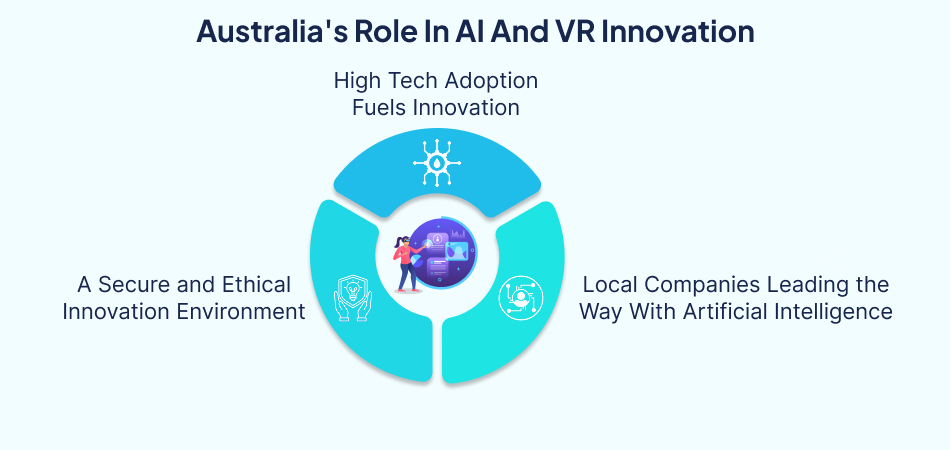 3. A Secure and Ethical Innovation Environment
 These games are seen as emotionally intelligent, detecting and responding instantly to a player’s emotional state. Games could know how a player is feeling at any time using a combination of AI software development and biometric sensors, such as facial recognition, heart rate monitors, voice tone analysis, and even eye-tracking.
Without the combination of the AI software development and VR app development, this would not be possible.
Machine learning algorithms are essential in VR to detect various human emotions on a large scale. Facial expressions, voice tones, and body language are some examples of what is analyzed by these systems and then accurately predicts emotional states with surprising accuracy.
 Step-by-Step Breakdown of Real-Time Emotion Detection
Discover more about how biometric sensors, artificial general intelligence, and responsive, secure feedback systems can be used to enhance your game to the next level with read-time detection of emotion in VR.
It all starts when sensors monitor the physical and physiological reactions of the user, such as heart rate, facial expressions, and pupil size. The accumulation of these is via VR headsets with on-board sensors.
Inflection of the voice, tone, and speed is also observed. This multi-channel input is processed by AI systems trained on emotional datasets to determine how the player feels at the current moment.
Once an emotional state has been recognised, the game engine would adapt to it in real time: e.g., when bored or anxious. That could be a visual change, level of challenge, or, in some cases, music to affect mood.
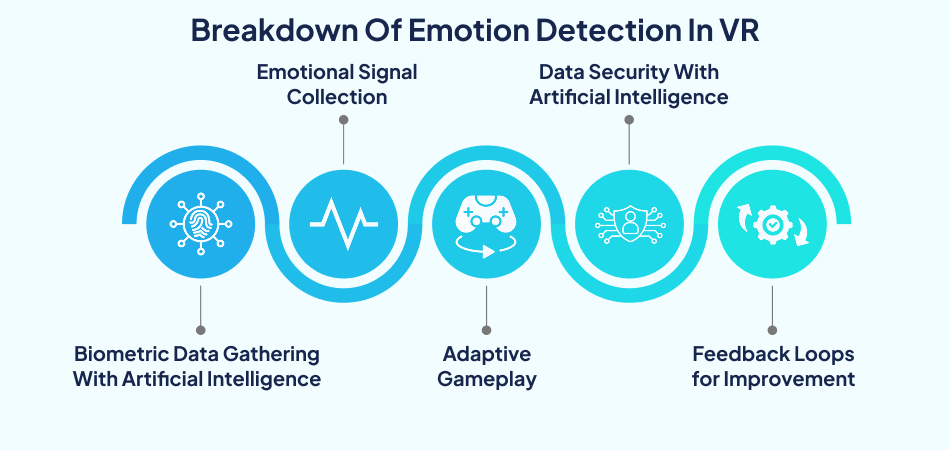
Since the emotional data can be very sensitive, data handling must be done securely. It is becoming customary for some iOS app developers to combine blockchain technology to ensure that user data is encrypted, immutable, and stored consensually.
Such AI models are still being enhanced based on user feedback and, with time, through further data collection, with greater accuracy in emotional response. This is an ability that is gaining prominence among all firms in high-end app development companies that are focusing on innovation within VR.
Simple virtual reality software development plans are unsuitable when integrating real-time emotion detection in the virtual reality experience. The developers will have to prioritize performance, as the introduction of emotion analytics must not add latency and destroy immersion.
Designing custom SDKs and frameworks with emotion recognition modules has become a widely offered service by the leading VR software development companies. These are plugged into established engines such as Unity and Unreal, and thereby provide the developers with out-of-the-box emotional intelligence capabilities when the VR application is built.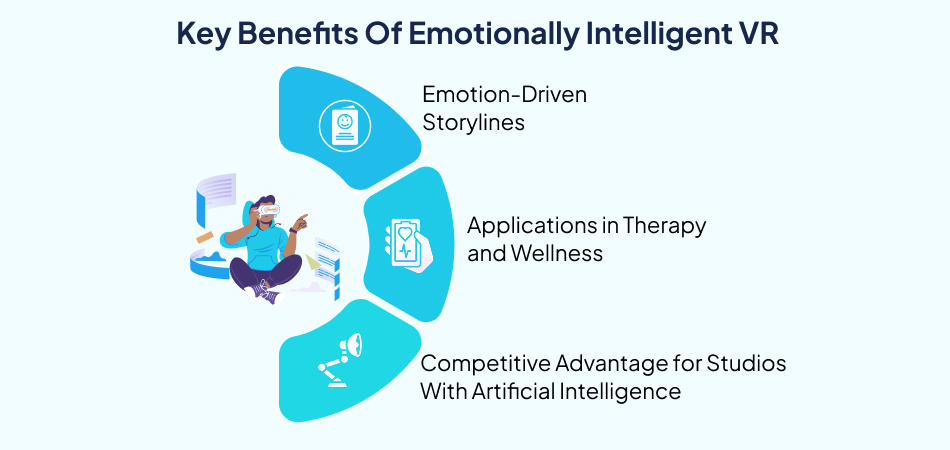
Games react to the player’s mood and thus form an extremely customized and responsive environment.
The ability to sense emotion introduces a nuance of interactivity to narrative-based games as it alters the characters, events, and endings based on the feelings of the players.
VR games have the potential to promote mental well-being, with emotional VR games helping users detect stress levels and prompt them with relaxing interplay.
With the incorporation of emotional intelligence, developers should be able to distinguish their games in this heavily saturated market, and virtual reality software developing firms are taking advantage of this.
Despite the thrilling potential of VR that appeals to the emotions, there are decisive obstacles to be considered:
 2. Cultural and Individual Variation in Emotional Expression
 Leading companies in the creation of virtual reality software have already taken a leading position in this process. They are collaborating with neuroscientists, psychologists, and AI researchers to create VR platforms capable of making the player feel.
Such firms specialize in biometric feedback loop integrations to VR games and applications. They usually cover:
Their end-to-end VR app development services allow on-demand app developers to integrate emotion-based features as painlessly as possible, which decreases time-to-market and maximizes innovation.
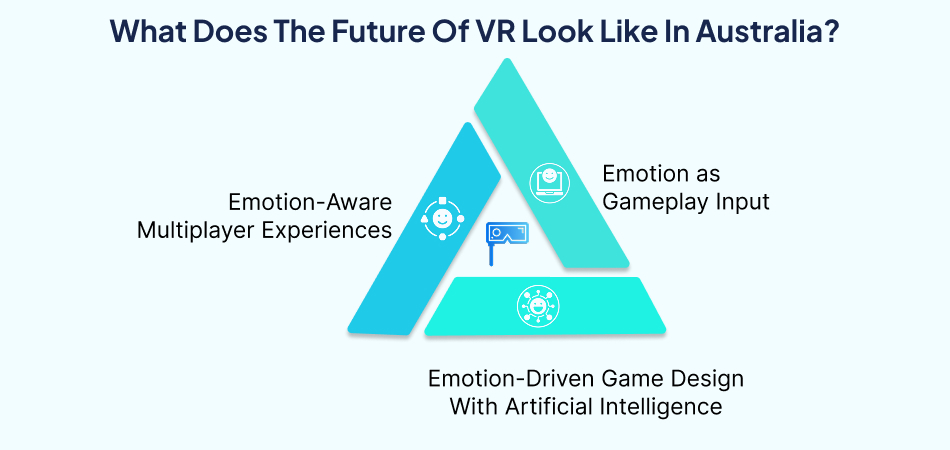
Virtual reality is changing with emotion detection, and deepening immersion, adaptive gameplay, and completely new forms of interaction are available between players and environments.
Emteq Labs
Health & VR Gaming
Emteq Labs is a UK-based app developer of VR experiences capable of real-time detection of emotions for therapeutic use.
Face EMG sensors and biometric monitoring with AI.
Applied to clinical research to trace the emotions of the patient and promote mental health conditions. Their solution becomes a trend-setter in the innovations of Emotion-aware AI in app development companies.
VR sensation discovery is transforming the VR gaming experience by providing real-time detection of the user’s digital experience. As Android app development develops, games are increasingly being designed to be adaptive, personal, and emotionally responsive. Similarly, professional on-demand app developers are creating applications that can respond to the feelings of the user in real-time.
Businesses and innovators need to consider the time to gain insight into emotionally intelligent VR solutions. Whether you need Android app development or highly skilled app developers, we can help you build the future of feeling through gaming. So, how about your next app?
Q1. Is emotion detection something that can be used in a Flutter mobile app?
Ans1- Indeed, supported by adequate integration of sensors and AI tools, a Flutter mobile app will enable emotion recognition in VR-ready environments.
Q2. Will I require on-demand app developers for emotion-based VR games?
Ans2- Absolutely. Flexibility and specialization. UI&UX developers deliver flexibility and expertise to build fast and customized applications.
Q3. Does it mean this tech is used only in games?
Ans3- No, therapy, education, and training simulations are also employing it.
Q4. Who will help to build it?
Ans4- A progressive web app development company with deep knowledge of artificial intelligence and virtual reality technology can turn your idea into a reality.


Partner with us to bring your vision to life.




 +61 (42) 108-3277
 contact@7pillars.com.au
 294A Station Street,

