1 Dec 2025
AI-Driven Fraud Detection in E-commerce: Protecting Stores and Shoppers

Shaun Bell



Online retailers are seeing an increase in fraud, with Australian businesses being put under pressure as digital payment scams have been increasing by more than 18% each year. The question of how to secure online stores has become a partnership issue between brands going online and e-commerce app developers. Fraud prevention and security departments are increasingly relying on intelligent software as the primary agent of their improvement. We provide advanced mobile app development services to create high-performance, user-friendly applications.
Fraud prevention is at the centre of attention among retailers in the fast-growing e-commerce sector in Australia, which will be worth more than AUD 100 billion in the next couple of years. To combine real-time monitoring, risk scoring, and predictive analytics, businesses are turning to an e-commerce mobile app development company. The appearance of advanced AI intelligence programs means that dangers can be spotted even before they cause losses to revenue or customer trust.
This article is about how AI is helping Aussie online retail brands to be fearless and super big by, e.g. detecting suspicious behaviours, blocking fakes, limiting chargebacks, or automating security checks.
Securing Australia’s E-commerce Future
This part targets Australian retailers, tech startups, and digital brands that would like to protect their online shopping systems with more recent solutions. A cross-platform app development company that collaborates with an e-commerce mobile app developer company will be in a better position to see how AI-powered security fits into their growth strategy. The role of artificial intelligence software development will be of particular interest to businesses modernising existing systems and to startups investigating scale-based architectures.
It can also be helpful to innovation leaders who want to minimise the losses from fraud and enhance the user experience. Whether it is a new store or a platform upgrade, you will always be better off having an e-commerce mobile app development company as your partner to be able to guarantee a future-safe protection with the backing of the latest AI software development.
 AI-Driven Fraud Detection in Australian E-commerce
AI fraud detection is becoming popular as online payments are increasing in Australia. As the number of cyber threats increases, merchants are implementing AI to monitor behaviour, identify anomalies, and secure transactions in real-time. The increasing digitalisation of both SMEs and major retailers is leading to a higher demand for systems that not only make stores more secure but also give security to the customers.
- The growing digital economy of Australia, where more than ninety per cent of consumers are online shoppers, puts brands under pressure to enhance security without losing convenience.
- Mobile commerce is an excellent business revenue channel, which has led a cross-platform app development company to adopt AI-based mobile app development solutions that include predictive analytics, tracking, and behaviour-driven authentication systems that can identify abnormal activity.
AI-driven authentication, secure payment protocols, and blockchain technology are emerging technologies that are changing the way Australian retailers protect online transactions. Many businesses are collaborating with Ionic app developers to create super-fast, cross-platform, AI-powered security e-commerce apps.
Why Fraud Detection Matters for Australian E-Commerce?
Australian shoppers desire smooth online shopping experiences supported by uncompromised security. Recurring data breaches, artificial identities, stolen credit card attempts and questionable refund requests have prompted organisations to implement more advanced levels of artificial intelligence software development to protect transactions.
1. Regulatory Institutions that Push Secure Digital Solutions
- Driven by stringent privacy and consumer protection laws in Australia, companies collaborate with e-commerce app developers to create secure and compliant platforms.
- Through the use of AI-powered behavioural analytics and automated verification systems, retailers have reduced chargebacks by more than 40%.
2. New Technology Enhancing E-Commerce Security
- One such example is locally-based e-commerce platforms that incorporate blockchain technology to authenticate high-value purchases based on transparent and auditable digital registries.
- These innovations by an artificial intelligence mobile app development company build confidence in customers who are more conscious of online risks.
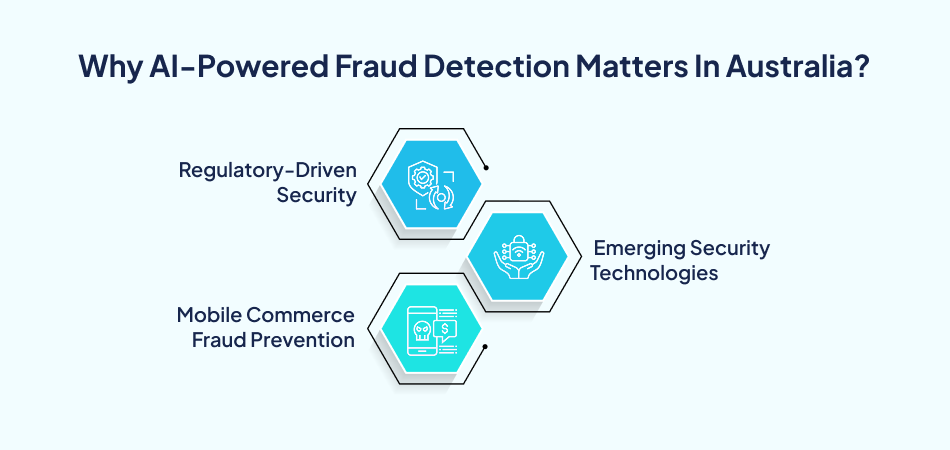 3. Mobile Commerce and the Prevention of Fraud
- As smartphone usage surpasses 95 per cent, mobile shopping has prompted companies to partner with Ionic app developer specialists and AI engineers.
- Such teams have implemented secure cross-platform storefronts that can analyse devices, IP behaviour, and biometric authentication patterns into one ecosystem.
Benefits for Online Stores and Shoppers
1. Reduced Chargebacks
- The chargebacks can paralyse working budgets.
- Through an AI Application, stores can identify high-risk orders before product shipment.
- Fraud attempts can be traced by mobile teams via an artificial intelligence mobile application, thereby saving money.
2. Enhanced User Trust
- Customers keep coming back to a safe site.
- Security measures supported by AI for eCommerce Fraud Detection in applications create a secure environment for browsing and purchasing for users.
- If you hire an expert app developer, they can implement these features in a non-intrusive manner and therefore, offer a good user experience.
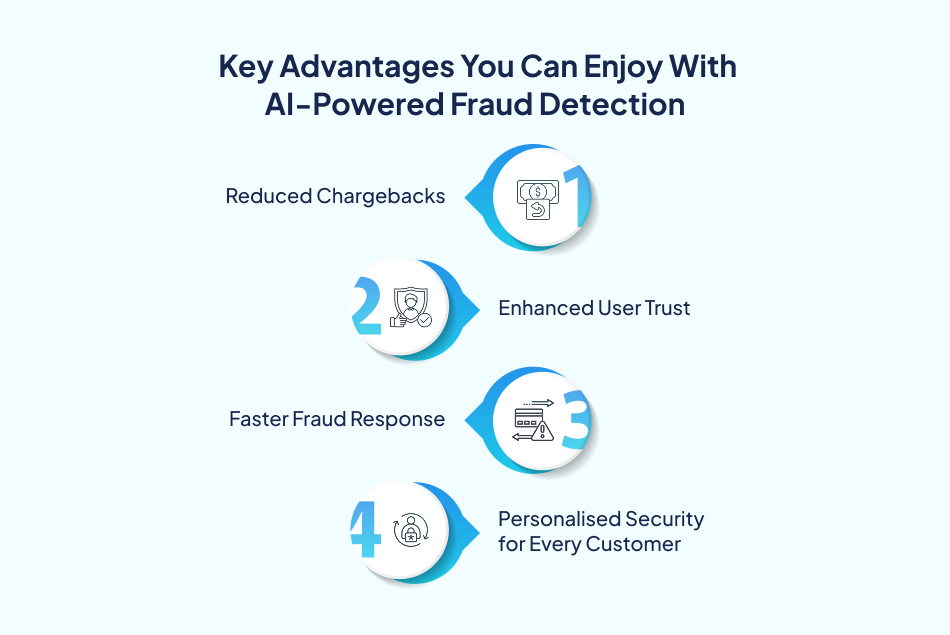 3. Faster Fraud Response
- Fraud detection is fast with automation.
- With the help of AI, merchants do not need large teams to look through the transactions that might be suspicious. Instead, AI can identify security breaches in a matter of milliseconds.
- Our solutions focus on fraud prevention in online retail to protect businesses and customers.
4. Security Personalisation of every Customer
- The user can train an AI Application to support regular behaviour and provide personalised security without prompting them about it.
- An AI-powered mobile application might have the capability to adjust the verification activities for a user on a mobile device by analysing the previous interactions with clients.
Key Features of AI-Driven Fraud Detection Systems
1. Live Transaction Analysis
Fraud usually occurs within seconds. Using artificial intelligence applications, systems process transactions in real-time and signal abnormalities before they can develop into threats. Machine learning will detect suspicious IP traffic, device rotation, or suspicious purchasing patterns.
2. Behavioural Biometrics
An advanced AI software can monitor very subtle user behaviours-typing, tapping, scrolling, or mouse movements to distinguish real users from fake ones, thus enabling companies to deeply examine mobile interactions not only by the user but also by the device, like gesture speed and device tilt.
 3. Device Fingerprinting
Fraudsters usually have multiple identities; however, their device fingerprints are traceable. Such information proves helpful in e-commerce web applications that experience heavy and diverse traffic. Combining it by employing e-commerce app development services enables retailers to build a more solid fraud-prevention system.
4. Automated Decision Engines
Intelligent fraud systems enable businesses to automate approvals or rejections. Artificial intelligence applications perform the analysis of hundreds of variables automatically while we are using them.
How AI For E-commerce Fraud Detection Works?
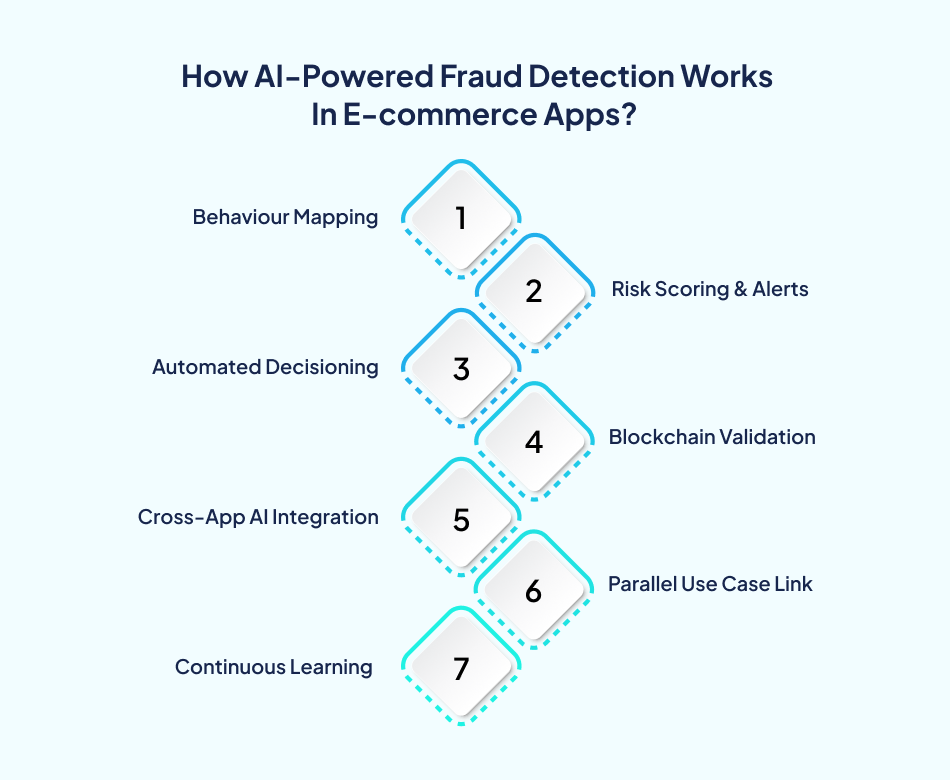
1. Data Capture and Behaviour Mapping
Australian e-commerce app developers employ AI applications to gather data, device fingerprints, click patterns, and spending history, to locate behavioural anomalies.
2. Risk Scoring and Live Alerts
Machine learning uses fraud scores where AI location changes, quick checkout, and mismatched credentials, and even in the absence of human intervention, it flags a risky transaction.
3. Automated Decisioning
The AI decision engines allow, block, or demand verification, fast-tracking processing and minimising false declines to retailers that adopt AI software development.
 4. Blockchain-Enhanced Validation
Blockchain is the technology that allows premium orders to be kept safe through the creation of immutable transaction records, thus providing transparency and compliance to Australian retailers who are using e-commerce.
5. Cross-App AI Integration
Businesses using ionic app builders incorporate features like fraud alerts, identity verification, and analytics into their hybrid ecommerce apps to ensure higher security levels.
6. Parallel Use Case Link
AI in the case of fantasy sport is to predict the results of the game to happen, while E-commerce AI mainly aims at estimating the fraud probability through pattern recognition, anomaly detection, and behavioural modelling.
7. Continuous Learning
There are developers from Australia who are working on AI solutions that are given the latest fraud patterns to help e-commerce businesses remain safe, even if the threats are continuously changing.
Challenges in AI For eCommerce Fraud Detection
AI for eCommerce fraud detection is a solution that mitigates system risks, but it also faces some challenges. Besides, AI-powered mobile applications are efficient as the threats escalate.
1. Technical Challenges
AI-driven apps have to deliver real-time insights without compromising the user experience because e-commerce mobile app development is riddled with problems such as inconsistent data, rapid model degradation, and high computing demands.
2. Operational Challenges
Being compliant, minimising false positives and having smooth integration are challenging. Combining automation with professional supervision is necessary for an e-commerce mobile app development business to create robust, reliable, and fraud-resistant systems.
 Future of AI For eCommerce Fraud Detection
Ongoing training and automation will still be necessary in fraud detection down the line. More advanced AI applications will, in fact, be able to predict fraud even before it happens by analysing worldwide data streams and cross-platform information.
Innovations like federated learning can, in principle, enable AI applications to learn from distributed data without causing any privacy violations. In the meantime, future AI mobile applications with edge computing capabilities will be able to identify anomalies locally on the users’ devices.
In the web segment, the development of e-commerce web applications will incorporate smart risk boards for store owners. Moreover, companies will be able to deploy scalable AI-driven applications that can handle high seasonal peaks or a large number of users due to a campaign once they have developed top-notch e-commerce apps.
Australian Fashion Retailer Reduces Fraud by 48%
Client Background
A medium-sized Australian fashion store was seeing increased chargebacks, suspicious refunds, and account hijackings that were scaring away customer loyalty and causing retail sales to drop. Their existing rule-based system lacked real-time detection.
Problem
Fraudulent transactions increased with seasonal traffic. Paper-based reviews led to delays, lost carts, and customer grievances by real shoppers.
Solution
The retailer teamed up with an AI mobile app development agency to infuse their e-commerce platform with AI-powered risk scoring, device fingerprinting, and behavioural analytics. Most importantly, for the verification of high-value orders, they implemented the use of blockchain.
Results
In three months, fraud declined by 48 per cent, false positives decreased by 32 per cent, and checkout approvals speed up, enhancing customer satisfaction and total revenue.
Conclusion
Artificial Intelligence in E-commerce has become an essential tool to protect both the business and the customer from the fast-changing digital world. On-demand service app development come in and ensure that all layers of your e-commerce ecosystem are security-proof and capable of keeping up with the future.
As fraud patterns evolve over time, a partnership with skilled on-demand app developers will ensure that you remain safe, efficient, and peaceful. Would you like to upgrade the safety of your shop? It would be excellent if we could cover the topic of how employing AI in a security plan might be the most efficient and business goal-oriented way for you to work.
FAQS
Q 1. What role does AI play in distinguishing real users from bots?
Ans 1- In the shortest time possible, AI studies the usage pattern of the user, mouse movements, and user access information to find a bot and thereby stop automated fraud.
Q 2. How frequently should the fraud models be changed?
Ans 2- Re-training of AI models is like a healthy habit that is necessary to be kept in order to be updated with new fraud trends and new digital threats.
Q 3. Can AI reduce false positives during checkout?
Ans 3- Indeed, adaptive machine learning models help reduce the number of unnecessarily blocked transactions and maintain the accuracy of fraud detection.
Q 4. What can the iOS app developers do to promote continuous fraud prevention?
Ans 4- The professional iOS app developers facilitate the optimisation of the apps, refresh security layers, and the scalability of fraud prevention in the long term.
Join the newsletter and get all the updates.
Subscribe




