15 Dec 2025
Using AI Technology to Predict and Solve UX Friction Points

Shaun Bell



Have you ever wondered why users give up applications in minutes? As competition intensifies, even the slightest design problems can lead to colossal drop-offs, a significant concern across the Australian digital landscape. Consumer expectations for smooth interactions between brands and themselves couldn’t be higher than they are today, with firms investing more in UI and UX design, forcing companies to rethink how they pinpoint usability challenges. Our experienced AI mobile app developers build intelligent, scalable apps tailored to your business needs.
AI software development is changing things here. Predictive analytics has experienced significant growth in the Australian app market, enabling teams to identify hot spots before they affect engagement. The brands that need UI and UX design will have to use automation and behaviour modelling to remain competitive in 2025.
This blog addresses AI software development that enables the identification of hidden user frustrations and maximises insights into real-time interaction by building a more accurate understanding of the customer journey and aiding the team in doing it more effectively. Among the things you will learn is the application of AI in everyday situations, startups, and big companies to drive data-informed decisions that will enhance the UX workflows.
Smarter Decisions Through Behaviour-Driven Design
It is the perfect section to read when a reader wants to understand how product teams are enhancing digital experiences through state-of-the-art tools. As firms shift their focus towards founders and managers considering various options for integrating data-driven insights with creative solutions, they are focusing on AI software development. UI and UX design teams can draw insights into how predictive analysis will save them the guesswork and increase user retention in competitive markets.
Owners of products seeking to grow effectively, entrepreneurs, and firms in Australia will find it worthwhile, particularly with AI software development shaping intelligent workflows. If you are the one refining applications or digital products, then a competitive advantage is knowing how to design UI and UX with AI-supported tools.
 AI-Driven UX Optimisation for Friction-Free Digital Experiences
Predicting and solving UX Friction Points with AI has been a priority of digital teams. Australian users are demanding smooth and customer-friendly experiences. As AI software development is growing rapidly, businesses are no longer relying on traditional analytics and are now deploying behavioural prediction models to detect digital roadblocks earlier. The Australian economy drives the need for UI and UX expertise.
- Smartphones are over 90%, and e-commerce applications are the order of the day. Organisations are resorting to AI mobile app developers who integrate clever automation with human workflow.
- It opens up opportunities for UI UX designers, UI UX firms and organisations that embrace AI application solutions or hybrid blockchain technology such as builder frameworks.
- Even industries pursuing secure transactions are incorporating predictive UX flows to eliminate any friction at each step.
These changes reflect increased demands among Australian users and the rising demand for innovative digital experiences. As organisations evolve their AI capabilities, they focus on proactive design approaches that reveal problems efficiently and ensure a smooth platform experience and journeys.
AI-Driven UX Precision for Australian Digital Landscapes
AI assists in verifying and addressing UX friction points in a marketplace of fast and smooth digital experiences. With high mobile interactions and online competition, even minor UX problems can easily decrease trust and conversions.
1. Market Factors, Cultural and Legal
- The privacy expectations in Australia are a robust influence on the personalisation of journeys through AI.
- AI-driven interfaces are supposed to be transparent, ethical, and culturally inclusive, as users expect interfaces to be transparent and accessible.
 2. Local Success Stories
- AI and fintech apps are becoming essential for retailers to personalise content, enhance navigation, reduce drop-off, increase engagement and effortless customer flows.
3. Tech Adoption Stats
- Smartphone penetration in Australia is 95%, and the number of e-commerce apps is only growing as people become dependent on mobile transactions.
- AI-driven UX optimization can be effective.
How AI Predicts UX Friction?
To detect these frictions, AI systems will rely on machine learning, clustering, and behavioural analytics to detect them way before users report them. The ability to process thousands of interactions simultaneously is a fundamental benefit of artificial intelligence applications. By integrating such features into designs developed by an artificial intelligence mobile application development agency, teams will be able to identify disorganised layout patterns, sluggish components, or deceptive microcopy.
- AI-generated heatmaps resources indicate unknown user paths, whereas intelligent journey-mapping provides insights into why users give up on tasks.
- A progressive UI UX agency uses these insights to remodel processes seamlessly and frequently incorporates them into strategic POS software development in artificial intelligence.
Advantages of AI to eliminate UX Friction.
1. Data-Driven Decisions
- AI is known for making the most accurate guesses by providing the most credible information in many applications.
- When talking about app development or UX, one can basically think of Angular and UX as the same coin.
2. Real-Time Monitoring
- AI is used to track live communication and send immediate notifications for heightened friction.
- This feature is made possible by artificial intelligence software development, which allows real-time UX auditing at scale.
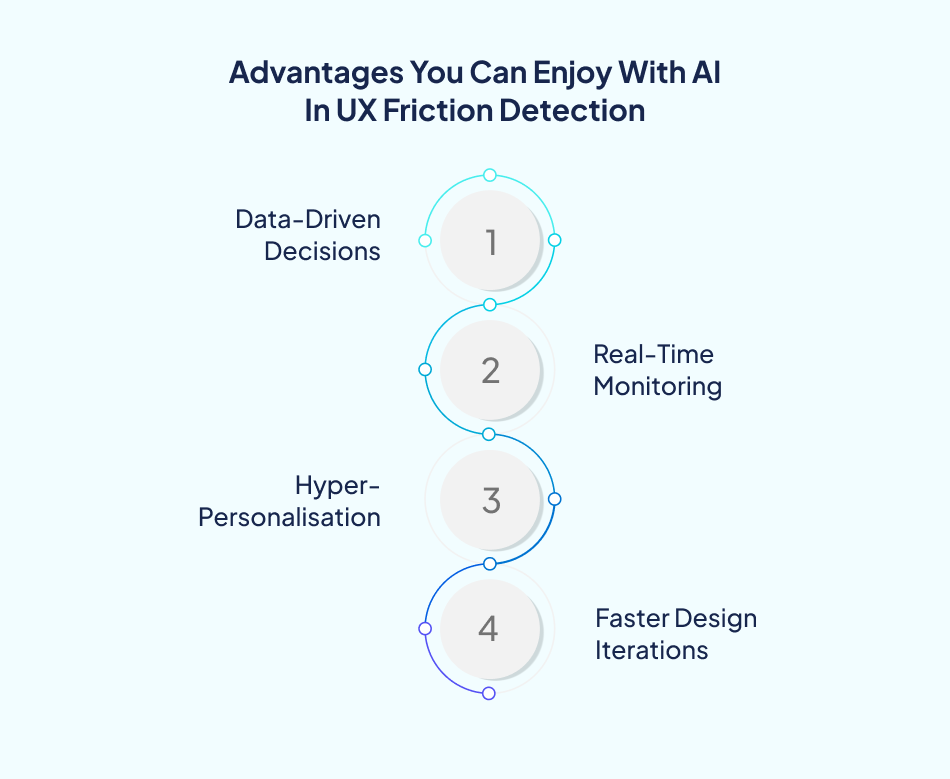 3. Hyper-Personalisation
- Customers have become used to personalised digital experiences, and AI personalises content, navigation and features.
- With masterful AI implementation, individualised user experiences are the norm.
4. Faster Design Iterations
- Prototypes and design recommendations facilitate the use of AI, enabling ux designers to test numerous ideas in a short period of time.
- A flexible UI and UX agency can cycle more quickly and consistently.
Key Features of AI-Enhanced UX Systems
1. User Behaviour Modelling
- With state-of-the-art artificial intelligence applications, machines act normally and notify of abnormalities.
- It provides designers with a clear vision of how users actually interact rather than how they are supposed to.
2. Predictive Analytics
- Predictive UX identifies possible friction in time.
- The tools with artificial intelligence software development reduces the number of support tickets and user frustration.
3. NLP
- NLP reserves user feedback, reviews, and support inquiries to outline the themes of friction.
- A professional artificial intelligence mobile app development company will incorporate NLP systems to facilitate this understanding.
 4. Design Generation
- AI-Powered Design applications assist ui ux designers to generate layout alternatives automatically.
- It makes an agency competitive by speeding up A/B testing.
Using AI to Predict and Solve UX Friction Points
1. Baseline Mapping and Data Collection
- The teams analyse heatmaps, session videos, and behavioural logs.
- UI/UX designers collaborate directly with AI engineers to create datasets to model, predict and improve an optimal user experience.
2. Recognition of Behavioural Patterns
- The models of AI recognise such patterns as drop-offs, rage taps, delayed responses, and baffling UI.
- Designers use discoveries to create visual resolutions that facilitate navigation and total user interaction.
3. Predictive UX Models
- Probability scores that predict friction points on the platforms. Intelligent blockchain technology based tools ensure data integrity, enabling AI and design teams to anticipate UX issues and intervene beforehand.
- We help brands boost conversions with specialised UX optimisation services.
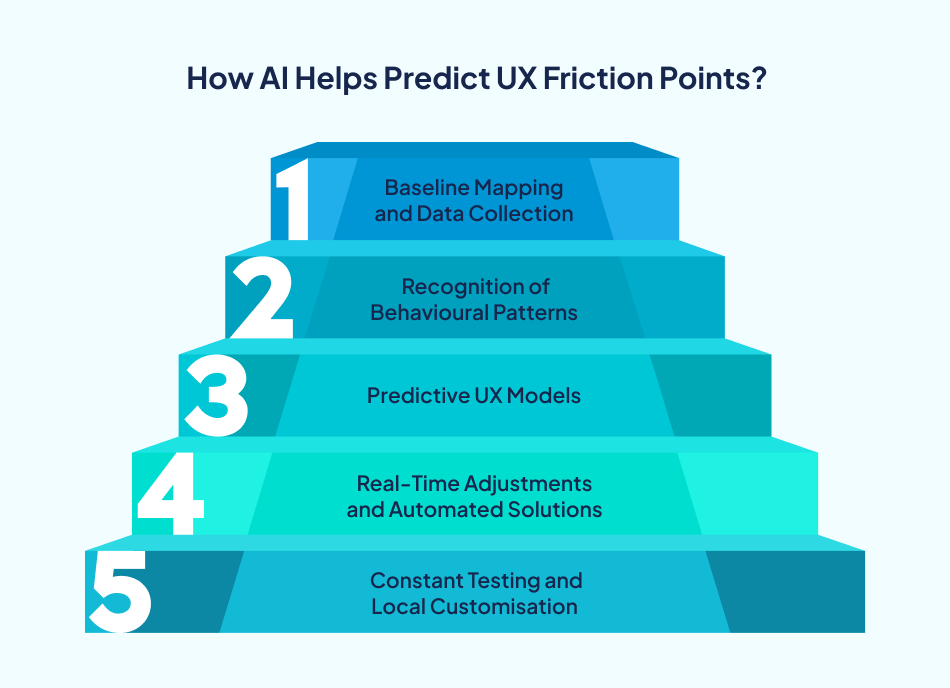 4. Real-Time Adjustments and Automated Solutions
- Dynamic interfaces are self-adaptable.
- UI/UX designers can modify layouts, navigation flows, or emphasise steps with the assistance of AI.
- Ionic frameworks can help update both mobile and web interfaces.
5. Constant Testing and Local Customisation
- The continuous testing considers accessibility, language, and device differences among Australian users.
- Using artificial intelligence, designers can eliminate friction points to continue optimising experiences and personalising them.
Challenges of Using AI to Remove UX Friction
1. Data Privacy & Security
- An AI-driven UX system needs massive amounts of user behaviour data. Meeting privacy compliance- particularly in the context of world rules is a fundamental issue.
- In addition, external entities must acquire data from AI-generated applications and ensure that the data collection process is ethical.
2. Complexity of Interpretation
- AI can detect friction points, but interpretation needs human skills.
- The teams, even with the assistance of an artificial intelligence mobile app development company, still require knowledgeable UI UX designers to understand emotional context, intent, and background user actions.
3. Incorporation into Legacy Systems
- Many companies have old platforms that are not compatible with new AI tools.
- These systems might prove demanding and technologically challenging to integrate with machine learning models developed to leverage artificial intelligence.
 4. Risk of Over-Automation
- AI applications can suggest UX improvements or even implement the changes; nevertheless, if the dependence is excessive, the final experience will be devoid of human empathy.
- A great UI agency has to merge automation with genuine user understanding; if not, the interactions will lack human touch.
5. Constant Model Repairing
- Unless retrained, AI models degrade with time.
- To be accurate, there should be an investment in data pipes, user testing, and the development of all associated artificial intelligence applications.
The Future of AI in UX
1. Autonomous UX Optimisation
- The new generation of AI uses will not only identify friction but will also modify interfaces on the fly.
- Organisations that deploy sophisticated artificial intelligence software development will facilitate UX to dynamic user trends.
2. Hyper-Adaptive Personalisation
- The apps developed by an artificial intelligence mobile application development firm in the future will offer highly personalised paths.
- Features such as navigation, content, and features change based on the user’s specific intent and context.
3. AI-Based Enhanced Workflows
- AI is not going to supplant the good designers of AI, but it will speed up the ideation process.
- These tools will generate a range of layouts, interaction flows and prototypes, allowing designers to focus on strategy, narrative and emotion.
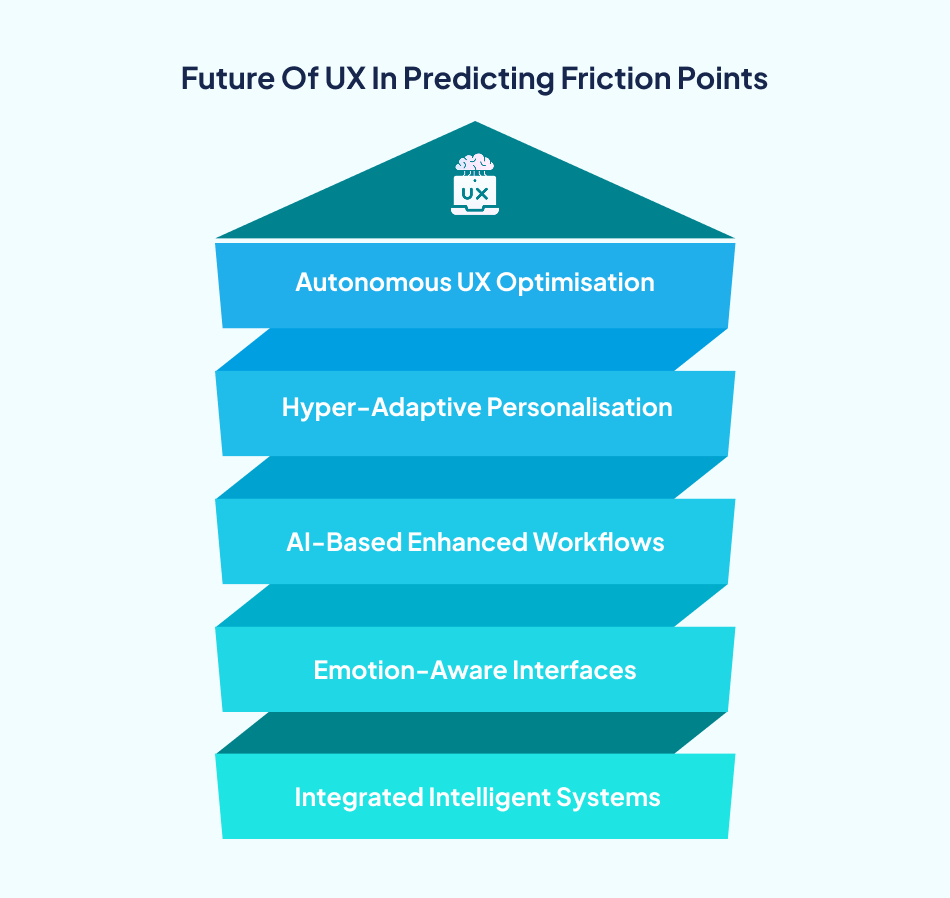 4. Emotion-Aware Interfaces
- Sentiment analysis and predictive modelling will enable AI to know when a user is frustrated, delighted or lost.
- Emotional signals are used to sway the interaction by a progressive UI UX agency.
5. Integrated Intelligent Systems
- The future is the smooth implementation of AI in mobile, web, voice, AR, and wearable experiences.
- This strategy relies on AI to deliver a more consistent, uniform UX across various touchpoints.
Improving Checkout Experience Using AI
Client Background
One Australian online store has been experiencing high cart abandonment rates despite high traffic and prices. Their manual UX evaluations did not identify the precise friction points that led to user drop-off.
The AI-Driven Solution
Our group used behavioural analytics and predictive modelling to visualise hesitation areas, error loops and confusion patterns at the UI in real time. The automated UI changes occurred without disrupting the live experience.
Outcome & Impact
In six weeks, checkout completion increased by 27 per cent, support queries decreased by 34 per cent, and user satisfaction increased significantly. Continuous monitoring depends on the continued use of an AI-powered UX optimisation retailer.
Conclusion
Learning how intelligent automation helps businesses create digital experiences and stay ahead of the competition. This blog has noted why having a reliable on-demand app developer could be a more plausible way to make the transition easier. Finding friction, streamlining travel and matching interfaces to live user behaviour allow businesses to develop effortless products.
Modernise your platforms with the strategy and help of professional on-demand app developers to reduce risks and development costs. If you really want to improve yourself, you’d better be with the solutions of the future. Don’t hesitate to call us if you desire to talk about it. We will figure out together how to do it most efficiently for your plan.
FAQS
Q1- What is the role of AI in the identification of UX friction points?
Ans 1- The analysis of behaviour patterns, identification of hesitation, and drop-off prediction occur before affecting user flow and AI-based analyses. AI fetches and then correlates these signals to reveal hidden facets of customer dissatisfaction overlooked by analytics.
Q 2- How can iOS app developers improve user experience with the help of artificial intelligence?
Ans 2- Top-notch iOS app developers use AI-powered tools, experimentation, POS software and continuous user interface monitoring to make Apple navigation easier and an ultra-smooth experience.
Q 3- Can small businesses use AI for UX optimisation?
Ans 3- No, predictive UX improvements are now affordable for startups and SMEs due to the affordable automation offered by modern AI platforms.
Q 4- Does AI fit with current app designs?
Ans 4- Absolutely! The AI layers can comprehend current interfaces and advise iOS app developers on how to make data-driven improvements without rebuilding the entire product.
Join the newsletter and get all the updates.
Subscribe




