22 Dec 2025
How To Develop An On-Demand Food Delivery App?

Shaun Bell



Mobile ordering is more popular than ever among Australians, and application slowness costs users. Having millions of orders each month and double-digit growth in metro cities, creating a stable food delivery application is no longer a luxury but a competitive necessity. A company excelling in on-demand food delivery app development can help you stay up-to-date with the latest technologies and trends. The increasing demands of customers for order now, live updates, and smooth payments are transforming the online restaurant competition. Startups can accelerate growth by leveraging custom app development solutions tailored to their business needs.
Speed, payment security and local compliance are high in Australia. Collaborating with seasoned on-demand app developers can help companies comply with GST regulations, real-time monitoring requirements, and scaling to peak usage without wasting money. Local players are also required to handle delivery partners, surge demand, and customer support well.
This blog describes features, selecting the correct tech stack, estimating costs and launching faster. You will know how to engage on-demand app developers early to prevent rework and how to test your food delivery app before going national. It is a feasible guide for founders intending a scalable launch in 2025.
Built for Fast-Moving Food Delivery App Ideas
The blog will best suit startup founders looking to validate their first food delivery app, restaurant chains looking to digitalise the business, and entrepreneurs modernising their takeaway operations in Australia. It would be clear if you were comparing the decisions for build versus scale by working with on-demand app developers in the early days to define timelines, features, and budgets.
The product managers and technology founders’ process of investigating logistics, payments, and real-time tracking will help them understand better what makes a food delivery app competitive in local markets. It can also be helpful to decision-makers evaluating vendors, particularly when selecting an on-demand app developer that is familiar with Australian compliance, user behaviour, and high-volume purchasing settings.
 Australia’s Digital Food Delivery App Revolution
The food delivery environment has been shifting rapidly, and Australia is one of the brightest examples of this shift. Ten years ago, customers used to use telephone orders and in-store menus. Digital formats now reign supreme, focusing on mobile-first behaviour, Android adoption, and increased pressure for rapid, customised food ordering experiences.
- The growing digital economy of Australia has greatly spurred this transformation. With smartphone penetration high and e-commerce heavily utilised, companies are investing heavily in scalable food platforms.
- This expansion has spurred innovation among iOS app developers, modern food delivery app developers, and cloud-based systems that aim for real-time tracking, payment, and user interaction.
Why Is Australia an Appealing Market for Food Delivery Apps that Work On-Demand?
On-demand food delivery applications are what Australia cannot live without. They are the result of a changed lifestyle, busier cities, and people adopting digital technologies. Australians are increasingly requiring more convenient food, especially in urban areas like Sydney and Melbourne.
1. Market, Legal and Cultural Factors
The developers should adhere to Australian consumer legislation, data protection laws, and gig-economy worker policies. Australian culture emphasises quality, local restaurants, and sustainability, which ought to inform app functionality and partnerships.
2. Local Success Stories Of Food Delivery Apps
Apps such as Menulog, Uber Eats, and Deliveroo (before exit) were highly demanded, and scalable models positioned via local tastes.
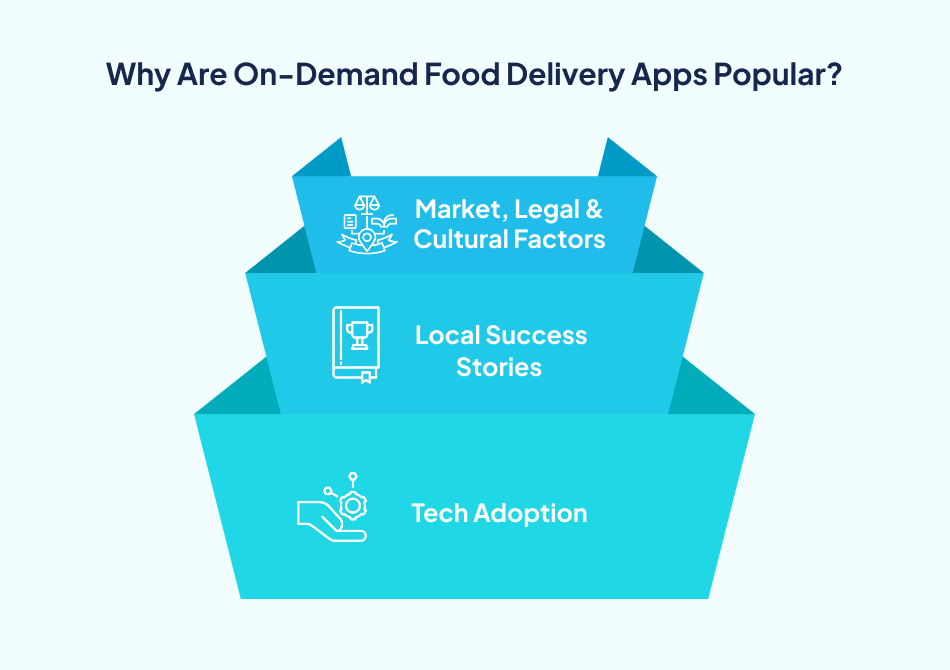 3. Tech Adoption in Australia
On-demand platforms are attractive to the Australian market, with the highest smartphone penetration of about 90-95% and over 80% of the population utilising e-commerce or food delivery applications.
Understanding the On-Demand Food Delivery App Market
The success of your food delivery business will be guaranteed by convenience, cost-effectiveness, and service quality, among other factors. These attributes, and even more, should be offered by your application to your customers, restaurants, and delivery partners to elevate their experience.
- A multi-restaurant tracking system enables customers to easily view their order status in a single app, without having to use multiple apps.
- It can also be a customer-friendly interface for placing several orders at numerous restaurants.
- When collaborating with a food delivery application developer from an experienced mobile app development company in Australia, entrepreneurs have control, flexibility, and security to grow their businesses and their success.
Benefits of Developing an On-Demand Food Delivery App
Creating a modern food delivery application results in a gradual increase in income through scalability and changing consumer habits.
1. New Revenue Sources
The creation of a food delivery app enables restaurants and aggregators to create new digital income streams and greater exposure for restaurant brands, which is not possible with traditional apps (Commission, Premium Listings and Advertising).
2. Successful Competitive Advantage
A brand with a dedicated food delivery app is definitely separate from those brands that only use traditional ordering. The brand gets positioned as one that embraces technology and cares for the customers.
 3. More Brand Recognition and Loyalty
The food delivery app is well-designed and adds value to the restaurant brand by making it unique and easily recognizable. This app allows for the creation of loyalty programs, personalised offers and push notifications to continue the customer relationship with the restaurant.
Must-Have Features In Food Delivery App for Success
Certain core features will determine the success or failure of each food delivery app as it competes against other apps in the same category. Customers expect the best food delivery applications to provide reliability and transparency throughout their experiences.
1. Ratings and Reviews System
An open review and rating system for both eateries and delivery partners creates trust and helps users make wise choices. Also, high-quality feedback loops serve as a powerful tool for overall service quality on the platform.
2. Real-Time Order Tracking In Food Delivery App
Real-time order tracking takes a food delivery app one step beyond average competitors by keeping users updated during the delivery process, providing a distinct competitive advantage for the best applications.
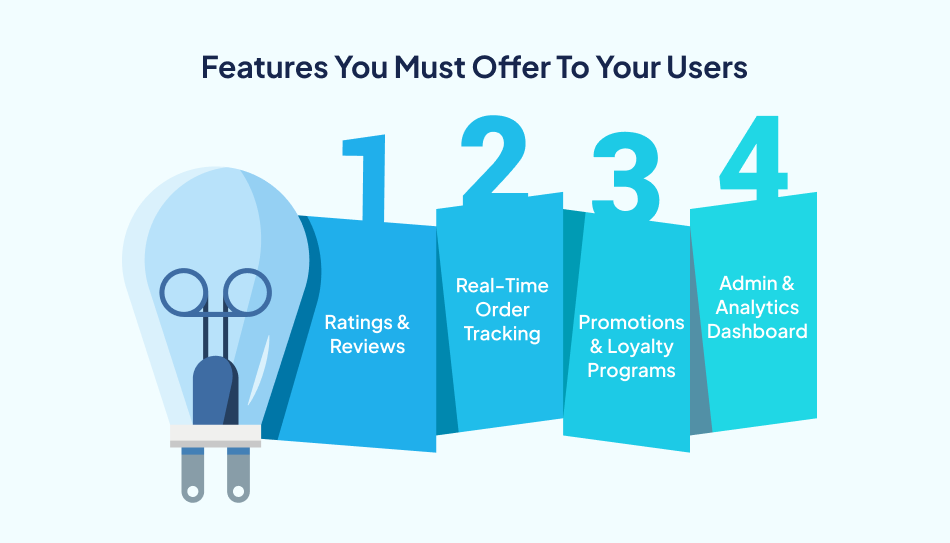
3. Promotions and Loyalty Programs
Users are motivated to frequently order through personalised offers, price reductions, and loyalty points. The most successful food delivery applications in the market use a combination of promotional tactics and gamified loyalty programs to increase their customer base and become more influential in the industry.
4. Admin and Analytics Dashboard In Food Delivery App
The use of admin dashboards created by an on-demand food delivery app development company, supported by an app development company, will help track a business’s performance, vendors, and customers’ purchasing habits.
Steps To Building A Successful Food Delivery App?
1. Market Research
Begin by reviewing user behaviour and restaurant requirements. Determine loopholes in current platforms to craft the ideal food ordering app. This stage helps food delivery app developers Australia specify the app’s main functionality, such as live tracking and dynamic pricing.
2. Feature Planning and Architecture Of Food Delivery App
An effective on-demand food delivery app development company offers customer apps, restaurant dashboards, and rider panels. Most on-demand app developers Australia suggest modular construction aided by Android application development to increase scalability.
3. UI/UX & Prototyping
Food delivery navigation and fast checkout experiences are two critical aspects of a food delivery app. UX significantly contributes to whether users consider it the best food delivery app.
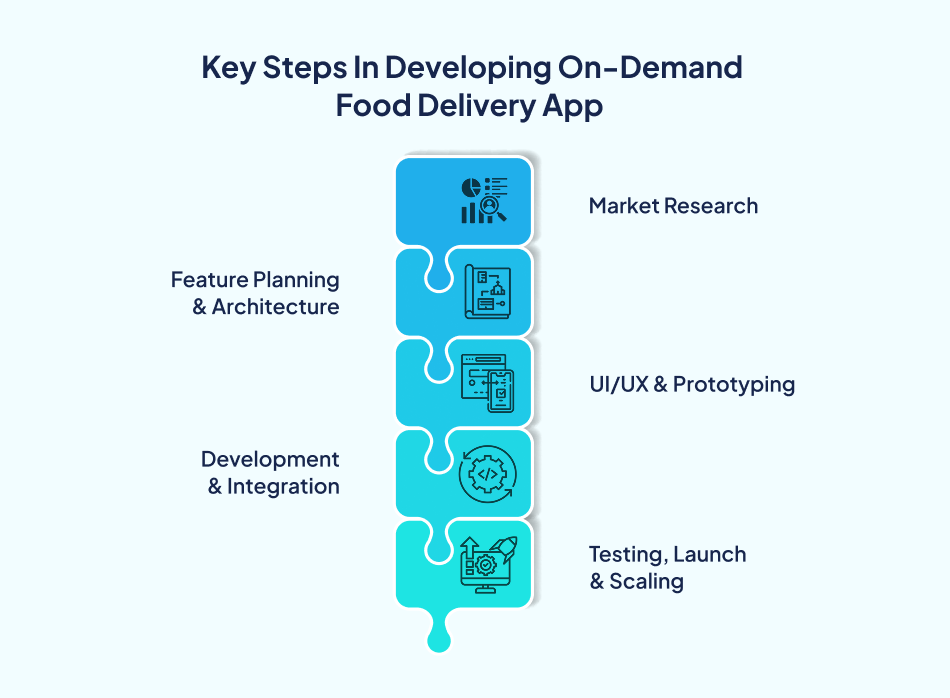 4. Development & Integration
It is the point where professional food delivery apps and on-demand development systems work together. High-tech APIs, AI assistants, and blockchain transparency make things more believable. Android application development is helping many teams to access a base.
5. Testing, Launch & Scaling
Perform security testing and optimisation during pre-launch. The most efficient food ordering app is one that improves with analytics and on-demand app developers.
Challenges in Developing an On-Demand Food Delivery App
The on-demand food delivery app development has several operational, technical and market-driven challenges. The best food delivery app has to stay relevant and profitable.
1. Intense Market Competition
The demand-based food is highly saturated. New applications require distinct functionality, flawless functionality, and good differentiation to compete effectively. Restaurants can boost efficiency and customer satisfaction by adopting AI-powered food delivery solutions.
2. Logistics and Delivery Management
Effective control of delivery partners is not easy. Efforts to provide customers with poor routing, delay delivery, and non-real-time coordination directly reduce customer trust and retention. A skilled on-demand food delivery app development company can help you understand the logistics for delivery management.
3. Scalability and Performance Problems
It is critical to scale the app at peak demand without downtime. Inefficient optimisation can lead to crashes, revenue loss and negative reviews. A food delivery app development company helps you plan your next step.
Future of On-Demand Food Delivery Apps
Innovation, automation and shifting consumer behaviour are the fuel of the future of the best food delivery app. The new technologies will transform how the food ordering application works and provide value.
1. AI-Powered Personalisation
AI will revolutionise food delivery applications, offering customised suggestions, pre-emptive ordering, and a better understanding of customer preferences to offer greater satisfaction.
2. Smart Logistics and Automation
Modernised route optimisation, dispatch automation, and delivery intelligence will be more efficient. Intelligent automation will be the new normal with food delivery applications.
 3. Voice and Chat-Based Ordering
Voice assistants, along with chatbots, are going to redefine customer interactions by providing a very convenient hands-free experience. A skilled mobile app development company can help you integrate voice and chatbot in your app.
Scaling a Local Food Delivery Platform in Australia
The Challenge
A medium-sized Austrian food startup has poor order processing, late delivery, and poor customer retention. The lack of a dedicated platform meant the business failed to compete with bigger delivery aggregators or exceed customer expectations.
The Solution For Food Delivery App
To make their business as efficient as possible, the organisation enlisted the help of skilled on-demand app developers Australia to create a customised food delivery application with feature tracking, intelligent dispatching, and secure digital payment processing.
Outcome
The increase in order volume was 45%, the decrease in delivery time was 30%, and the improvement in the number of repeat customers within six months was significant. Due to architectural scalability, the organisation planned to develop across multiple Australian cities.
Conclusion
To create an effective on-demand food delivery platform, you must execute the technical component, understand the market you operate in, and finally design your business with the user experience in mind. This guide shows how, when you blend careful planning, localisation, and scalable technologies, you will build a competitive solution. Choosing an established mobile app development company in Australia will help your on-demand service to fulfil the needs of Australian customers and work within the context of conducting business in Australia.
After making a decision, our on-demand app developers can reduce risk, speed growth, and offer strategy and expert guidance for launching a product. We will support you with a consultation to turn your idea into a market-ready application if you are already thinking about your next steps.
FAQS
Q 1. What level of scalability should an on-demand food delivery application have when launched?
Ans 1- The application must accommodate expansion. Senior iOS app developers create modular architectures permitting features, users, and regions to grow without significant rewrites.
Q 2. How important is UI/UX in customer retention?
Ans 2- Extremely important. User-friendly interface, quick checkout, and transparent delivery are the main ways that customer retention and app ratings get a direct lift. A mobile app development company in Australia can help you create a unique UI/UX interface.
Q 3. Are small restaurants able to gain the advantages of tailor-made delivery apps?
Ans 3- Yes, bespoke apps enable local restaurants to retain customers, manage branding, and lessen aggregator charges by placing orders directly.
Q 4. What is competitive about an app in the Australian food delivery market?
Ans 4- Rapid response, easy checkout and localisation are the primary variables in long-term user adoption.
Join the newsletter and get all the updates.
Subscribe




