23 Dec 2025
How does Predictive Analytics in mobile apps enhance Digital Learning?

Shaun Bell



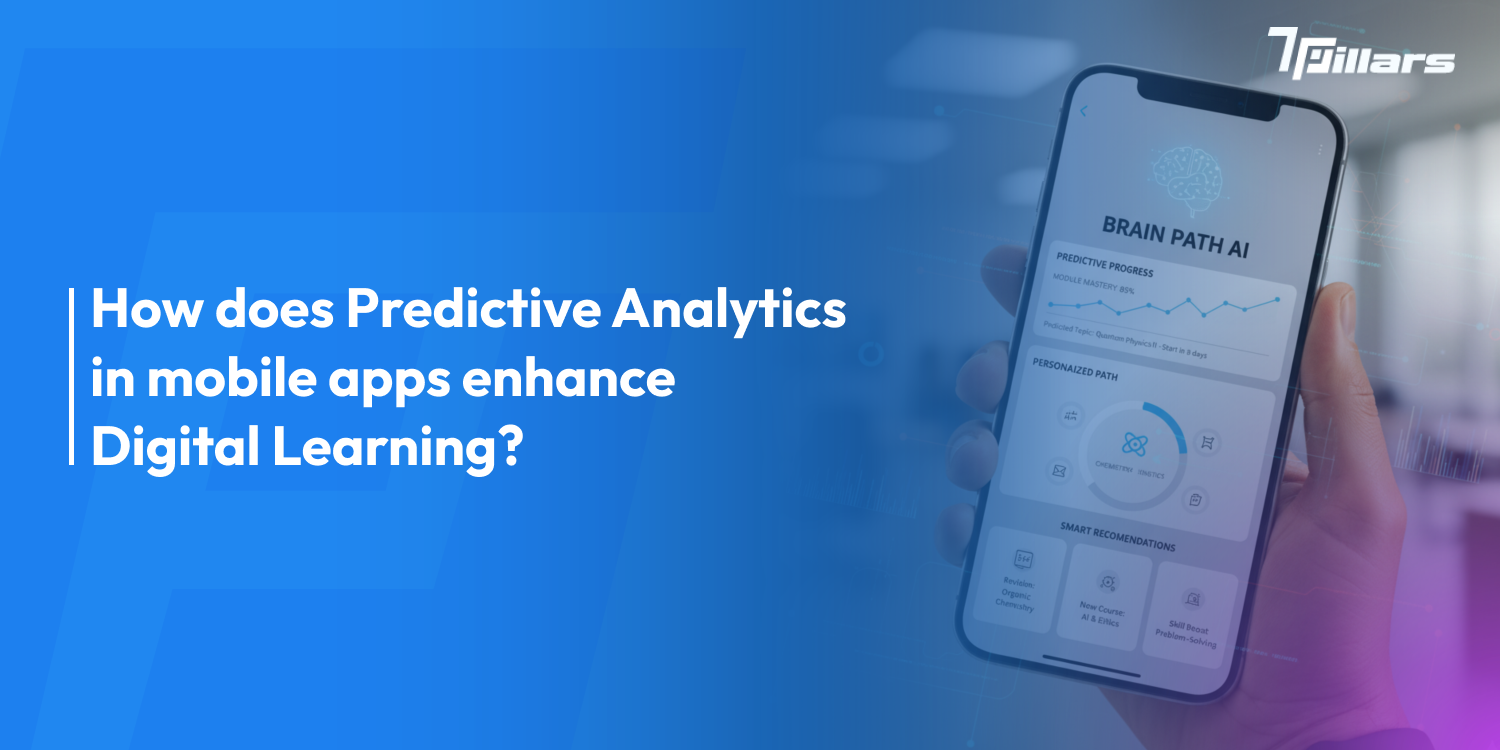
Australian students demand deeply individualized and customizable education experiences, yet most digital learning systems continue to offer one-size-fits-all content. As the Australian e-learning market continues to grow, the overall app economy, a mobile app development company, gravitates towards predictive analytics to fill this gap. Predictive analytics in education apps has proved to be a game changer for Australians. With the help of tracking learner behaviour, drop-off points, and performance tendencies, apps can predict needs rather than respond later, hold the students engaged and raise their performance. We deliver custom software development solutions tailored to your business goals and workflows.
The change is relevant in Australia, where higher competition and demographic diversity among learners present new challenges to universities and RTOs, as well as edtech startups. Relationships with a mobile app company that incorporates data intelligence enable education providers to customize learning experiences, streamline assessments and predict skill gaps critical to workforce-ready education. The use of advanced e-learning app development services helps institutions comply with accessibility standards and improve user retention.
Today, we will discuss the predictive analytics operation in learning applications, its practice in Australia, and the transformation of engagement, performance monitoring, and long-term learner success with e-learning application development services.
Predictive Analytics Driving the Next Wave of Digital Learning
The section appeals to edtech founders who develop data-driven learning systems, as well as the product executives who enhance digital learning instruments nationwide in Australia. It also helps businesses that invest in online training solutions. For planning and executing roles in growing organisations in the country today, the guide aims to prioritise and simplify complex decisions that need to be made during both planning and execution phases by assessing feature depth, development timelines, and cost efficiency.
It is helpful in the context of learning designers seeking individualised learning experiences and technology managers assessing analytics-prepared platform systems. The directions are to meet Australian expectations of accessibility, performance and measurable learning outcomes. Regardless of the process of legitimising an MVP or scaling an enterprise-level solution, teams become confident to make future-proof, evidence-based decisions in various education and training environments.
 Predictive Analytics Transforming Education App Development in Australia
The advent of data-driven personalisation and intelligent systems has increased the rate of digital learning in education app development. Key to this change is predictive analytics in education apps, an application that utilises past and current information about students to predict their performance, personalise content and improve interaction. The digital economy in Australia is also expanding, and smartphone penetration is high, making mobile-first learning in demand.
- An artificial intelligence mobile app development company has become a common partner in many institutions to incorporate machine learning in education app architectures, which can dynamically adjust to the behaviour of the learners.
- Android application development, cross-platform platforms such as Ionic App Builder, and blockchain-based secure frameworks are also supporting this trend.
Through predictive analytics, education application developers can perfect digital learning experiences, and a mobile application development firm can conduct scalability. All these platforms are based on Artificial intelligence app smarts, machine learning in education apps, and cross-platform application building on Android and blockchain technology to provide secure and mobile-first experiences, backed by trusted academic credentials in the Australian markets.
How Predictive Analytics Enhances Digital Learning?
Predictive analytics can help digital learning apps go beyond static content in the Australian market, providing learners with personalised learning paths. Mobile apps can identify learning gaps and suggest specific resources, as well as enhance student outcomes in schools, universities and corporate training by understanding how people use their apps.
1. Legal, Cultural, and Market Factors
- The Australian data protection regulations are robust, and the use of artificial intelligence apps is responsible, thus making the predictive models transparent and ethical.
- Online and blended learning is well accepted culturally, particularly in remote and regional locations.
2. Local Success Stories
- Predictive insight-based Australian EdTech platforms must report increased course completion and better learner engagement.
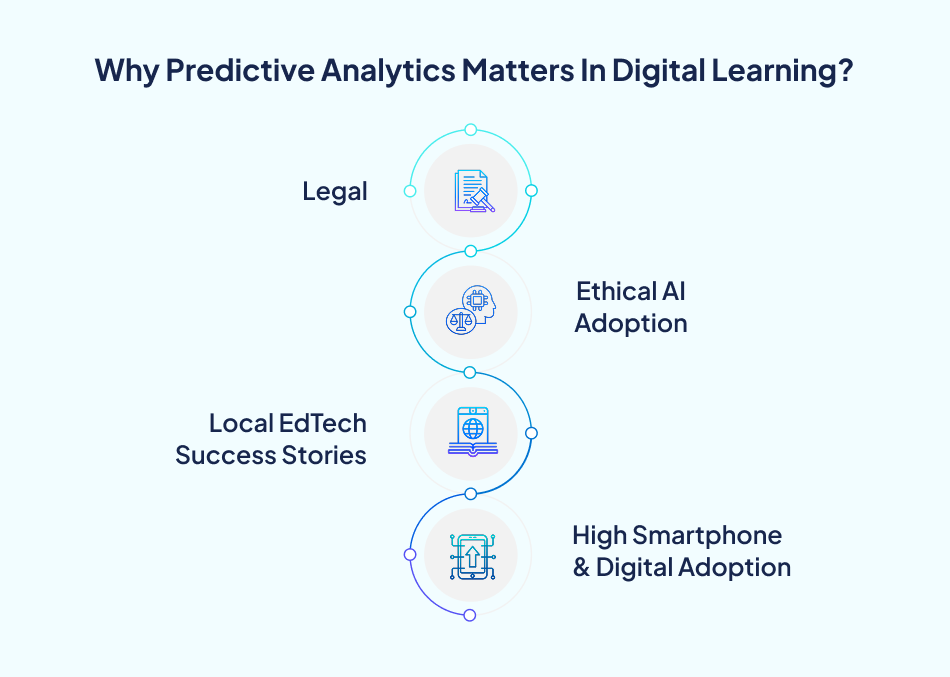 3. Tech Adoption Stats
- Australia has a high rate of smartphone penetration (over 90%) and a high level of e-commerce app usage, making the country an ideal location to implement data-driven innovation in digital learning.
Understanding Predictive Analytics in Digital Learning
Predictive analytics can be defined as the utilisation of both past and present data to determine the future. In online learning, this involves researching how students interact with the content, the issues they face and how they are motivated.
- These insights enable learning platforms to assess the level of difficulty in content, recommend learning resources, and even anticipate drops in students before they occur.
- To the learner, predictive analytics within an artificial intelligence app created by a mobile app development company can customize the education development application at a scale that has never happened before.
Benefits of Predictive analytics in Education Apps
Predictive analytics is also changing the face of mobile learning as it relies on data to offer insights, enhance personalisation of experience, increase engagement, and improve educational outcomes in context.
1. Individualised Learning Plans With Predictive Analytics
Using the predictive model to analyse learner data presents education not as a regular curriculum, but as personal lessons, quizzes, and practice according to individual learner abilities, pace, and learning style.
2. Greater Interaction and Retention
The platforms can speculate when a learner may lose concentration and provide the necessary intervention through timely alerts, gamified or other types of content, including videos or micro-lessons.
 3. Premature Performance Intervention
Analytics can identify students who are likely to underperform. Educators or systems can then offer the extra support and assurance of higher academic results.
4. Data-Driven Decision Making
The effectiveness Assessment tool provides learners, institutions, and content creators with ways to evaluate and determine their effectiveness for improving the quality of learning that occurs.
Core Features Enabled by Predictive Analytics
Predictive analytics in mobile applications changes the mobility of learning through data, enabling the prediction of learner needs, particularly when an expert mobile application development company provides solutions.
1. Individualised Learning Profiles
By creating apps that calculate performance, apps suggest personalized lessons and speed to each student.
2. Adaptive Content Delivery
Models created by a mobile app development company change the difficulty of content in real-time depending on the predicted level of comprehension.
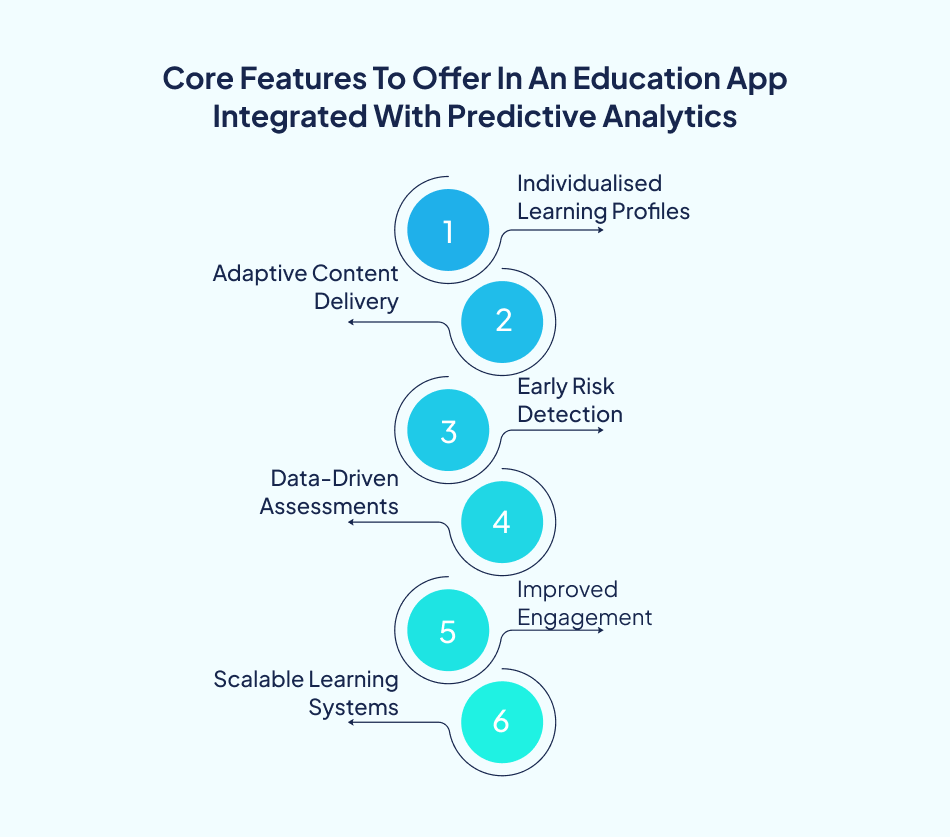 3. Data-Driven Assessments With Predictive Analytics
A mobile app development company can develop quizzes to illustrate the future trends using predictive scoring software.
4. Improved Engagement
Analytics are used in education app development to predict desired formats and motivation for the most relevant videos or activities.
5. Scalable Learning Systems
A mobile app development company scales predictive analytics securely, which assists organisations with a practical understanding.
What is the role of Predictive Analytics in Mobile Apps in Digital Learning?
1. Data Capture and Profiling of Learners
- With the current app development in education, apps gather information, including quiz progress, time spent, interaction details, and content selections.
- This information converts learner profiles using machine learning in education apps, which are constantly changing.
- A predictive analytics in education apps enhances mobile app learning.
2. Behaviour Prediction With Predictive Analytics
- Patterns discovered in predictive analytics in education apps include when a learner is likely to lose interest or perform poorly.
- It enables proactive interventions, a primary merit of an artificial intelligence app compared to fixed learning systems.
3. Individualised Content Delivery
- According to the predictions, the content tailors dynamically.
- The developer of a mobile application can create recommendation engines that deliver easier, challenging modules, or revision material based on anticipated results.
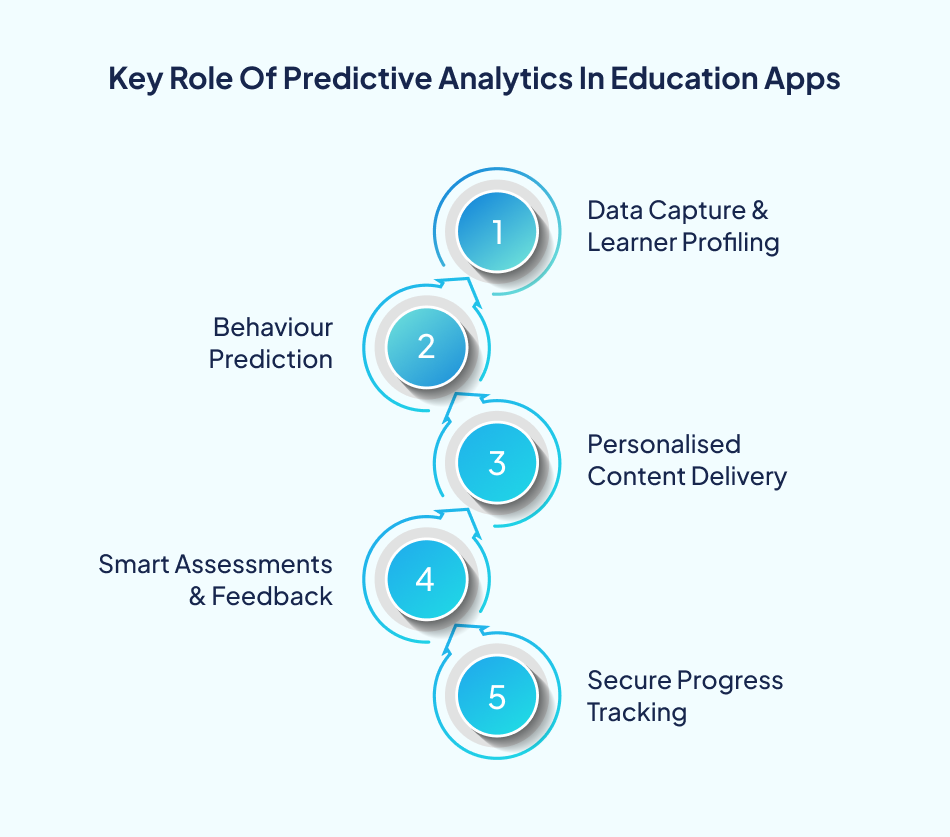 4. Smart Assessments & Feedback
- Android application development can help to predict exam performance and recommend specific practice.
- It is a machine-learning education app method that resembles a personal tutor for a course.
5. Secure Progress Tracking
- There are Australian sites that are incorporating blockchain technology to store certificates and learning milestones.
- Together with Predictive Analytics in Education Apps, it ensures trust, transparency, and long-term records of learners.
Challenges in Implementing Predictive Analytics
The development of predictive analytics presents significant challenges for any artificial intelligence mobile app development company that would like to provide reliable insights within modern apps.
1. Information Quality and Unification
- The lack of high-quality data, its inconsistency, and privacy issues compromise the model.
- Inconsistent learner data in education app development lowers the predictability and personalisation results.
2. Technical Complexity With Predictive Analytics
- The model’s expertise, scalable infrastructure, continuous tuning, and build, train, and deploy the app.
- A mobile application development firm with artificial intelligence should be able to control performance, latency, and device compatibility.
3. Regulatory and Ethical issues
- There is a bias, transparency and compliance. App development in education should safeguard students’ data and be fair.
- An Artificial intelligence mobile app development company needs to develop predictive systems, considering the current global requirements, regulations and user trust.
 The Future of Predictive Analytics in Online Education
With the still-growing speed of technological advancement in the education sector, artificial intelligence apps disrupt how we learn, personalising learning and enhancing the quality of education through the invention of new learning methods.
Looking ahead, we can expect:
- Emotion-sensitive learning systems respond to the mood and degree of stress of learners.
- Conditional AI tutors with a conversational interface.
- Profiles of lifelong learning which change over the years of the learner.
- Greater interconnection with AR/VR leads to the development of immersive predictive learning.
- Personalized learning systems adapt content and pace to each learner’s behavior, improving engagement and outcomes.
- The innovations will make digital education more accepting, interactive, and functional.
Predictive Analytics in Education Apps in Australia
Client Overview
An Australian technology education startup that provides mobile-based professional upskilling courses experienced a low course completion rate and low engagement.
Challenge
Students abandoned partway through due to the generic type of content and the absence of personalised feedback. Predictive analytics in education apps has helped solve numerous challenges.
Solution
The application incorporated predictive analytics to profile user behaviour, assessment scores and frequency of sessions. The platform, based on AI-generated insights, forecasted the risks of drop-off and optimised learning paths dynamically, with specific content and reminders.
Results
In six months, the rate of course completion improved by 32%, enhancing learner interaction, and more people were willing to renew their subscriptions, confirming the significant effect of predictive analytics on the results of digital learning.
Conclusion
Predictive analytics has demonstrated how mobile applications can make digital learning a personalised and outcome-driven one. These insights allow businesses and educators to provide quantifiable value by identifying learners, minimising the number of drop-offs, and enhancing performance. With professional assistance of on-demand app developers, predictive learning systems are scalable, secure and congruent with actual user behaviour.
It is a clear and assured way forward to intelligent digital education for organisations that consider it. With a collaboration of skilled on-demand app developers, you can establish a next-gen, data-oriented and user-friendly app. Are you thinking about your next digital learning project? It is time to consider how predictive analytics can help you achieve greater impact. Let’s begin the discussion.
FAQS
Q 1: What is the performance of predictive analytics in digital learning?
Ans 1: Predictive analytics customises the learning experience by examining behaviour, detecting gaps in results promptly, and suggesting materials, which enables the learner to remain active and get higher results.
Q 2: Is it possible to implement predictive analytics in current education applications?
Ans 2: Yes, the best iOS app developers will be able to add predictive models to existing platforms without interrupting users, provide a seamless upgrade and a quantifiable performance boost.
Q 3: Does predictive analytics have anything to do beyond education, such as retail or payments?
Ans 3: Absolutely. CPOS software operates on similar data models to predict demand and user behaviour, and predictive analytics is much broader than just digital learning.
Q 4: Who is to develop a predictive learning application?
Ans 4: The iOS app developers who are skilled and knowledgeable in AI design scalable solutions, and decision-making is enhanced through the understanding gained by borrowing insights from the AI used in POS software.
Join the newsletter and get all the updates.
Subscribe




