Let's have a
Quick Chat
with you!
Quick Chat
with you!
You have our ear and we can't wait to hear about your idea! Share your details here and we will make sure to schedule a coffee date with you soon.




In an age where users want apps to “learn” and adapt, adaptive testing via ML algorithms is transforming quality assurance. Research indicates that more than 72% of Australian app users reject apps because they are poorly performing or buggy, a problem that machine learning app development services are addressing now with predictive accuracy and automation. 7 Pillars delivers custom app development solutions designed to fit your business goals perfectly.
For Australia’s tech industry, where innovation and speed-to-market are key to success, using adaptive testing ensures apps work flawlessly on devices and user behaviours. Collaboration with a machine learning development company enables ongoing enhancement and quicker bug detection, reducing testing time by 40%.
This blog discusses how machine learning app development services and collaboration with a proficient development firm enable developers to create intelligent, self-correcting apps that can adapt, learn, and provide perfect experiences in real-time, transforming the way Australian businesses guarantee app excellence.
Machine Learning (ML) and Artificial Intelligence (AI) adaptive testing can be of invaluable use to companies that need to scale more efficiently and reduce app downtime. This approach is used by start-ups, digital product owners and established enterprises in Australia to enhance the performance and reliability of apps.
By collaborating with machine learning app development services provider businesses can create intelligent systems which develop. Through artificial intelligence software development, apps will learn through user behaviour and evolve, thus ensuring continued optimization. It not only enhances user interactions but also leads to sustained returns on investment over a long period.
Australia’s digital revolution has surged through education, training, and business sectors, fueled by artificial intelligence (AI) and machine learning (ML) app development services. One of the most influential innovations is adaptive testing that uses ML algorithms to develop tailored learning experiences and dynamic performance assessments. Such tools have intelligent, more responsive systems that meet individual requirements in real-time.
The mobile penetration rate of over 95% makes digital learning easily accessible. A progressive web app development company and ML specialists are assisting companies in developing more intelligent assessment models that reduce bias, increase personalization, and enable scalable, competency-based hiring and upskilling.
Adaptive testing applies machine learning (ML) algorithms to adjust the tests depending on a person’s performance. The systems provide dynamic difficulty adjustments in questions, increasing the precision and effectiveness of knowledge evaluation.
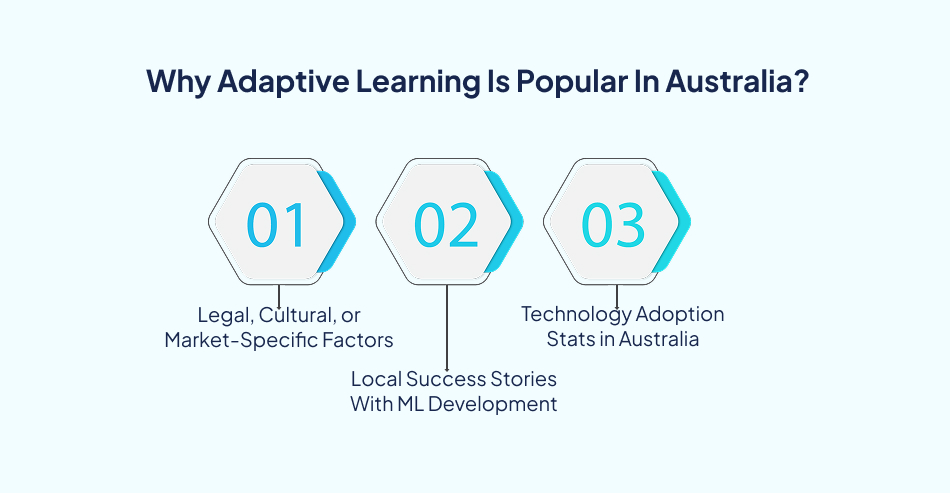 3. Technology Adoption Stats in Australia
| Feature | Traditional Testing | Adaptive Testing Using ML Algorithms |
| Question Sequence | Fixed and identical for all users | Dynamically adjusts based on user performance |
| Difficulty Level | One-size-fits-all | Personalized per user response |
| Accuracy of Evaluation | Moderate, may misjudge skill levels | High precision due to ML development insights |
| User Engagement | Static and less interactive | Interactive and adaptive learning experience |
| Implementation Support | Manual design and updates | Automated via machine learning app development tools |
| Device Compatibility | Often web-only | Multi-device through cross-platform app development company |
| Scalability | Limited by manual grading | Scalable via machine learning development company systems |
Adaptive testing (CAT) is a test where questions are selected dynamically based on the test-taker’s answer. Although traditional item response theory (IRT) is a successful method, the addition of machine learning enhances the flexibility, pattern recognition, and personalization.
The process involves pre-processing data, training of the models, online training and the integration of the front-end. The techniques of cross-validation, regularization and online learning help ensure fairness and accuracy. Machine learning streamlines the adaptive testing process to be more efficient, scalable and intelligent.
Some of the fundamental techniques employed in machine learning development for adaptive testing include:
In an end-to-end machine learning development platform, the machine learning application utilizes these models in the backend. A machine learning development company would provide real-time scalability, latency, tracking, and feedback loops.
Machine learning is transforming the educational field, as the system of assessment becomes more accurate, scalable and impartial. It is the way adaptive testing has improved with ML.
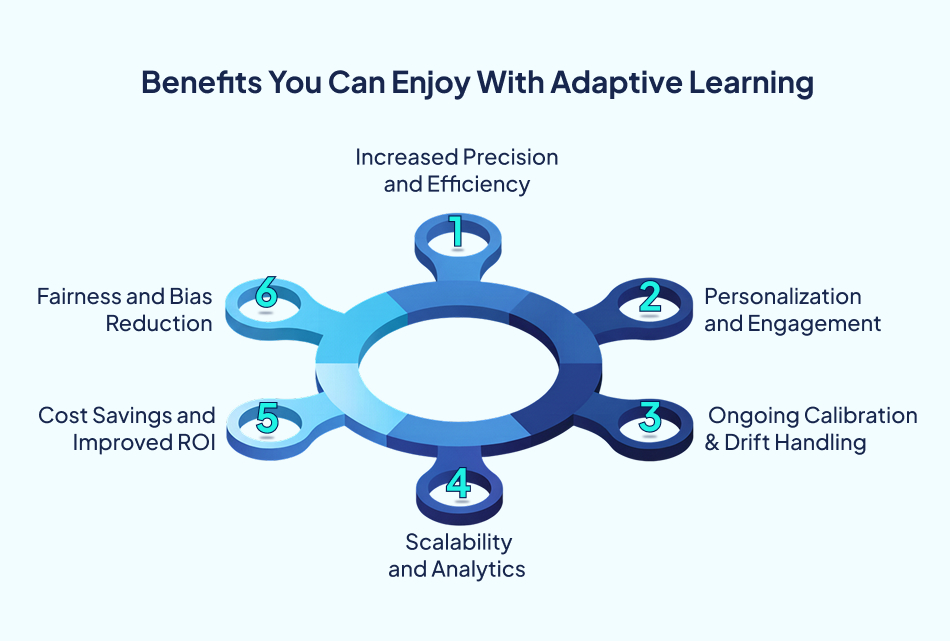 4. Scalability and Analytics With ML Development
The implementation of adaptive testing is a data-driven process in which the development of ML can guarantee personalization, scalability, and accuracy across platforms and types of learners.
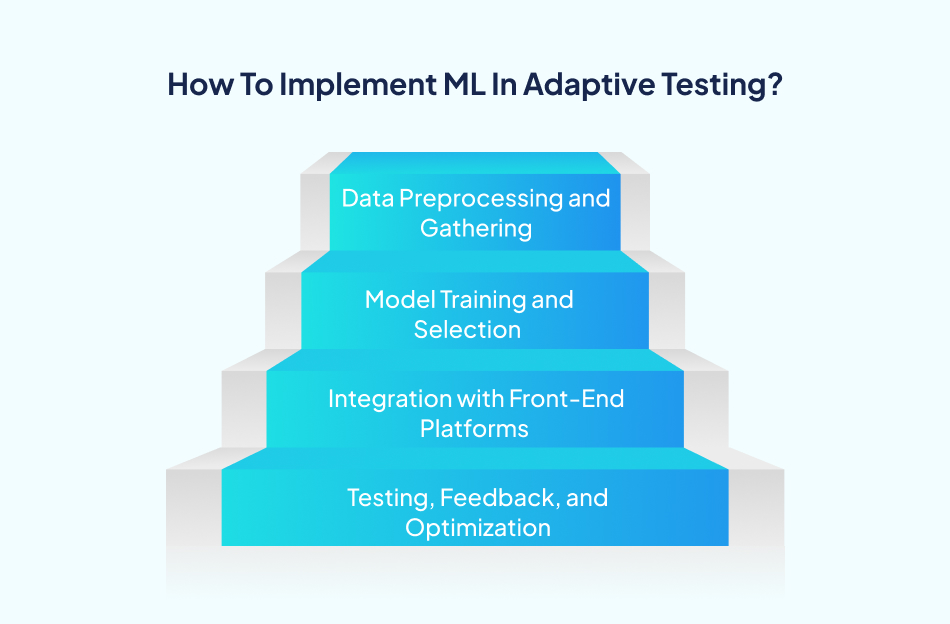 4. Testing, Feedback, and Optimization With ML Development
Constructing adaptive assessment systems presents special machine learning challenges, which necessitate a special approach to accuracy, fairness, speed and long-term reliability.
New markets or small user populations restrict training. An app development services team engaged in machine learning employs fallback approaches such as hybrid IRT+ML models.
Large item pools, which are quality-tested, are hard to maintain. ML systems must deal with drift, cheating, and duplication when content changes.
Answers must be computed immediately. Inference speed is optimized, outputs are cached, or approximate models are employed to satisfy rigid time constraints.
 4. Model Interpretability & Explainability
Teachers require transparent reasons. Engineers must incorporate interpretable layers or post hoc explanations to enable model transparency.
An Australian EdTech company collaborated with a machine learning development firm to update its online assessment platform and increase learner engagement.
Conventional testing approaches did not measure in-time student performance, resulting in inconsistent results and inadequate tailoring.
With machine learning app development services, the team designed adaptive algorithms integrated via a progressive web app development company to facilitate web and Android application development.
The new system enhanced test accuracy by 40%, reduced completion time by 25%, and met a 90% learner satisfaction rate with varied educational modules.
ML-driven adaptive testing has transformed the institutions and companies that assess talent to be fair, accurate, and personal. Companies in Australia currently have the option to incorporate AI-based assessment tools seamlessly on their platforms with advanced models developed by talented on-demand app developers to achieve better learning and training results.
Through the engagement of experienced application developers, businesses can future-proof their systems and provide flexible learning experiences across devices. The opportune moment to invest in ML-powered innovation is to get in touch with our team to create adaptive testing solutions that transform the way you evaluate, interact and empower your learners or workforce.
Q 1. How does adaptive testing benefit modern education and training?
Ans 1- Adaptive testing tailors learning by adapting question difficulty through the application of ML algorithms. iOS app developers incorporate these intelligent systems in apps to monitor performance in real-time and enhance engagement.
Q 2. Is it possible to use ML-based adaptive testing on mobile devices?
Ans 2- Yes, with assistance from professional iOS app developers, adaptive testing can be integrated throughout Android and iOS apps for adaptive, cross-device learning.
Q 3. Is adaptive testing appropriate for corporate training?
Ans 3- Yes. It improves employee appraisals by adapting tests to the level of each individual’s competency.
Q 4. Which industries employ adaptive testing?
Ans 4- Adaptive testing fueled by ML algorithms is used in the education, healthcare, and enterprise learning markets.


Partner with us to bring your vision to life.



 +61 (42) 108-3277
 contact@7pillars.com.au
 294A Station Street,
