Let's have a
Quick Chat
with you!
Quick Chat
with you!
You have our ear and we can't wait to hear about your idea! Share your details here and we will make sure to schedule a coffee date with you soon.




Lost luggage is one of the most annoying problems for passengers, who cost airline companies over $2.1 billion each year. As a result of an increase in post-pandemic air travel at Australian airports, intelligent, automated bag-tracking solutions are more needed than ever. Artificial intelligence software development is causing a stir by helping airlines and travel technology start-ups decrease their losses, boost productivity, and establish customer trust. Airlines rely on custom software development solutions to build smarter, automated AI based baggage tracking system that improve accuracy and reduce losses.
Artificial intelligence technology is transforming the real-time data processing in the aviation and tourism industries in Australia, which is thriving, preventing misroutes and alerting employees even before the bags have gone in the wrong direction.
This blog describes the method of integrating airport logistics with artificial intelligence software development, image recognition and predictive analytics to increase accuracy, decrease operational costs and offer a hassle-free and seamless travel experience.
Australian airports are transforming their operations using artificial intelligence apps. Travellers experience fewer delayed baggage deliveries and lost baggage cases, as AI-supported baggage tracking and lost item detection help to reduce delays and loss cases. They are solutions that utilize artificial intelligence software development to enhance logistics, foster security, and customer satisfaction in real-time.
Australian tech founders, start-ups, and businesses considering logistics, travel, or technology at airports should understand the effects. The possibilities of artificial intelligence applications are gigantic. Investing in artificial intelligence software development today can place your venture at the lead of a professional, more efficient travel industry that is the future.
 Transforming Travel with AI and Smart Tracking
The AI Bag Tracking and Lost Items Finder is transforming the travel and logistics industry by combining technologies to create an image recognition-based and predictive analytics-based product. The type of AI-based systems minimize the loss of baggage, enhances the precision of baggage tracking, and automates airport processes.
The very environment here is conducive to the adoption of intelligent systems across every travel infrastructure. Artificial intelligence software development has become one of the driving forces to improve transit efficiency, customer satisfaction, and offer high-level security.
The culture of technological innovation is closely linked to high levels of digital engagement, leading to the innovation of industries in Australia, particularly in the fields of travel, logistics, and AI applications.
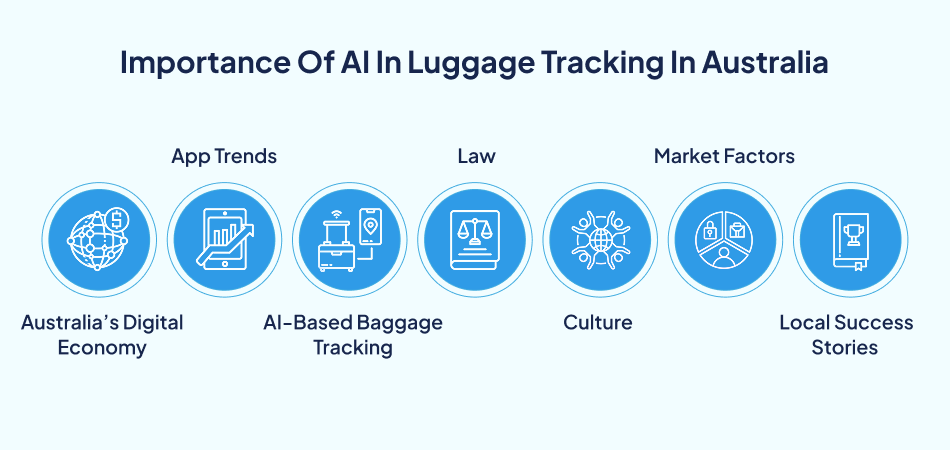 3. Law, Culture and Market-Specific.
 Human involvement and barcodes are the mainstays of older luggage systems. Yet, as the number of travellers increases, these ancient systems cannot keep pace. AI has introduced a paradigm shift to airport operations with its mix of computer vision, machine learning, and IoT sensors.
On the same note, artificial intelligence applications can enable detectives to locate lost objects by tracking cameras and RFID tag readers. AI also helps track luggage or lost items in a few minutes, and it used to take hours or even days to do it.
The best benefit of AI software development in baggage management is accuracy. Automated tracking reduces human errors, and bags arrive at the proper destination each time.
Through AI mobile app development, travellers can monitor their luggage, offering them relief, security and transparency. Alerts regarding baggage status or location updates end uncertainty while travelling. Airports are adopting custom IOT software development solutions to monitor baggage movement in real time with higher accuracy.
The ability to identify misplaced objects nearly instantly, AI-generated image recognition enables the development of artificial intelligence apps that significantly reduce the time spent on location and the restoration of lost items.
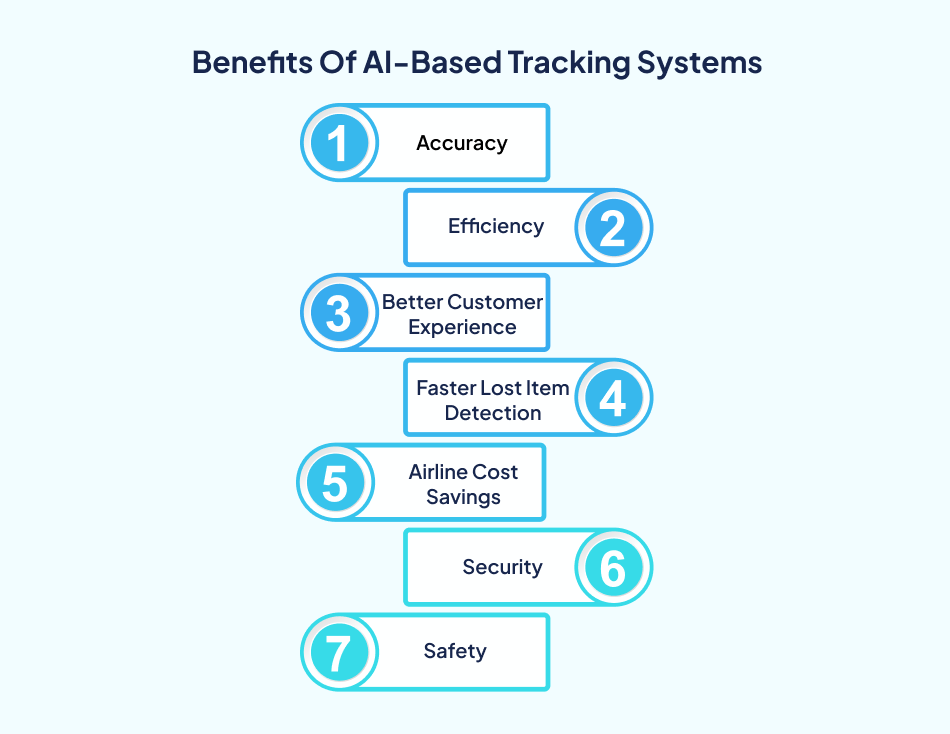 4. Airlines’ Cost Savings
Millions of dollars are paid by airlines every year to compensate customers for lost luggage. AI application development saves a massive amount of money by providing fast and correct handling of luggage.
An advanced AI mobile application is in the screening department of airports to detect suspicious or unattended baggage and protect passengers’ lives.
Though the advantages are considerable, airports and airlines have some issues with implementing these technologies:
Numerous airports have legacy equipment installed for decades. Implementing the latest artificial intelligence app development platforms into these systems is intricate and expensive.
AI applications process massive volumes of passenger data, including biometric and location data. It is crucial to ensure strict global data privacy regulations.
 3. Steep Upfront Expenses
The implementation of AI software development solutions is more expensive because it requires investment in hardware, IoT sensors, and analytics platforms that are prohibitive to small airports.
Shifting to AI-controlled baggage handling requires the creation of human resources to operate and support AI systems. The Android application development team helps track lost luggage and retrieve it.
Several airports across the globe have already been using AI mobile apps development and artificial intelligence apps development to enhance the efficiency of baggage handling:
Introduced an AI-powered lost item finding system in collaboration with a cross-platform app development company, allowing employees to find and reconnect with owners.
Installed an artificial intelligence software development system to develop predictive maintenance for baggage belts, to make sure they operate smoothly.
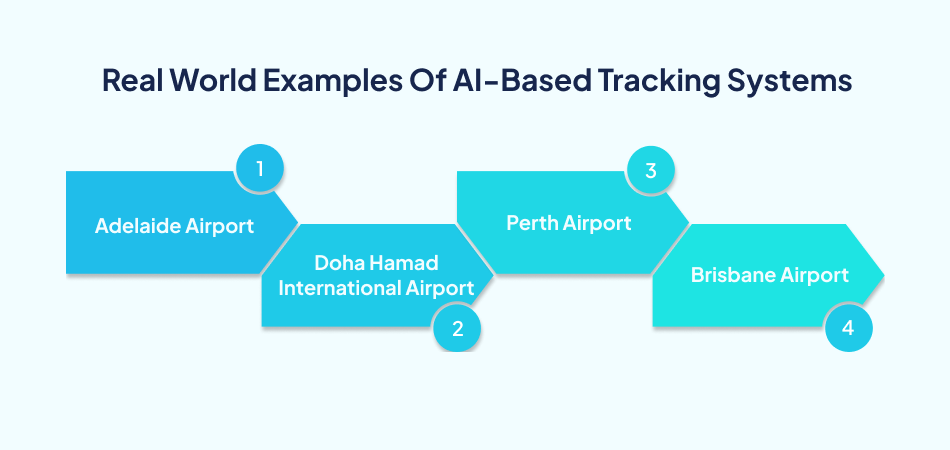 3. Perth Airport
Piloted computer vision is used on baggage claims to detect unattended baggage or misrouted baggage in a real-time setting to increase the recovery period and customer satisfaction.
Collaborated with a technology start-up to use AI-based conveyor belt tracking, which will decrease the number of lost baggage cases by a quarter.
These success stories highlight that AI mobile app development and AI software development are the future of smart airports.
The baggage tracker systems of the next generation will bring the boundaries even further:
The integration of blockchain and artificial intelligence applications will lead to the development of tamper-proof records of every baggage movement, improving the degree of transparency.
The development of AI mobile apps is soon going to create voice assistants, enabling passengers to ask, Where is my luggage? And receive instant updates.
 3. Predictive Passenger Support
With the help of behavioural analytics, the AI software development tools will indicate possible baggage mishandling and notify ground staff beforehand.
The use of artificial intelligence to create such apps in the future could provide AR navigation to direct passengers to their baggage claim sections without difficulties.
The issue of missing bags was recurring at Brisbane Airport, affecting passenger satisfaction, as well as the costs incurred by the business. There was no real-time visibility and predictive analytics for legacy systems.
As a collaborator with an artificial intelligence application development firm, the airport combined AI software development and blockchain technology to design a single baggage tracking system.
In six months, incidents of lost baggage reduced by 25%, and passenger location accuracy increased by 40%. It is one example of how AI applications and intelligent cross-platform app development company solutions can transform airport logistics at a high level of efficiency and security.
The Baggage Tracking and Lost Item Recognition can be transformed by predictive analytics, and easy automation can improve the experience. Intelligent data systems and high integration will enable airports to achieve greater transparency, improved baggage recovery, and better passenger satisfaction. With the collaboration of qualified on-demand app developers, these technologies can be smoothly rolled out and customized to the aviation regulations of Australia.
As the travel industry continues to grow, using on-demand app developers and artificial intelligence-powered tools can make airports and logistics companies more competitive, efficient, and customer-centric. Ready to optimize your airport operations? Connect to our experts to create an intelligent, AI-based tracking solution today.
Q 1. How does AI reduce airline operational costs?
Ans 1- Reduced lost luggage cases and automated detection saves AI, reducing compensation claims and manual labour costs, enabling airlines to deploy resources to better areas and enhance overall service delivery.
Q 2. Are iOS users able to access AI based baggage tracking system apps easily?
Ans 2- Yes, expert iOS app developers make it easy for iOS device users to access AI tracking functionality through user-friendly mobile apps.
Q 3. Is data privacy ensured in AI-based baggage systems?
Ans 3- Totally. AI systems are subject to stringent Australian privacy regulations, employing encrypted information and blockchain technology for protection.
Q 4. How can airlines introduce such systems?
Ans 4- Collaborate with iOS app developers and AI professionals to create scalable, cross-platform tracking apps.


Partner with us to bring your vision to life.





 +61 (42) 108-3277
 contact@7pillars.com.au
 294A Station Street,
