












Ever wondered how your favorite grocery delivery sites anticipate exactly what you’ll need before you even order? That’s the wizardry of AI technology software development redefining retail logistics. The shift to AI-based analytics in supply chains is growing faster, with over 75 per cent of the Australian retailers projected to invest in analytics. In the case of grocery technology start-ups, the modern-day competition is on the ability to apply machine learning to make data-driven stocking decisions. We provide custom mobile app development solutions tailored to your business needs.
Seasonal and regional variations in the Australian demand require precision in the inventory management process. A properly constructed grocery delivery app powered by AI can predict sales peaks, prevent stockouts and waste, and enhance user satisfaction.
This blog discusses how artificial intelligence software development uses predictive algorithms within grocery delivery app ecosystems. You’ll discover how Australian retailers are leveraging demand forecasting models to enhance the accuracy of delivery times, lower costs, and deliver products to their customers more quickly and fresher than ever.
Retail Solutions for Modern Innovators Using AI Technology
This blog is for grocery start-ups, e-commerce founders, and retail technology businesses to improve their operations. If you are experimenting with AI software development to improve stock accuracy or reduce waste, this manual is a perfect source of valuable insights for you.
Whether you are a grocery delivery app entrepreneur or a technology consultant supporting retail brands, understanding predictive analytics and POS software is essential. As a result of the rise of Artificial Intelligence software development and automation in the Australian retail ecosystem, the use of AI for your grocery delivery app can bring efficiency, customer satisfaction, and profitability enhancement in a fiercely competitive market.
Smarter Grocery Inventory with AI Technology in Australia
The development of artificial intelligence software is changing the way grocery stores operate their inventory in 2026. Machine learning models nowadays look at past sales, current demand signals, and weather conditions to offer accurate predictions.
- The growth of the Australian digital economy continues to accelerate; currently, 92% of Australians own a smartphone, which has contributed to the rapid increase in popularity of grocery delivery apps in metropolitan and regional Australia.
- AI-based inventory management has become a common practice in grocery stores due to its ability to streamline operations, minimize shrinkage, and enhance fulfillment accuracy for grocery chains and startups.
- As grocery delivery apps developed by a cross-platform app development company in Australia deliver services, real-time inventory updates, and demand forecasting have become available for grocery stores throughout the country.
Due to the significant number of Android devices utilised by Australian consumers, Android app development accounts for the majority of grocery delivery app development in Australia.
Tired of Overstock and Stockouts? Let AI Fix Your Forecasting
Get clarity on demand prediction models, inventory data integrations and estimated development cost for your grocery business.
AI-Driven Demand Forecasting in Australian Grocery Retail
1. Using AI Technology to Improve Inventory Management
- Demand Forecasting Models, powered by AI Technology, utilise atmospheric trends (i.e., Climate), regional trends, promotions, local events, and consumer behaviours when forecasting.
- In 2026, models will continue to learn on their own, enabling Australian supermarkets to anticipate fluctuations in demand and make supply decisions that will both reduce supply shortages and excess supply.
2. Accounting for Market-Specific Factors in Australia
- Market-specific factors play a huge role in how Australian grocers can implement AI.
- Among other considerations, Australian grocery retailers need to consider factors such as food safety, as dictated by consumer and local supply chain practices, when implementing AI tools.
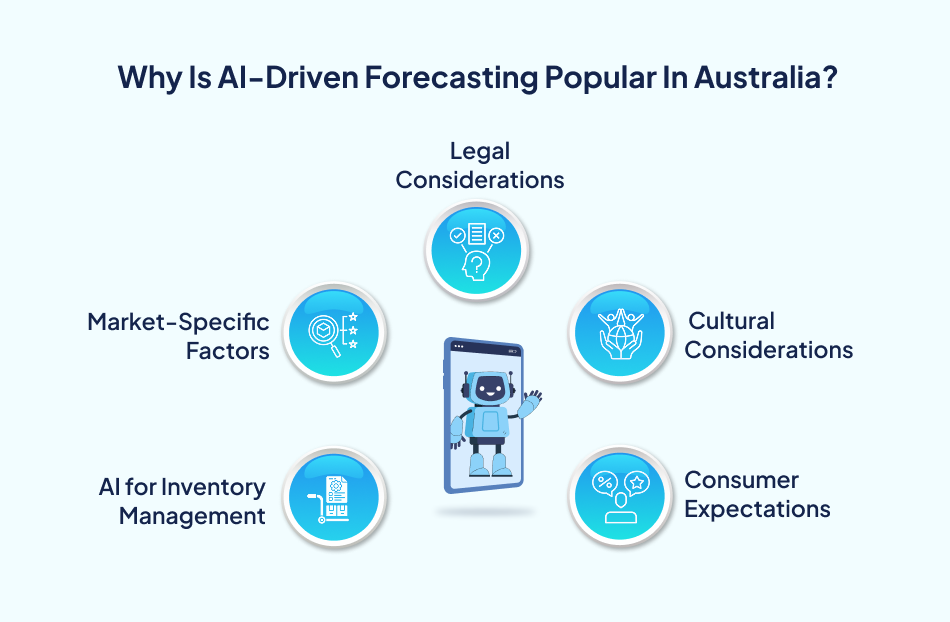 3. Accounting for legal and cultural factors With AI Technology
- When creating AI models, the impact of regulatory and legal problems, such as data protection, should be considered, as outlined in the Data Protection Act 1988.
- In 2026, the development strategies for artificial intelligence software cannot omit adhering to ethical AI practices, transparency, and sustainability, as these have become compulsory elements of the industry.
4. Cultural Expectations
- Moreover, the cultural expectations will have an impact on consumers’ demand in Australia as they are progressively inclining towards fresher, locally sourced products, thus elevating the level of forecasting even more.
-
Artificial intelligence software development enables grocery businesses to improve forecasting accuracy, operational efficiency, and customer satisfaction.
Benefits of AI Technology in Grocery Demand Forecasting
Mobile grocery store delivery apps are becoming more efficient, less wasteful, and more satisfying to customers with the help of Artificial Intelligence, allowing intelligent planning and forecasting.
1. Increased Inventory Accuracy
AI technology offers accurate information on item-level demand, reducing overstock and understock scenarios. It means inventory levels remain coordinated with customer demand across zones.
2. Reduced Perishable Waste With AI Technology
In the case of perishables, particularly, inaccurate forecasting leads to food spoilage. AI predictive modelling takes into account information on shelf-life and shopping behaviours to reduce food waste.
3. Efficient Supply Chain Planning
Through integrated artificial intelligence software development, the demand information is directly input into ordering and logistics to support just-in-time stock replenishment and lean supply chains.
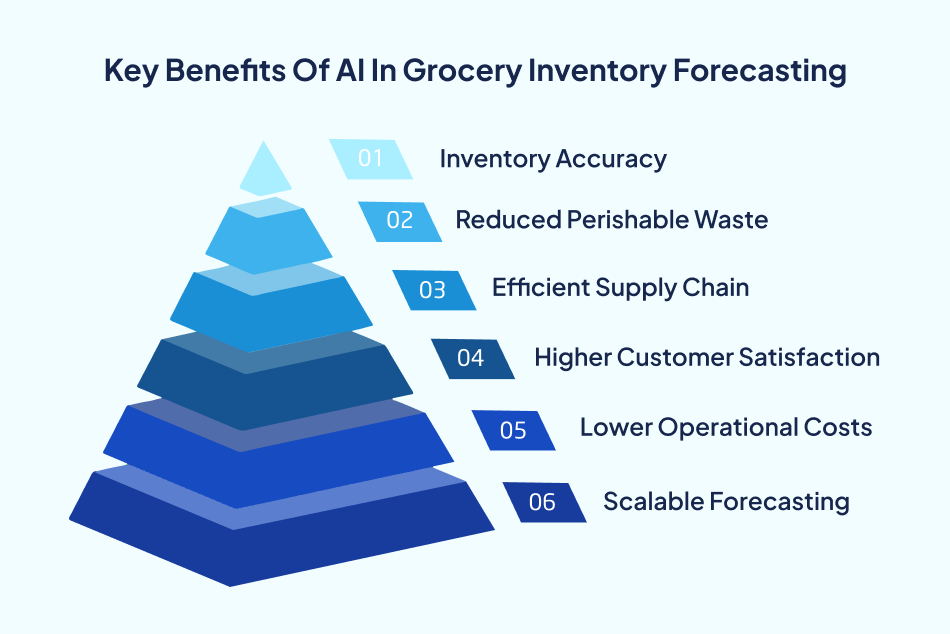
4. Improved Customer Satisfaction Through AI
Stockouts annoy consumers and result in cart abandonment. If forecasts drive inventory visible on the grocery delivery app, consumers are more apt to encounter their preferred products in stock.
5. Reducing Operation Costs
AI streamlines procurement cycles, reduces emergency restocking, and avoids over-buying, decreasing costs throughout the grocery delivery application stack.
6. Scalable Forecasting Across Locations With AI Technology
Supermarket delivery apps are not limited to working in 10 cities or 1,000 cities. AI enables the forecasting model to scale appropriately to local-level demands, without reliance on operators.
How AI Technology Enhances Customer Experience in Grocery Delivery Apps?
| Customer Experience Area | Role of AI Technology | Impact on User Satisfaction
Role of AI Technology |
| Product Availability | Predicts frequent purchases | Fewer out-of-stock items |
| Smart Substitutions | Suggests similar alternatives | Lower order cancellations |
| Delivery Slot Accuracy | Matches stock with capacity | On-time deliveries |
| Predictive Carts | Pre-fills weekly essentials | Faster checkout |
| Freshness Control | Optimises stock rotation | Better product quality |
Features of AI-Powered Forecasting Solutions
The development of AI software in the transforming environment of grocery delivery plays a vital part in improving accuracy, speed, and efficiency.
1. Predictive Modelling Engines With AI Technology
Developed through strong AI software development, these engines process large data sets (sales history, weather, events) to predict future demand patterns at various levels (SKU, store, region).
2. Real-Time Data Processing
Upcoming artificial intelligence systems utilize streaming data to fine-tune forecasts in real-time. It is critical for same-day delivery concepts operated by several grocery delivery apps.
3. Inventory System Integration With AI Technology
Forecast engines integrate directly with backend inventory and fulfilment systems, allowing automation and smooth order execution in grocery delivery apps.
4. Visualization Dashboards for Planners
Operational teams require transparency. Human planners can interpret predictions, make strategic adjustments, and monitor the performance of AI applications on visual dashboards.
5. Multi-Variable Analysis Capabilities
Innovative models that integrate internal and external variables, such as price elasticity, promotions, competitor actions, holidays, and weather into their delivery app forecasts, are essential for grocery store delivery apps.
6. Customization per Business Model With AI Technology
Every grocery delivery application has specific requirements. Special AI models are created with personalized AI software development to fit fulfillment models and customer behaviour.
AI Technology in Demand Forecasting for Grocery Inventory
A methodical strategy is necessary to apply AI in demand forecasting.
1. Data Collection
Collect its historical sales data, supplier information, seasonality, and consumer/purchasing patterns. With AI software development, it gathers relevant data to ensure data quality.
2. Model Training With AI Technology
Use machine learning models to find patterns in grocery demand and convert the data. AI apps can analyze millions of data points to generate data-driven predictions.
3. Integration
Build AI into grocery delivery apps or ERP platforms. An established cross-platform app development company will enable development on IOS or Android platforms.
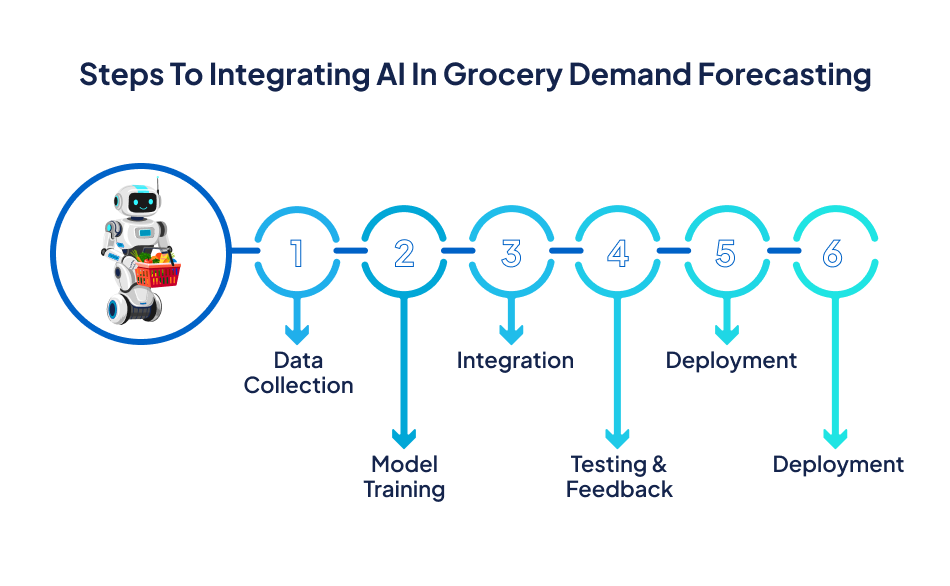
4. Testing and Feedback With AI Technology
Position of the predictions against actual sales in supporting AI down the road to frame models around localized edit markets that perform differently or have normal variances. AI apps position organizations for continuous learning based on data and automated improvement of systems.
5. Deployment
Use of predictive dashboards for store managers or the supply chain team within the organization. An Android app will alert when 75% for the next replenishment.
6. Optimization With AI Technology
Monitor key performance indicators, including turnover, waste, and customer satisfaction, for the forecasting unit. AI software development can help improve accuracy.
Real-Time, Sustainable, and Autonomous Grocery Forecasting in 2026
| AI Capabilities | How Does It Work? | Value for Grocery Delivery Apps |
| Real-Time Demand Sensing | AI analyses live signals such as in-app searches, browsing behaviour, weather updates, and local events | Instantly adjusts inventory to prevent sudden stockouts during demand spikes |
| Sustainability-Driven Forecasting | Tracks waste and carbon impact | Reduces perishables loss |
| Autonomous Replenishment | Auto-generates supplier orders | Faster restocking |
| Micro-Fulfilment Optimisation | Forecasts at local area level | Quicker deliveries |
| Scenario & Risk Simulation | Runs supply disruption scenarios | Better preparedness |
Challenges in Implementing AI Technology for Demand Forecasting
Grocery delivery apps have issues that can make their effective functioning difficult, despite the enormous forecasting capabilities of AI.
1. Data Availability and Data Quality
AI works with high-quality data. Unfinished, inconsistent, or sales data may result in faulty forecasts that affect operating efficiency in the short run.
2. Cold Start Issues for New Products
New SKUs with no prior history are challenging to predict. AI will need to infer demand based on analogues or buyer behaviour, presenting accuracy limitations.
3. Model Maintenance and Drift With AI Technology
Consumer trends change, and AI models can become stale. Ongoing monitoring and retraining are essential for stability and predictions.
4. Lack of Explainability
Most AI models are “black boxes.” Without explicit reasoning supporting forecasts, managers will no longer trust or respond to the insights.
5. High Infrastructure Demands With AI Technology
Thousands of SKUs and locations necessitate massive amounts of computing power, which is achieved through efficient AI software development pipelines.
6. Legacy System Integration
Most grocers have legacy ERP systems that do not integrate with current AI solutions, resulting in integration and data flow bottlenecks. AI technology in grocery apps helps predict demand and reduce waste.
Future Outlook for AI Technology in Grocery Forecasting
The grocery delivery experience changes with AI advancements that are creating intelligent, more eco-friendly, and customized systems that are independent and collaborative.
1. Independent Supply Chain Planning
As AI applications develop towards maturity, autonomous systems will perform tasks related to procurement, restocking, and warehousing with minimal human intervention.
2. AI and IoT Device Integration
Smart sensors embedded in refrigerators, grocery shelves, and delivery vehicles will enable precise data feeding into AI-based forecasting models, advancing the development of artificial intelligence software.
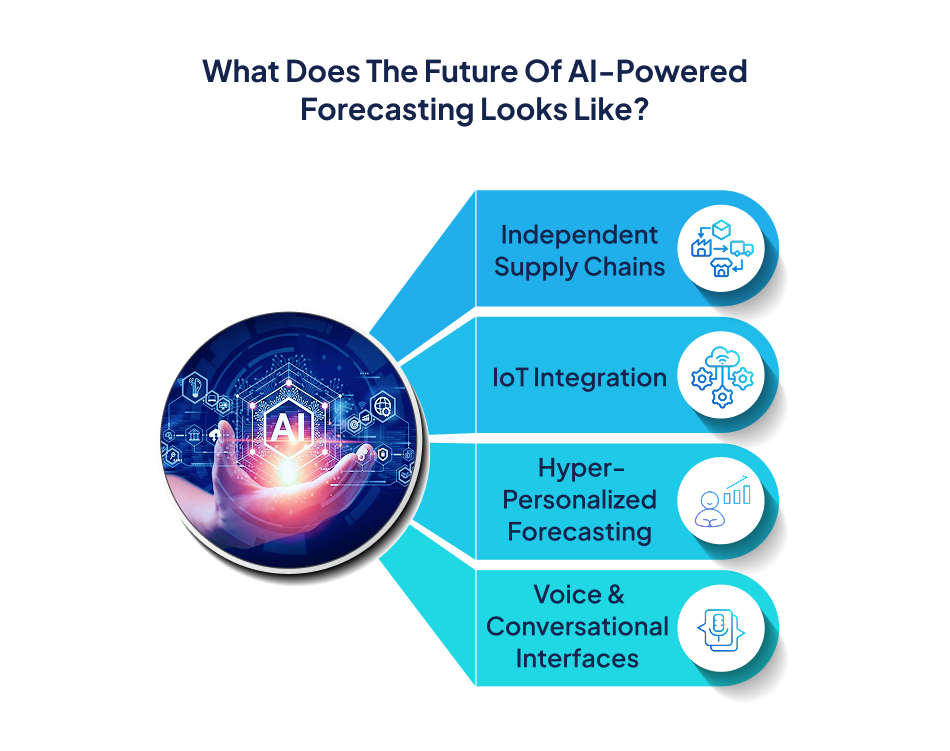
3. Hyper-personalized Forecasting Models With AI Technology
Future grocery delivery service applications will feed customer-specific forecasting data to anticipate consumers’ weekly grocery needs, which would also fill consumers’ shopping carts and facilitate delivery.
4. Voice and Conversational Forecasting Interfaces With AI Technology
Forecast findings will be presented through natural language models, allowing managers to engage with artificial intelligence applications using voice or chat commands to obtain results.
AI-Powered Demand Forecasting for an Australian Grocery Chain
Client Overview
A top Sydney grocery delivery app collaborated with a cross-platform mobile app development company to improve its stock management system.
Challenge
Stockouts and overstocking were common, which resulted in high wastage and customer frustration.
Solution
Advanced AI software development was employed to integrate predictive models into their ordering system via Android app development.
Results
Within a period of three months, forecasting precision increased by 30%, wastage decreased by 22%, and customer satisfaction scores increased immensely, attesting to the worth of AI in demand forecasting for grocery stock.
Build a Smarter, Leaner Inventory System
From POS and supplier integrations to forecasting models and dashboards, choose the right approach before you build.
Conclusion
AI technology-based demand forecasting systems and POS software for grocery inventory management have become the new standard for retailers to handle their product planning and restocking operations, and distribution of items that meet consumer needs immediately. Digitalized economies require organizations to adapt and lead the market to survive in the competitive environment.
Businesses can transform their existing inventory systems into intelligent AI-powered solutions through their collaboration with expert on-demand app developers. Now is the time to engage this technology and maximize your grocery delivery business. Build your next customer-centric intelligent app with an expert team.
FAQS
Q 1. What is the benefit of AI in the forecasting of groceries?
Ans 1- AI uses historical data, market trends, and customer behaviour to predict future demand. With the support of iOS app developers, grocery delivery apps can apply these insights to reduce waste and maintain optimal stock levels.
Q 2. Why do retailers need to invest in AI software development?
Ans 2- In addition, this technology will help the company save money as well as enhance its services. Technology enables firms to create a personalized contact with customers using self-service systems, which provide innovative customer experiences.
Q 3. Can AI be implemented in the current grocery delivery applications?
Ans 3- Absolutely, AI parts can be merged smoothly by skilful iOS app developers in a way that does not require a total system overhaul.
Q 4. What’s the advantage for Australian retailers?
Ans 4- Fresh stock, less waste, and better customer satisfaction are some of the advantages for Australian retailers.

Sundeep Mann

Get in touch
We'd love to hear from you.





 +61 42 108-3277

 contact@7pillars.com.au
 Stay Inspired with our