Let's have a
Quick Chat
with you!
Quick Chat
with you!
You have our ear and we can't wait to hear about your idea! Share your details here and we will make sure to schedule a coffee date with you soon.




Have you ever wondered why your followers and audience scroll through boring ads yet pause and use AR filters? The emergence of interactive content has transformed user expectations, and AI technology is the latest trend. On the strength of artificial intelligence software development, brands are designing hyper-personalised face filters that not only entertain viewers but also can produce measurable engagement. Businesses gain a competitive edge with custom app development solutions.
In Australia, such a shift is particularly due to the increased amount of time people spend on immersive channels. By collaborating with an augmented reality app development company, businesses can integrate AI to augment reality so that the campaigns are likely to mean much to local people and increase ROI.
The blog will delve into the idea of how AI and AR are revolutionizing engagement strategies, why an augmented reality app development company in Australia can provide a competitive advantage to the brands, and how artificial intelligence software development can take the AR experiences to the next level and beyond the fun level to a powerful tool in business.
This blog is written with startups, technology entrepreneurs, and Australian companies in mind who want to create interactive experiences that set them apart. Companies can provide a smarter, more personalised user experience with greater interaction owing to artificial intelligence software development.
Hiring an augmented reality mobile app development company in Australia provides brands with the ability to create immersive applications that grab attention and keep users engaged. Artificial intelligence software development is also a valuable contribution in the sense that it allows real-time adaptability and predictions.
The proper selection of an augmented reality app development company can open new opportunities for businesses in Australia, as well as accelerate user engagement and growth of their digital footprint.
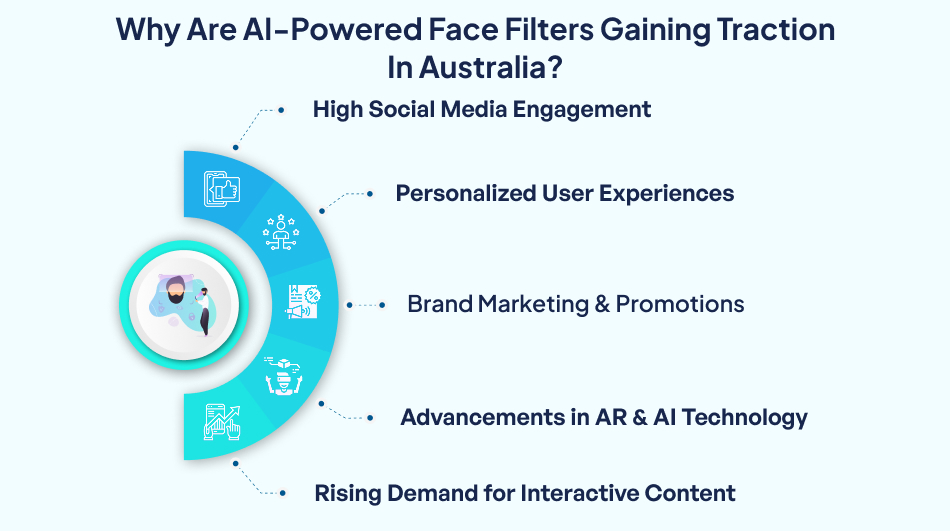
Face filters that use artificial general intelligence have moved beyond a fun add-on on social media. They have become an essential AR (augmented reality) engagement device. AI software development includes filters monitoring facial movements, usage overlays, and other expressions in real-time, allowing the user to be immersed and have a personalized experience. This increased demand has presented a chance for a metaverse app development company to venture into AR innovation.
Australia is showing a robust digital uptake at the forefront of change. More than 88 percent of Australian people have smartphones, and mobile commerce is estimated to reach over AUD 37 billion by 2025. An Australian cross-platform app development company can utilize AI-assisted filters to promote consumer interaction and business campaigns.
Local retailers and event organizers are also implementing these tools. This approach to augmented reality using AI software development creates interactive and engaging digital experiences that are inclusive and resonate with younger audiences seeking personalized experiences.
Face filters are created with the functionality of artificial general intelligence and augmented reality, which place visual filters upon the face of the individual when they take a photo or video. They can be found in social media, retail applications, and live events, where they have become very popular, offering immersion and interaction.
 3. What Legal Regulations Must Developers Follow in Australia?
 The augmented reality software development companies have to adhere to
The face filters were initially shared on apps like Snapchat or Instagram, and they added a fictional feature to selfies of a user, such as pet ears, glasses, or a flower crown. What started as some entertaining digital enhancements has grown fast with the assistance of artificial general intelligence programs to facilitate face recognition, emotional monitoring, and live movement reaction.
With the help of AI technology, now filters can
Such abilities would not otherwise be possible without highly developed AI software engineering, dependent on machine learning and neural networks that learn as they go, to increase the precision and capability of these filters.
They consist of intriguing experiences that are a profound convergence between the application of artificial intelligence and augmented reality. Upon opening an AI application with a feature of face filter, the system will frame facial landmarks, i.e., eyes, nose, and mouth, using the AI technology, and then animate imposed graphics or effects that mimic natural facial movements.
Through the following, this dynamic engagement is driven by.
Camera-based images are processed with the help of AI algorithms.
These are points and movements of the user on their face that are identified.
They place overlying effects that react in real-time to angles and gestures.
Converging these technologies into one fluid experience requires the use of up-to-date AR app development skills in the hands of the developer.
The process of creating AI-powered face filters has many steps. The way an augmented reality mobile app development company in Australia is as follows:
Learn how people behave and the cultural expectations. AR content desired by Australian citizens, especially among younger demographics, is more interactive and shareable.
The sophisticated algorithms study a wide variety of data on facial features, skin color, and emotional reactions to identify them accurately. This will be both inclusive and bias-free.
A metaverse app development company has an inventive team that produces active designs. The rapidly developed prototypes are made with tools such as Unity, Spark AR, or even an Ionic app builder.
Filtering is tested on platforms and devices before the launch. Data and privacy are taken care of, and there is usually support using blockchain technology to verify the same.
Real-time analytics assist in brand continuation and monitoring brand access once launched. An Australian augmented reality software development business usually updates filters constantly to keep them trendy.
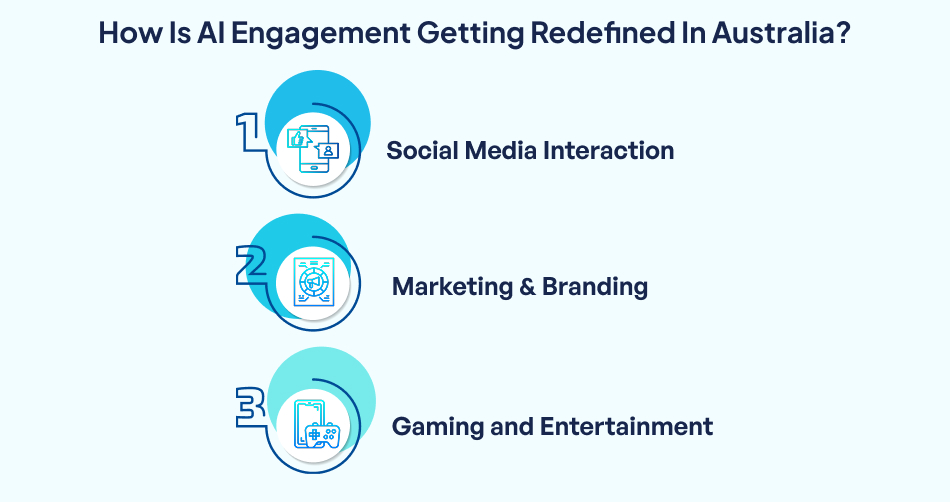
Face filters are not all that fun or cute anymore, but they are shaping a potential new way in which we communicate with brands and content.
AI-augmented facial filter content created by the user is polluting social platforms like TikTok and Instagram. These filters not only keep more of your users on your platform, but they also make them more engaged friends, i.e., sharing or commenting.
Brands are developing branded face filters to make them viral. As another example, a beauty company could implement a virtual lipstick try-on with the assistance of an AI application so that users could test products in real-time before their purchase.
Gaming apps are implementing AR face filters to generate character masks, avatars, or even whole mechanics of the game being read through facial expression. This imaginative artificial intelligence app makes the gameplay more stimulating and memorable.
| Features | Estimated Cost | Benefits |
| Real-time AI facial recognition | $8,000 – $12,000 | Highly accurate and inclusive user experiences |
| Custom AR design & branding | $5,000 – $10,000 | Stronger brand engagement and recall |
| Integration via Ionic App Builder | $3,000 – $6,000 | Faster prototyping and cost-effective development |
| Security layer with blockchain technology | $4,000 – $7,000 | Improved data security, trust, and compliance |
| Post-launch updates & maintenance | $2,000 – $5,000 | Ensures filters stay trendy and relevant |
 Business Opportunities in AI-Powered Filters
 The explosion of the artificial intelligence app face filters has introduced a new field of developers, marketers, and businesses. Considering that companies are identifying ways of incorporating such experiences into their mobile apps, the demand for specialized AI software development and AR app development has skyrocketed.
It is where companies are getting huge returns.
Using an AI application to virtually determine how glasses, makeup, and clothing look increases a buyer’s confidence and lowers returns.
AI filters can also augment learning via AR simulations, e.g., medical training or language learning with human interactivity.
Face effects and masks have become virtual tools in the digital event arsenal, granting the virtual event experience a fun, personalized feel to the attendee experience, even on remote connection.
The popularity of AI face filters implies the emergence of new ethical concerns and technical hazards that should be thoroughly dealt with.
Facial data processing must be based on tight security and transparency. The users also need to be aware of how their information is stored, consumed, and secured.
The filters should be for everybody. Variation in training data is necessary to avoid biased training outcomes across skin color and facial features.
The technology of face alteration may be misused to distribute fake news or emulate other personalities, raising ethical and legal concerns.
The companies and manufacturers experienced in providing Saas services who are involved in AI software development are therefore advised to remember these issues and the data security policies and ethical AI conditions.
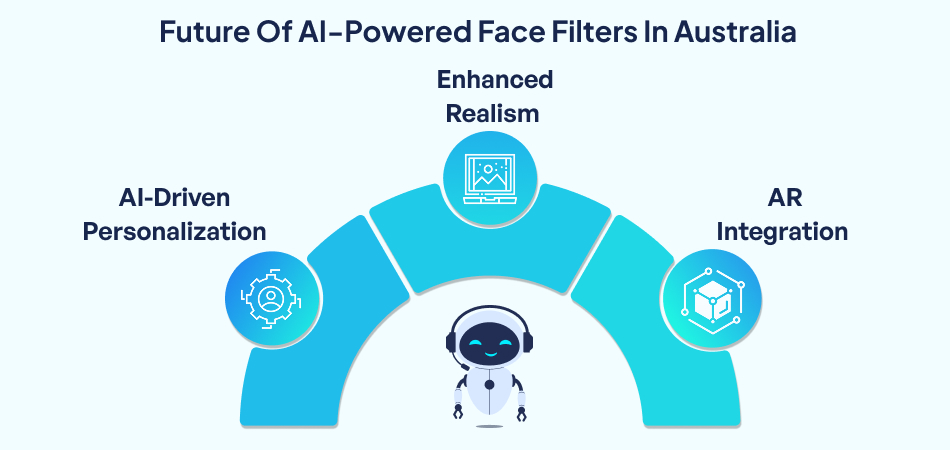
Face filters are rapidly changing. As artificial intelligence develops, face filters will be more interactive, personal, and emotional.
They will act in real time, “hyper-personalizing” filters to match users based on mood or preferences, perhaps even facial expression with emotional recognition technology.
It will be more challenging to discern the difference between filters and on-screen appearances because they can be treated with better rendering techniques, which will make filters look more natural and seamless.
They will do more than focus on faces; native filters will encompass all manner of augmented reality, including clothes fitting to digital fashion and dynamic story add-ons.
The international beauty chain Sephora applied complex Artificial intelligence software development to incorporate face filters powered by AI in the mobile application.
In a collaboration with an AR app development firm, Sephora introduced a virtual try-on AR instrument called a Virtual Artist that allows users to test almost any makeup in real-time.
The feature increased engagement and improved sales conversion, and became an example to follow for integrating AR and retail in every mobile app development company in Australia.
The future of Android app development is held by face filters powered by artificial intelligence systems, as they can create intimate zoom-in experiences tailored to each user, as well as provide companies with new means of contact with the target audience. As innovation is picking up pace, engaging with experienced app developers ensures that the developing digital ecosystems donors stay on top of the game.
Companies that are willing to plunge into app development have a chance to develop secure, captivating, and scalable AR solutions. The collaboration with specialized on-demand app developers can bring creativity to life and transform it into useful apps. Unravel with us how your brand can take the lead in this AR-driven future, today.
Q 1. How do AI-powered face filters enhance mobile apps?
Ans 1- They increase the interactivity of applications and enhance market exposure and brand recognition through personalized AR.
Q 2. Can a progressive web app development company build AR filters?
Ans 2- Yes, a progressive web app development company can incorporate AR features, but native apps can offer a smoother user experience.
Q 3. Why should brands work with iOS app developers for AR?
Ans 3- Seasoned iOS app developers can ensure that AR filters are easy to implement on Apple products.
Q 4. Is the Flutter mobile app suitable for AI-powered filters?
Ans 4- Indeed, Flutter mobile apps support cross-platform AR experiences that are optimized through experienced on-demand app developers.


Partner with us to bring your vision to life.




 +61 (42) 108-3277
 contact@7pillars.com.au
 294A Station Street,
