Let's have a
Quick Chat
with you!
Quick Chat
with you!
You have our ear and we can't wait to hear about your idea! Share your details here and we will make sure to schedule a coffee date with you soon.




Imagine visiting a doctor from the comfort of your own home, but this time, with immersive AR/VR equipment replicating actual clinical settings. With Australia’s digital health industry expected to exceed $4 billion by 2025, the need for innovation in medical applications is expanding fast. A top health app development firm can now move beyond conventional telemedicine to develop AR/VR applications that advance diagnosis, patient education, and even remote surgery. Our team builds custom healthcare software solutions that streamline workflows and improve patient outcomes.
Why is this important in Australia? With vast geography and rural communities, access to specialist care is limited. Collaboration with an augmented reality app development company closes this gap, providing interactive solutions that bring healthcare closer and make it more appealing.
This blog will discuss how AR/VR in healthcare apps is transforming, why Australian service providers must act now, and how hiring a healthcare app development company or an augmented reality app development firm ensures scalability, innovation, and compliance with the country’s health regulations.
This blog targets start-ups, tech entrepreneurs, and healthcare professionals in Australia searching for the latest digital solutions. Collaborating with a healthcare app development company ensures access to the skills needed to develop safe, intuitive platforms that fit patient requirements.
Although AR/VR can no longer be considered simple consultations, collaboration with credible augmented reality application developers can provide a wide range of medical training, computer diagnostics, and patient care. For companies aiming to pioneer, the technology superiority that comes with an agreement with a healthcare app development company grants industry competitiveness in the fast-growing health-tech sector in Australia.
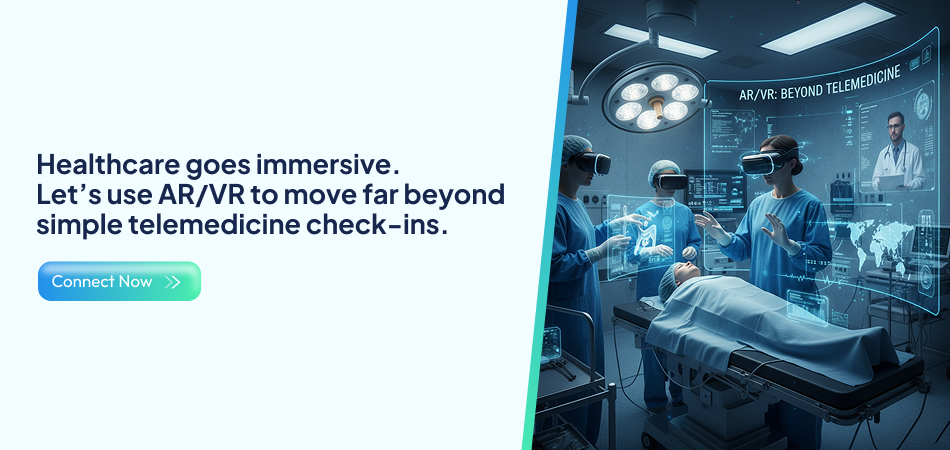 How AR/VR is Transforming Healthcare Apps in Australia?
The healthcare industry is undergoing an unprecedented transformation due to accelerated and increased demand from patients for innovative services. The integration of AR/VR in healthcare apps is one of the sectors experiencing rapid development. Contrary to traditional telemedicine, where consultations occur through video calls, augmented and virtual reality expand the opportunities to immersive diagnostics, surgical simulations, rehabilitation, and patient education.
For this transformation to be successful, a partnership with a healthcare software development company and the services of augmented reality app developers are critical. These experts believe that apps are not only efficient but also easy to use, compliant with regulations, and compatible with various devices, utilizing the services of a cross-platform app development company to scale effectively.
Advancing immersive, secure and patient-centred Australian healthcare, AR and VR are transforming how healthcare is treated and accessed.
The study of the work done by the medical professionals extends beyond telemedicine and the implementation of AR/VR technologies to enhance the patient experience and medical performance.
Medical students can now simulate surgeries using AR-based applications and get practical experience before operating in a real operating room.
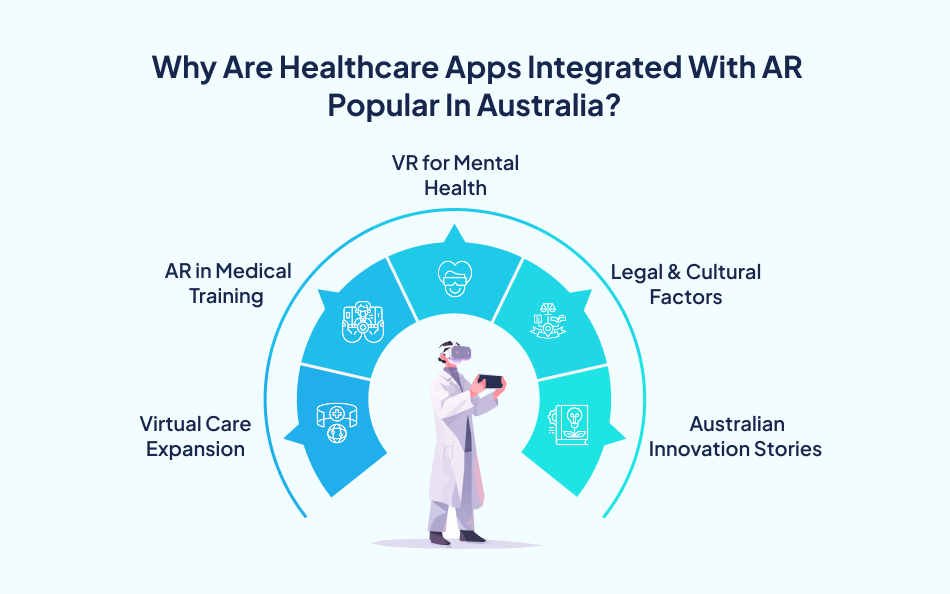 3. Treating Mental Health Through Virtual Reality
The use of VR in mental health treatment related to PTSD, phobias, and anxiety in realistic and controlled settings that promote recovery.
Understanding the role of the Privacy Act 1988 in Australia and the rising patient acceptance in the safe and effective use of AR/VR.
Outlining Australian healthcare organizations and start-ups that are leaders in AR/VR solutions to chronic pain management and surgical training. An Android application development team helps you integrate AR technology into your app.
AR and VR are no longer buzzwords in games or entertainment. They apply deeply and fundamentally to healthcare in practice:
With the growth in demand, AR apps development firms are currently collaborating with healthcare app developers to provide custom solutions themselves beyond conventional healthcare apps.
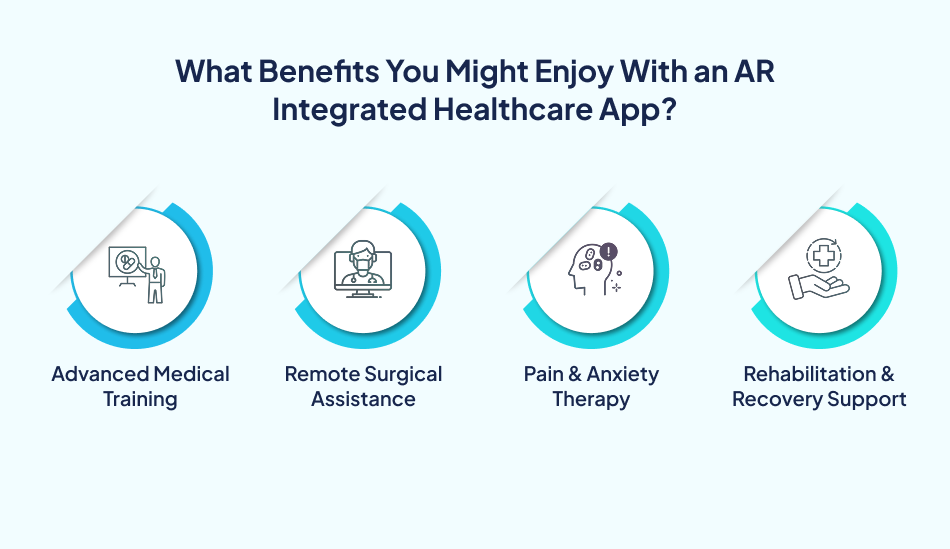
The application of AR/VR to healthcare apps offers a plethora of advantages, including not only improving training but also transforming therapy and the overall results of patient care.
One of the most common applications is probably in medical training. AR/VR can take medical students and professionals to view complex anatomy in three dimensions and learn more effectively without having to use physical cadavers.
The AR development firms are creating systems that enable medical operations, such as surgeries, to be trained in a virtual environment, eliminating mistakes in the real world.
Veteran surgeons can offer their assistance on-site in complex surgeries using real-time AR superimposition. Remote collaboration can be particularly useful in remote or underserved locations.
Healthcare app developers play a crucial role in developing secure and easy-to-use interfaces for lifeline interactions.
 3. Pain Management and Therapy
Virtual reality settings assist in the management of chronic pain and anxiety by exposing patients to soothing, controlled virtual surroundings. Physical therapy sessions and burn centres both employ this strategy.
Firms that develop AR apps have started incorporating therapeutic modules in common healthcare apps to make them more accessible.
Gamified AR applications to assist patients in motor function recovery. Such applications not only improve patient engagement but also provide data analytics to track progress.
The creation of AR means that patients will have access to tailored rehabilitation exercises that they can perform from the comfort of their homes.
To create future-ready healthcare apps, a systematic strategy is necessary to accommodate all three factors: technology, regulation and patient experience.
An app development company for healthcare starts by mapping patient pain points to AR/VR capabilities. For example, rural patients may require the use of a VR specialist consultation.
In this case, augmented reality application developers create interactive 3D models of anatomy or therapy practice. At this level, a cross-platform app development company assures that apps work on both iOS and Android.
A medical software development firm ensures smooth integration with hospital systems such as electronic health records without compromising Australian healthcare standards.Startups are launching AI-powered healthcare apps to deliver smarter, data-driven medical support.
Healthcare app developers conduct an intensive amount of testing to have their applications provide safe, reliable, and user-friendly experiences that meet the needs of healthcare professionals and patients.
To train medical professionals on the seamless integration of AR/VR apps in actual processes, hospitals and clinics collaborate with a healthcare mobile application development firm.
Frequent releases teams of augmented reality application developers and health software development companies to implement new features like AI-based analytics or advanced VR simulations.
AR/VR is revolutionizing healthcare, yet numerous obstacles must be overcome during its implementation by both developers and institutions themselves.
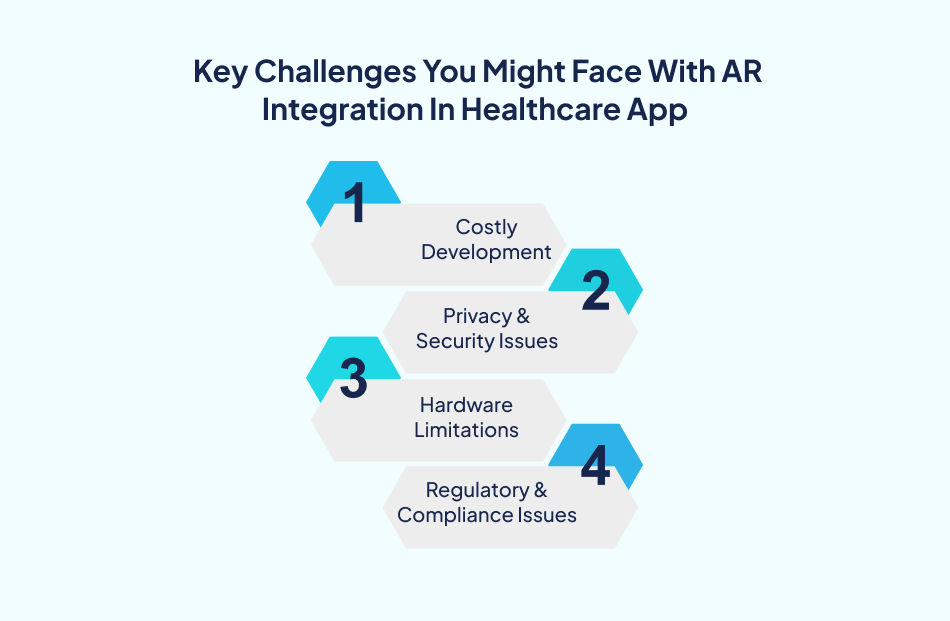 3. Hardware Limitations
Utilizes AR to overlay a map of the veins on the skin to make blood draws more precise.
Enables neurosurgeons to plan the surgery using VR simulations.
Provides neurorehabilitation using VR to stroke survivors and brain injury survivors.
The latter innovations could not have happened without the synergistic work of the AR development companies and healthcare software developers.
The ride has recently begun. It is a preview of the future:
 3. Mental Health and Cognitive Therapy
A top healthcare mobile application development firm collaborated with a Sydney-based hospital to develop a VR-based rehabilitation mobile app for stroke victims.
Conventional rehab procedures were monotonous, resulting in low patient interest and spotty outcomes.
With the help of senior augmented reality application developers, the team designed an interactive VR app that gamified therapy exercise sessions, making them more engaging and measurable.
In a span of three months, patients who used the app were 40% more compliant than traditional rehab programs, indicating the capabilities of AR/VR in transforming healthcare delivery.
AR/VR is no longer a project of the future, but a tool that revolutionizes healthcare applications. These technologies experience beyond traditional telemedicine, from patient education to advanced training modules. Healthcare organizations can tap into the appropriate combination of creativity and technical skills by contracting on-demand app developers to help them produce meaningful solutions.
For companies in Australia that wish to take this transformation, collaborating with skilled on-demand app developers is the guarantee of conformity, applicability, and innovation. The time is now to find how AR/VR can expand your healthcare services. Get in touch now to discuss consultatively on how to shape your next breakthrough app.
Q 1. What challenges exist in AR/VR healthcare app development?
Ans 1- The main issues are the observation of the Australian healthcare standards, data confidentiality, and the provision of convenient interfaces among various patients.
Q 2. Why should businesses partner with iOS app developers for AR/VR healthcare apps?
Ans 2- iOS app developers offer years of experience, ensuring apps for the Apple ecosystem and adhering to the stringent performance and security requirements in healthcare.
Q 3. What are the benefits for patients in Australia?
Ans 3- Patients have better access to interactive learning and engaging rehabilitation tools even in remote areas.
Q 4. How can healthcare providers start building AR/VR solutions?
Ans 4- Hiring a reliable healthcare app developer can be a source of strategic advice, compliance assistance and best technical knowledge.


Partner with us to bring your vision to life.



 +61 (42) 108-3277
 contact@7pillars.com.au
 294A Station Street,
