Let's have a
Quick Chat
with you!
Quick Chat
with you!
You have our ear and we can't wait to hear about your idea! Share your details here and we will make sure to schedule a coffee date with you soon.




Quality assurance (QA) is a significant, albeit frequently labour-heavy, aspect of app development. But what does it mean for testing to think for itself? In the rapidly evolving digital market today, machine learning app development services are transforming how QA teams work by reducing manual testing by as much as 40% while improving accuracy through error prediction. Partnering with a custom software development agency in Australia helps businesses build scalable, AI-driven QA solutions.
Time and consistency are the major drivers of success in a global environment like Australia’s technology culture. By hiring a machine learning app development firm, companies can elevate their efficiency and also maintain the quality as well as the assurance of their testing code and features with merely a few clicks of the mouse, without compromising performance.
In this blog, we will explore how machine learning can improve quality and assurance by using self-learning models, defect prediction, and regression testing. Firstly, you understand how developers of Australian applications can incorporate machine learning and AI-driven solutions for testing and QA in their workflows, to release strong, stable, efficient apps in today’s challenging market.
This part is ideal for start-ups that wish to spend less on testing, those in technology desiring quicker release cycles, and enterprise teams concerned about reliability. The benefits that companies implementing machine learning app development services include the automation of manual testing and workflow accuracy.
This approach will be invaluable to businesses in Australia that value quality and assurance, as it can improve the performance of software and reduce downtime. Through the services of machine learning app development, teams have the potential to streamline quality and assurance pipelines and produce intelligent, error-free apps that can keep up with changing market expectations.
 The Rise of ML Development in Quality and Assurance
Machine learning app development services have been integrated into business quality and assurance in digital platforms in recent years. Applications are becoming serious, and user expectations are improving, making it necessary to develop smarter, faster, and flexible quality testing.
Moreover, local companies are now merging Android application development with machine learning app development services to provide users with smooth and bug-free experiences. Human QA teams equipped with AI-driven analytics have a higher probability of engagement.
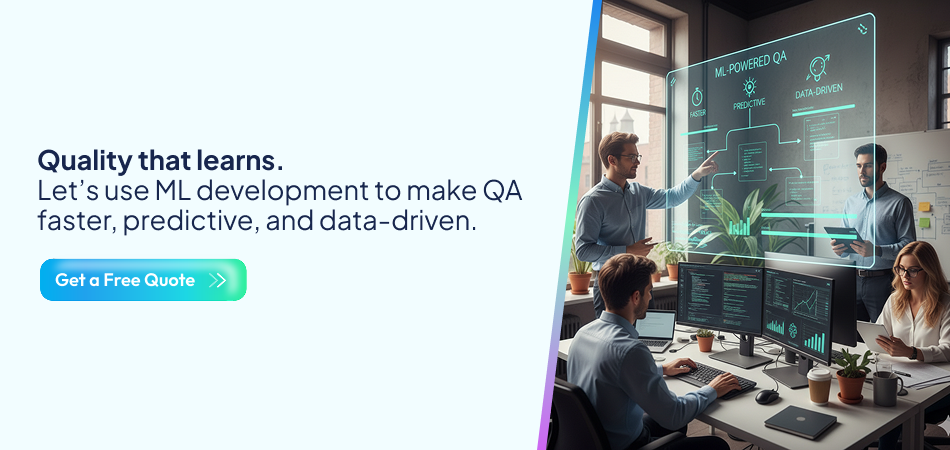
Machine learning is transforming quality assurance; automated testing, accuracy, and faster, informed decision-making are available in the majority of digital sectors today.
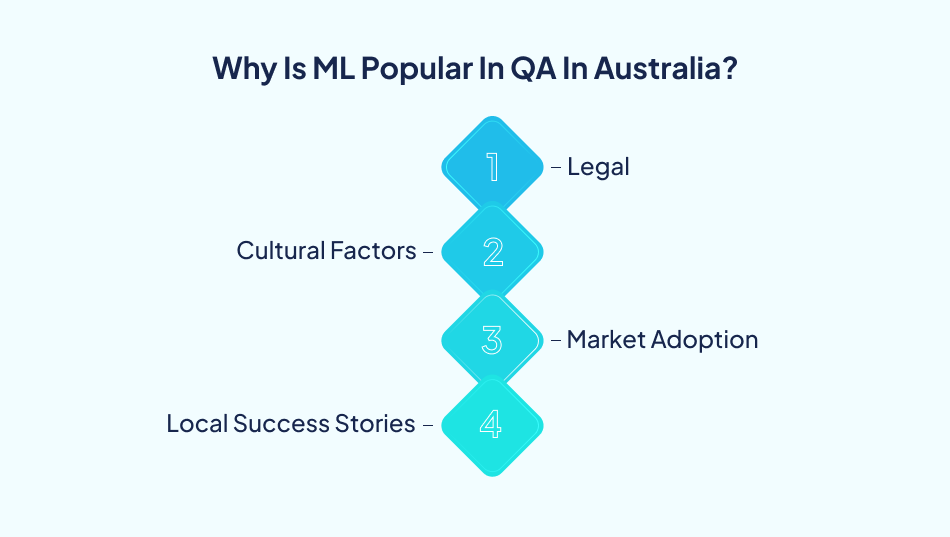 3. Local Success Stories
 Manual testing was once at the core of quality and assurance processes. Nevertheless, it is a labor-intensive, time-consuming process and is often associated with human error. With the increasing complexity of software, manual methods can no longer scale to the agile and DevOps-driven environments of today.
An ML development firm can build models that do not review the code for the least robust parts and detect possible bugs, but propose changes to create a software QA revolution of the utmost level.
Integrating machine learning development to QA results in a large number of quantifiable benefits that extend far beyond mere automation. Let us consider some of the most significant benefits:
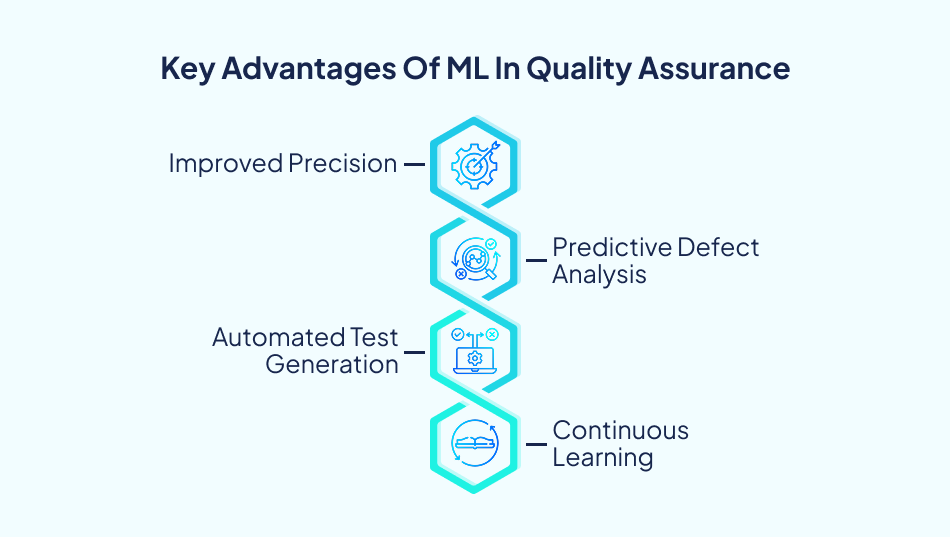
Machine Learning algorithms can assess thousands of data points in real-time, supplanting human error and creating quality and assurance at every stage of the testing pipeline.
With the help of machine learning app development services, QA systems can anticipate which modules are more likely to fail. This foresight helps teams better allocate their qa testing resources.
A machine learning development company can build intelligent frameworks that automatically generate test cases based on past bugs and user stories. It means greater test coverage with less manual effort.
 4. Continuous Learning and Changing With ML Development
 Machine learning systems grow over time, beyond traditional quality assurance software. Machine Learning learns from new data, user behaviour, and project patterns, turning quality and assurance into a continuous and adaptive process.
Machine learning app development services, when implemented correctly, can enable QA services to incorporate sophisticated features that surpass the capabilities of traditional QA tools. Some of these advanced features are listed below:
Using historical defect information, the machine learning system tests based on the likelihood of risk and impact, ensuring that high-risk areas or significant customer impact are addressed before lower-risk regions.
Quality assurance software with machine learning capabilities can automatically update test scripts in UI and code changes.
Machine learning models can assist in identifying anomalous patterns in the system or in the behaviour of a system, which significantly increases your ability to conduct proactive testing.
 4. Smart Reporting and Insights With ML Development
 Advanced analytics dashboard tools help teams examine and manage patterns for greater clarity in the quality and assurance process through a data-driven approach.
As new builds occur, machine-learning-powered QA will continue to learn and confirm universally accepted QA testing strategies due to the development of machine learning.
The fast-moving software changes quality assurance (QA) methods by introducing intelligent and efficient machine learning algorithms, which enable us to test in a more efficient and quicker way.
Machine learning application services develop QA systems that examine historical data to predict where bugs are most likely to occur. This predictive capability allows developers to focus on more critical testing.
A machine learning company can train algorithms that will generate new test cases automatically to save time from repetitive manual work and to free human QAs for better problem-solving.
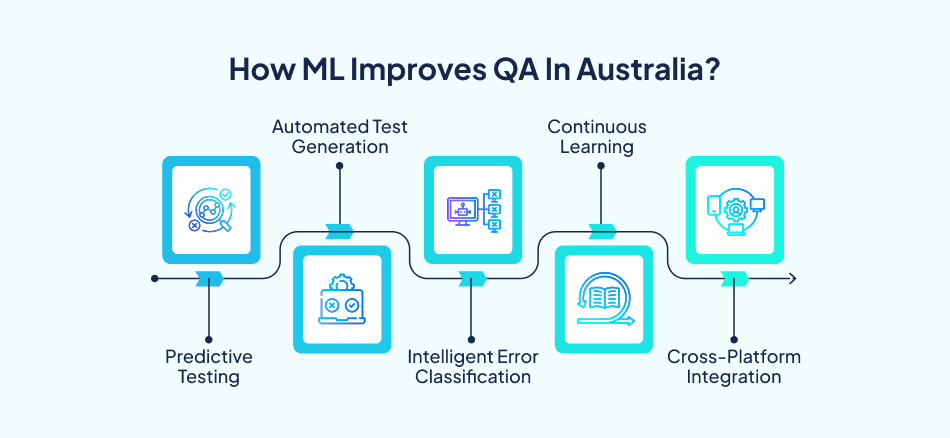 3. Intelligent Error Classification
By employing artificial intelligence in a quality assurance framework, it is possible to rank bug severity and occurrence. This work is worth the development of Android applications, and the result will be the quick release of the application.
The core of machine learning progress is always continuous improvement. As systems process more data, they detect new anomalies faster and accurately, ultimately delivering better long-term quality and assurance.
Using a cross-platform app development company, ML will draw insight from learned experiences to ensure test scripts run in the same manner across multiple platforms without platform errors.
| Feature | Traditional QA | ML-Powered QA |
| Test Case Creation | Manual, time-consuming | Automated via machine learning app development services |
| Bug Detection | Reactive after issues occur | Predictive through machine learning development |
| Adaptability | Static scripts | Self-learning, adaptive models |
| Efficiency | Slower cycles | Faster release with fewer regressions |
| Scalability | Limited to human resources | Enhanced through machine learning development company applications automation |
| Cross-Platform Testing | Separate for iOS/Android | Unified under cross-platform app development company workflows |
| Data-Driven Insights | Minimal | Continuous analytics-driven quality and assurance |
While it is evident that there are many advantages, the challenges in leveraging machine learning development for quality assurance remain.
 3. Cost and knowledge barriers With ML Development
 The next phase of quality assurance software is the intelligent, automated, and predictive testing structures. As additional companies leverage machine learning app development services, QA teams will have tools that not only discover bugs but also analyze user experiences and system behaviour in real-time.
In future, QA systems are likely to have incorporated:
One Australian retail start-up approached a machine learning development company to improve testing speed and accuracy during the Android application development phase.
The manual QA was consuming 40% of development time and delaying releases due to inconsistent quality and assurance.
Machine learning app development services created predictive models that can detect recurring bugs and automate regression testing. The company developing cross-platform apps incorporated continuous learning algorithms, which adapt with every change.
Intelligent machine learning development reduces 50% time while increasing accuracy by 35%. The solution for the machine learning app allows the client to reach the market sooner and attain better customer satisfaction.
Machine learning innovation is changing the way companies test, automate, and ensure quality assurance. Australian companies with qualified on-demand app developers have the chance to fix bugs, market application stability, and improve user experiences.
Firms interested in going green will have an edge over their competitors, provided they engage on-demand app developers who are familiar with machine learning app development services and cross-platform integration. The next generation of QA intelligence and automation is the moment; therefore, it is the right time to make a commitment to more intelligent solutions that provide impeccable standards at every digital touch point.
Q 1. How does Machine Learning improve QA testing?
Ans 1- Machine Learning test generation automation, early anomaly detection, and quality assurance improve the reliability of the results provided by teams.
Q 2. What are the reasons why companies should employ iOS app developers to do QA integration?
Ans 2– Skilled iOS app developers will be able to use ML models in testing pipelines, resulting in smarter, faster and adaptive quality assurance.
Q 3. Are Android and iOS equally beneficial to Machine Learning?
Ans3- Yes, predictive analytics and automation enhance QA in both platforms, bug down and make them more efficient.
Q 4. What is the way businesses can begin operating Machine Learning in Quality Assurance?
Ans 4- Identify an iOS app developer team or a machine learning development company, and partner with them to deploy automated intelligent testing systems.


Partner with us to bring your vision to life.



 +61 (42) 108-3277
 contact@7pillars.com.au
 294A Station Street,
