Let's have a
Quick Chat
with you!
Quick Chat
with you!
You have our ear and we can't wait to hear about your idea! Share your details here and we will make sure to schedule a coffee date with you soon.




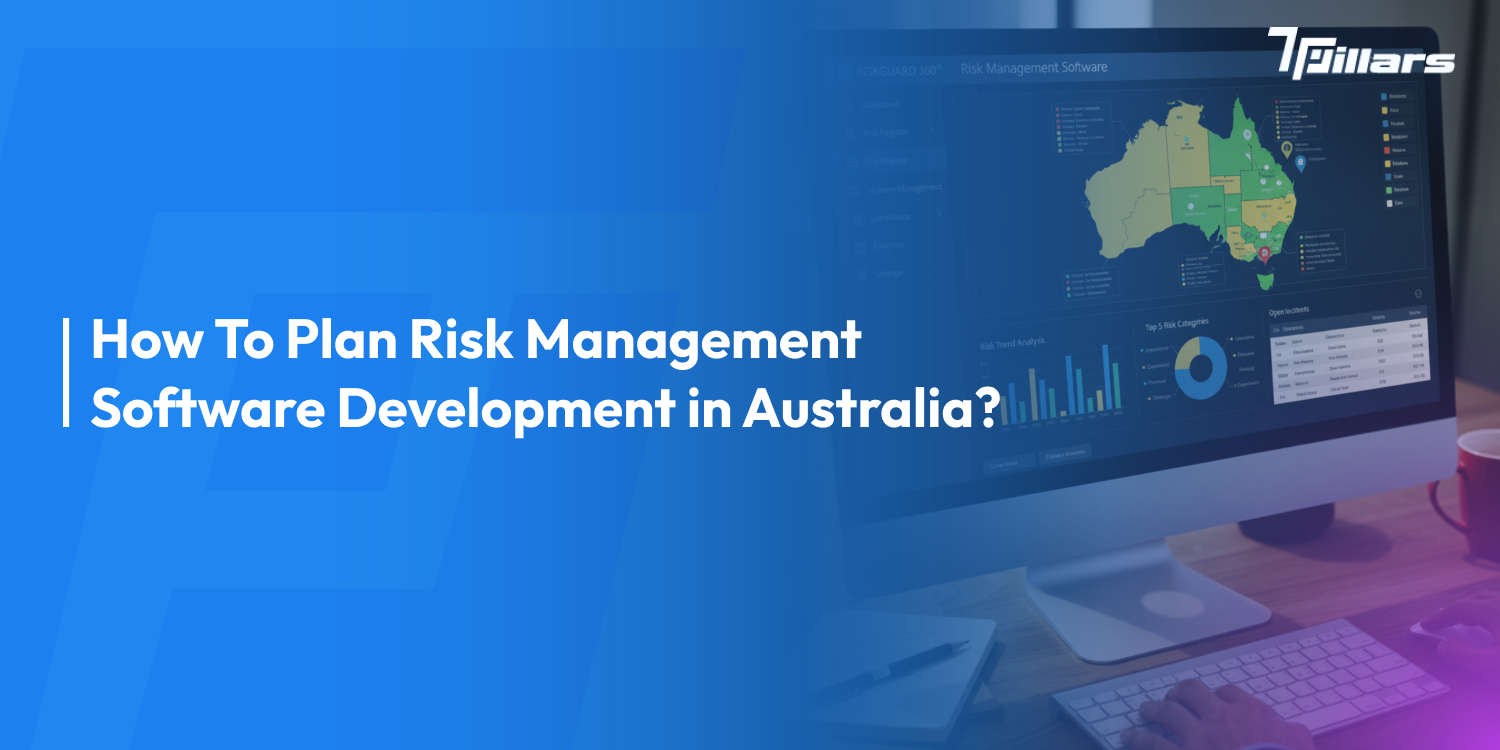
Risk management has been one of the key challenges that Australian companies face, particularly in areas such as finance, healthcare, and logistics, where compliance violations can result in millions of dollars in costs. The answers today cannot be spreadsheets and legacy systems; thus, many teams are collaborating with an application development firm that specialises in intelligent, scalable solutions, including risk management software development in Australia. As the Australian app market rapidly develops, finding an appropriate partner early might be key. Our company provides custom software development solutions tailored to your business needs.
To organisations in the Australian market, partnering with an established mobile application development firm ensures that risk systems are operational and meet regulatory requirements. Good software does not just track threats, but also simplifies reporting, alerts and mitigation planning, which are essential elements of operational resilience.
The blog goes through end-to-end software development of a risk management software, outlining the requirements, selecting the appropriate tech development stack, estimating the cost, and predicting the ROI. You also get to know the reasons why it is essential to collaborate with a mobile application development company to deliver secure, future-ready risk solutions.
Founders, CTOs, and operations leaders comparing the risk tools of enterprise scale should find this section valuable. Companies that are startups experimenting with compliance-ready platforms and scaleups modernising their governance systems will be able to learn through the experiences of a mobile app development company. It is also helpful in regulated companies that compare vendors or digital transformation with an application development firm that knows the local standards.
Guidance aligns with Australian conditions and the needs of decision-makers, including ROI clarity, realistic timelines and secure architecture. Though you are testing and validating an MVP or updating older systems, hiring a mobile app development company in Australia helps ensure that your implementation will be secure and future-proofed.
 Enhancing Risk Visibility Through Custom Software Development in Australia
Risk visibility is the capacity of an organisation to detect, track, and forecast operational, financial and cyber threats in real-time. In Australia, this capacity has moved to the board level as a result of heightened regulatory oversight, accelerated digitisation, and the growing number of cyber events. Risk visibility can enable leadership teams to be proactive and not reactive.
Compliance automation is emerging as a top priority at organisations to centralise risk data, simplify reporting, enhance the accuracy of decision-making and reduce manual input and vulnerability to regulatory fines.
The changing regulatory environment and the rapid adoption of digital technologies in Australia render efficient risk management a strategic requirement of contemporary, expansion-oriented organisations.
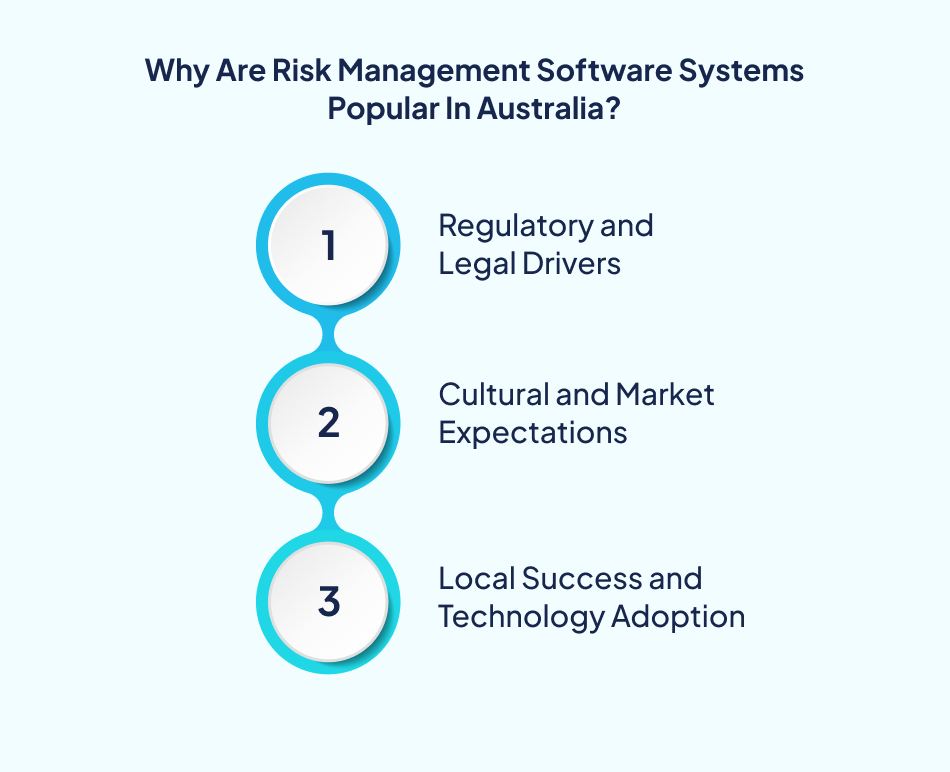
The stringent compliance environment in Australia, stipulated by APRA, ASIC, and the Privacy Act, demands proactive risk visibility and systematic methods creating risk management software that ensures audit preparedness and compliance with regulations.
Australian app development companies near me focus on resilience and long-term stability. The cultural attitude indicates the intelligent systems that help encourage informed decision-making and corporate responsibility.
 3. Local Success and Teaching Technology
Banks, insurers, and logistics companies have minimised operational losses through following structured risk management software arrangements. Australia exhibits the digital maturity of a scalable and mobile-centric risk management solution with more than 90% smartphone penetration and extensive e-commerce use.
Below are common risk system categories organisations typically evaluating during risk management software development:
| Type | Typical Use Case |
| Enterprise risk management (ERM) systems | Manage strategic and operational risks |
| Compliance risk management software | Track regulatory obligations and controls |
| Audit and risk assurance platforms | Plan, track, and follow up audit findings |
| Operational risk tools | Capture incidents and near misses |
| Supply chain risk management software | Manage vendor and third-party exposure |
| Industry-specific risk systems | Sector driven risks like safety or compliance |
Identifying the appropriate system based on feature lists alone is not the correct decision. Numerous organisations seek app development companies near me to seek partners familiar with the local Australian regulatory needs.
Australian organisations manage risk in a variety of highly interdependent areas, such as everyday business, regulatory obligations, and dependence on third-party business partners. These environments continue to become increasingly complex, and therefore, traps are likely to go undetected until an audit or compliance.
Key advantages include:
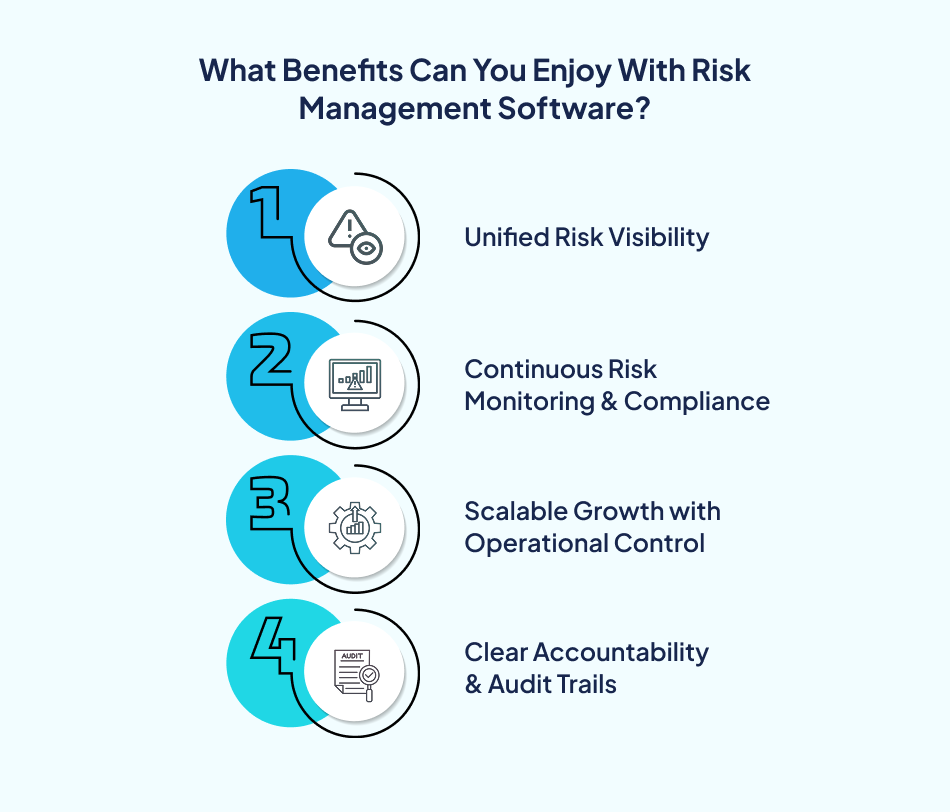
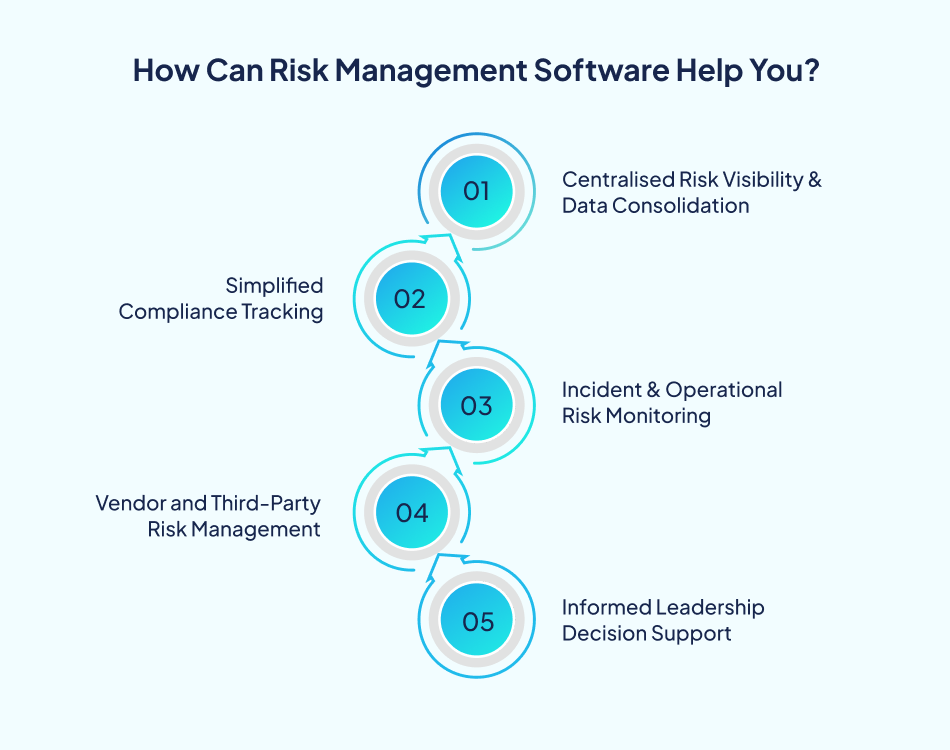
The risk data stored in a single system helps eradicate numerous, incompatible locations and enables a consistent view of risks across the business by informally sharing knowledge among teams.
By giving organisations the capability to identify potential problems before they occur through continuous monitoring, organisations will have the opportunity to ensure high levels of compliance through monitoring and periodic compliance assessments (e.g. based on a fixed schedule).
 3. Empower Organisational Growth with Control
As an organisation grows, its system will allow for the addition of locations, teams and departments in a linear fashion, thereby giving users greater visibility into their operational areas without introducing any increased complexity to the business.
To maximise accountabilities and audit trails through continuous monitoring of risk management systems and risk mitigation, you must ensure each risk’s allocation can be tracked through the system from the date of identification to the date of mitigation.
In the roles below, risk management systems provide the most tangible value:
Risk management systems provide a consolidated view of risk that is easy to look at, as opposed to having different or unrelated sources of data.
Such systems simplify the control of regulatory needs, the association of obligations with controls, as opposed to the dispersed documentation.
They document events when they happen and compare trends over time, which enables organisations to see patterns and not focus on an individual event as a unique problem.
 4. Vendor and 3rd Party Control
Risk platforms assist organisations in performing vendor and third-party risk assessment before the occurrence, facilitating more continuity planning and fewer surprises.
These systems allow leaders to make informed decisions about new risks and trends earlier, before they become expensive or out of control.
A successful risk management system should not merely include an assortment of features; it should seamlessly integrate into the day-to-day operations of teams and enable the governance capabilities of the organisation to continue without impairing the performance of daily functions.
Key modules typically found in a successful risk management system are as follows:
By supporting audit readiness, these capabilities provide the foundation for a customisable (or custom-developed) risk management software system that aligns with the organisation’s strategic and oversight goals. A skilled mobile app development company in Australia provides businesses with innovative and scalable solutions.
 3. Design and Development
Organisations will likely require enhanced capabilities for risk management programs as they grow. Examples of some of these capabilities are:
These capabilities are particularly relevant when considering a partnership with an established software development Provider or evaluating an app development company. An organisation should find a development partner with experience building complex, regulated enterprises.
Numerous factors impact the cost of developing risk management software in Australia. These factors include:
The size and scope of the system will determine development costs. As an illustration, entry-level platforms cost anywhere from $60,000 AUD to $120,000 AUD; mid-tier enterprise solutions may be between $150,000 AUD and $300,000 AUD; and large-scale enterprise systems may cost $400,000 AUD or more.
To meet these needs, most companies near me working in this industry partner with a mobile app development company in Australia that offers custom-sized, scalable, and compliant solutions.
 ROI of Risk Management Software in Australian Organisations
Risk management software returns realised via:
The majority of organisations start to realise value after 18-24 months, when manual work reduces, and automated workflow processes become the norm.
Systems will respond to early warnings rather than just reporting what has happened in the past.
The process of risk evaluation will change based on periodic reviews and continuous monitoring.
Decisions will include the supplier and vendor.
Solutions will give it clarity without introducing additional governance overhead.
By collaborating with the most reputable risk management software development in Australia, app development companies near me can get scalable and secure solutions with a higher ROI.
An Australian financial services organisation was experiencing increased compliance risk, delays in manual reporting and a lack of real-time visibility across the departments.
The company implemented a bespoke risk management software solution that automated monitoring, mobile dashboards, and regulatory reporting, in accordance with Australian standards.
In 12 months, the preparation time of audits was reduced by 40%, incident response was enhanced dramatically, and leadership obtained a real-time risk perspective that provided good ROI and operational resilience in the long term.
The process, understanding of regulations, and appropriate blockchain technology decisions in developing risk management software in Australia are transparent. Collaborating with professional on-demand app developers, Australia will ensure it is compliant, scalable and has a measurable ROI based on the local business realities.
With the appropriate strategy and on-demand app developers, organisations become confident, visible and resilient. Whenever planning your next risk platform, start by consulting us to discuss requirements, costs and a roadmap that aligns with your objectives.
Q 1: What is risk management software, and why is it important in Australia?
Ans 1: Risk management software helps Australian companies identify, evaluate, and reduce operational and compliance risks with live data, analytics, and platforms developed by iOS app developers, Australia.
Q 2: What is the cost of risk management software in Australia?
Ans 2: Prices depend on the features, integrations, and security requirements, particularly for risk platforms connected with POS software implemented in retail, logistics, and enterprise processes.
Q 3: What is the reason for selecting locally based development teams on risk platforms?
Ans 3: Selecting domestic partners is important since iOS app developers are aware of Australian regulations, data privacy expectations, and user behaviour, which enables scalable solutions in accordance with national compliance standards.
Q 4: Do the risk management systems integrate with business tools?
Ans 4: The POS software can be linked with risk systems to obtain transaction-level data to enhance the detection of fraud, accuracy of financial reporting, and real-time risk visibility to decision makers.


Partner with us to bring your vision to life.




 +61 (42) 108-3277
 contact@7pillars.com.au
 294A Station Street,
