Let's have a
Quick Chat
with you!
Quick Chat
with you!
You have our ear and we can't wait to hear about your idea! Share your details here and we will make sure to schedule a coffee date with you soon.




Over the years, over-ordering, spoilage, and unpredictable customer demand have been major causes of losses for restaurant owners, costing them thousands of dollars annually. Advanced technologies help to solve them. Machine learning is being implemented in Australia’s rapidly expanding food-tech sector to automate inventory management and maintain competitiveness. Restaurants seek to optimise their operations to support the needs of food-delivery applications. Custom POS software development ensures faster billing and smoother inventory tracking.
Precision in forecasting has never been higher in Australia, yet labour shortages and supply chain delays continue to plague the hospitality industry. Besides that, the profits are evident for small domestic enterprises that incorporate refined food-delivery systems to avert stock shortages, minimise waste, and facilitate customer flow. This transition makes machine learning app development services even more critical to the restaurant tech innovators.
The blog will cover the use of algorithms to optimize ML-based restaurant inventory system, how real-time data can save money and how developers can incorporate forecasting models in modern restaurant apps.
Startups, tech founders, and restaurant businesses in Australia that want to implement intelligent digital solutions should consider this part perfect. Companies that want to hire a machine learning app developer will be better informed about how sophisticated automation is revolutionising restaurant management. Conversely, a business that wants to build a new food delivery app or grow the existing one will be happy to learn how predictive analytics can accurately inventory and reduce waste.
Machine learning app development services deployment will be a competitive edge, especially when enhancing customer experiences through a contemporary Food delivery app ecosystem, as a result of the trend of more Australian brands going data-driven.
 The Rise of the ML-based Restaurant Inventory System
 Inventory Management in Restaurant Apps Using Machine Learning is one of the significant development directions of Australia as restaurants transition to real-time data, predictive analytics, and automated decision-making. As labour costs increase and customer expectations grow, companies are increasingly engaging machine learning app development services to automate stock control and achieve higher profit margins.
On the same note, the numerous local startups and businesses that are throwing their weight behind the creation of AI software are a clear sign of how fast businesses automate through data.
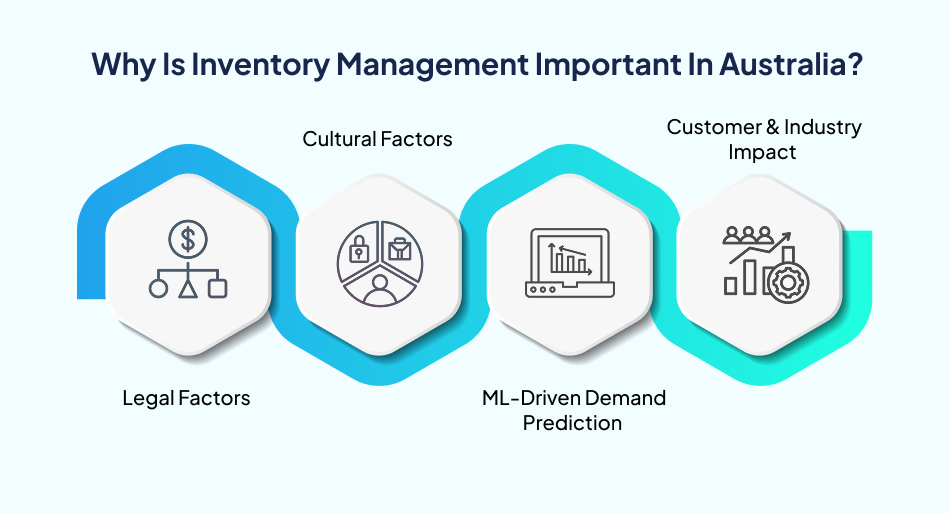 3. Customers and Industry Impact
Brilliant restaurant inventory control will be a great help in keeping track of the ingredients on the plate. In the absence of it, eateries endanger themselves to:
Modern food ordering apps can directly connect with inventory management systems. It allows restaurant owners to have a live view of their stock while processing online orders.
Machine learning algorithms help predict the inventory requirements by processing historical data, seasonal trends and customer behaviour patterns. It is a game-changer with food delivery app developers. The primary application of machine learning is:
Based on previous trends and promotions, he anticipates what ingredients will be necessary.
It helps in finding products that are about to expire and suggests their proper use.
 3. Dynamically Pricing Recommendations
 Change price or promotions to lower overstock.
Inventory is maintained with online ordering and will help eliminate stockouts.
A powerful machine learning inventory management application will typically contain:
This system performs real-time stock monitoring by automatically updating orders.
Ordering from the suppliers automatically when the stock is low.
Provides details about the ingredients consumption, their price, and wastage.
Notifies about low inventory or possible spoilage.
These characteristics might appeal to food delivery application programmers, as they enable eateries to increase customer demand efficiency through stock management.
 3. Automated Stock Reordering
There are many benefits of implementing machine learning app technology in inventory management:
Fewer waste and overstocking will lead to reduced operating costs.
It removes the inventory management that takes too much time and allows the employees to have a more efficient job. AI-powered restaurant automation is a brilliant help to food businesses in their operations and increases service delivery speed.
 3.Increased Customer Satisfaction
Maintains a stock of the most popular products on the leading food delivery apps.
The creation of machine learning programs can allow restaurants to operate more efficiently and be more efficient than competitors who have not adopted this technology.
Despite the importance of the advantages, developers of food delivery applications have difficulties with using machine learning in inventory management:
Neural networks require high-quality data to make precise predictions.
Developing a machine learning app can be expensive, especially for small restaurants.
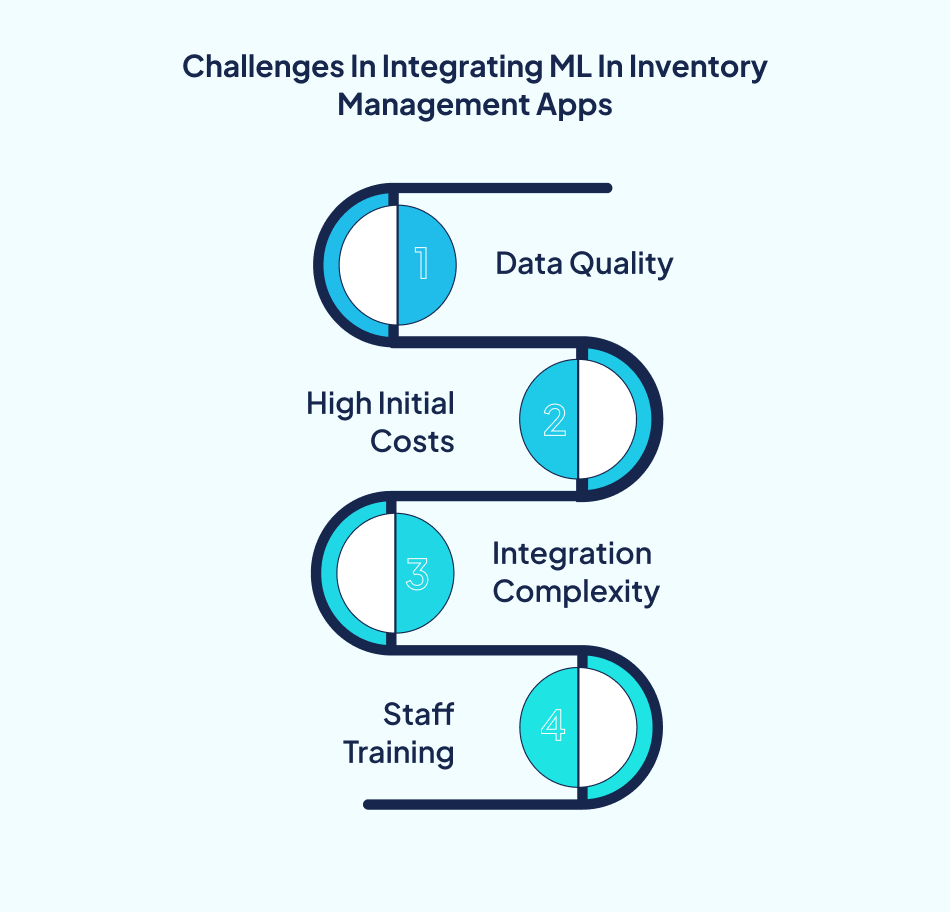 3. Integration Complexity
It can be complicated technically to align with existing POS systems and food ordering applications.
It is necessary to provide employees with training on the advanced inventory systems.
Still, the benefits of efficient inventory management outweigh the problems.
Machine learning software development in restaurant inventory management has a bright future. Emerging trends include:
Modifies the menu in real time depending on the available ingredients and adapts to user demand.
Using the experience of the leading food delivery applications to customize offers and promotions. Android application development helps improve customer satisfaction.
Guarantees that the supply chain is open and traceable.
As the originators of food delivery services, these changes allow them to build interactive, self-regulating systems that would be a great advantage not only for restaurants but also for their customers.
 How an Australian Restaurant Reduced Waste with ML Inventory Management?
 A medium-sized restaurant was battling with frequent stockouts, high waste, and inconsistent ingredient availability. The manualised tracking system they used was ineffective for the growing food delivery orders.
There were unpredictable customers with no real-time information, resulting in over-ordering, revenue loss, and delayed operations.
The restaurant partnered with a machine learning development company to adopt automated inventory prediction. The system analysed sales patterns, seasonality and delivery trends with ML development algorithms and machine learning app development services.
After a period of four weeks, reduced waste by 30%, increased stock accuracy by 45% and customer satisfaction level went up as a result of a regular supply of the menu.
Inventory management in restaurant apps with machine learning is a must-have for trendy food businesses with digital orders. Using these solutions, eateries become “lean” by forecasting demand, automating stock, and reducing waste, so customers get the same experience wherever they go. Working with proficient on-demand app developers will also make the AI integration not only scalable and trustworthy but also customized to your workflow.
The new industry changes require future-proofed technology, long-term economic benefits, and the certainty of running the industry. Restaurants have no problem with the implementation of intelligent equipment as facilitated by expert on-demand app developers. Would you not want to make your operations more efficient? We are going to find the perfect ML solution for your restaurant today.
Q 1. What are the advantages of Inventory Management in Restaurant Apps Using Machine Learning for restaurants?
Ans 1- Daily operations in restaurants become efficient and more cost-effective with precise demand forecasting, minimal waste, and automated stock updates.
Q 2. Should POS software developers add ML capabilities to my restaurant system?
Ans 2- Yes, the veteran POS software developers can ensure the integration, optimisation and compatibility across Apple devices.
Q 3. Will small restaurants find machine learning cost-effective?
Ans 3- Absolutely! Scaling the ML tools is a simple task, which is why small businesses can use them to avoid stock waste and raise their profit margins.
Q 4. What is the time spent on creating an inventory-centric restaurant application?
Ans 4- The development could also vary, but an experienced team like iOS app developers can deliver a functioning product within 6-10 weeks.


Partner with us to bring your vision to life.




 +61 (42) 108-3277
 contact@7pillars.com.au
 294A Station Street,
