










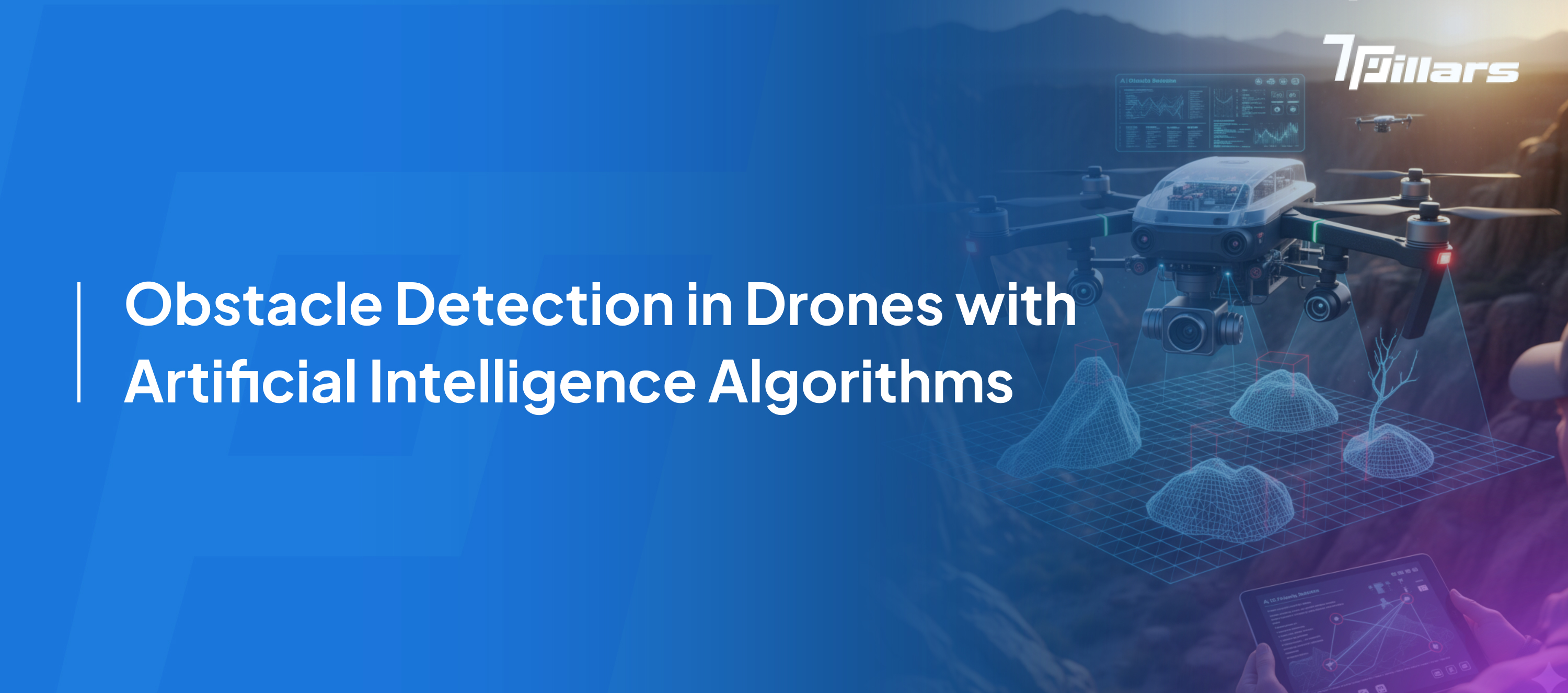



Imagine drones which can think during flight and avoid trees, poles or other planes in the air. As the Australian drone industry is soaring, with the industry projected to reach AUD 1.5 billion by 2026, firms are in a frenzy to integrate intelligent navigation systems. Artificial intelligence is currently taking centre stage, as drones navigate effectively and safely through dense environments. AI drone app development in Australia is driving safer, smarter, and more autonomous flight operations.
With a deep learning model in the flight control system, developers can create drones that sense, predict and avoid obstacles without human assistance. It is necessary in vast Australian landscapes, where mining, agriculture, and logistics are prevalent. These industries are using artificial intelligence software development to enhance decision-making and make drones more reliable, scalable, and efficient.
The blog explains how best drone app development is promoting intelligent aerial mobility using technologies such as sophisticated sensor fusion and accurate mapping. Drones’ application solutions are revolutionizing the field of automation by making it safer, quicker, and smarter. The ever-growing development of artificial intelligence applications is enabling drones capable of executing more complex functions, rendering another group of standards related to the autonomous aerial systems in Australia and other parts of the world.
Empowering Australia’s Drone Future with AI-Driven Innovation
Businesses seeking automation, logistics firms and Australian technology startups will find this blog helpful. As the development of artificial intelligence software allows drones to perceive and respond to their environment, industries will be able to reach new levels of safety and efficiency. The sectors that have been particularly affected by this evolution are in agriculture, delivery, and environmental monitoring, where drones are becoming an indispensable tool very quickly.
The blog is for innovators wishing to apply drone applications in practical situations. With the adoption of the latest software to create artificial intelligence programs, readers will see how sensing and navigation based on AI can assist in the development of intelligent drone applications that can adapt dynamically and make autonomous flight safer, unique, and commercially viable in the expanding drone environment in Australia.
The Rise of Smarter Drones in Australia With Artificial Intelligence
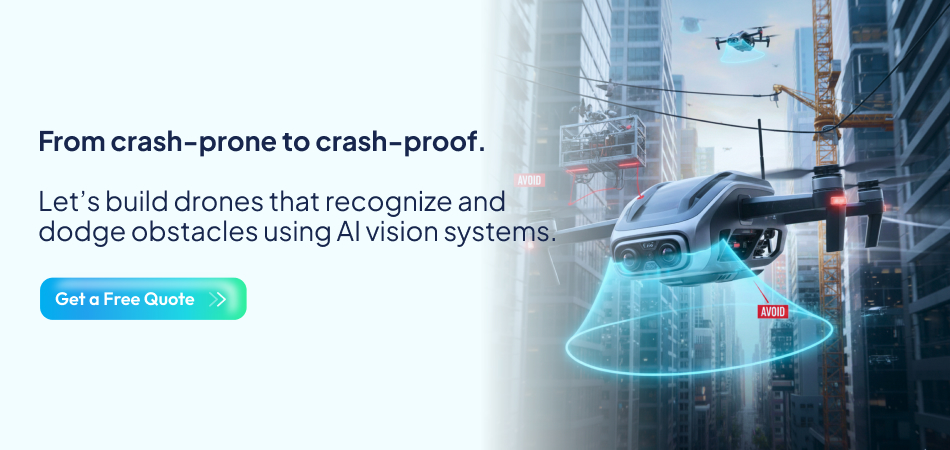
Artificial intelligence (AI) obstacle detection is the new revolution in current drone technology, as autonomous systems can autonomously detect, avoid, and recognise obstacles that do not rely on human control.
- Drones now operate autonomously, without relying on human operators.
- AI software and Machine learning techniques help drones to analyse their environment, forecast the motion of different objects, and decide on the next step when moving by themselves.
- According to analysts, the Australian Drone market is projected to exceed over AUD 1.5 billion by 2026, driven by the adoption of AI-based automation, Logistics, and Surveillance.
- Android connectivity development frameworks are critical to the Drone market,as over 93% of Australians use mobile phones. Mission planning, telemetry monitoring, and remote control provide increased efficiencies to Drone Operations.
As AI technologies continue to grow, Australia will maintain its position as a leader in AI-based Aerial Technologies through increased mobile integration of drones.
AI-Powered Obstacle Detection in Drones: Applications and Adoption in Australia
In other words, obstacle detection is the capability of a drone to detect objects it encounters on its way, such as trees or buildings and take the necessary corrective measures to avoid collisions. This function heavily depends on artificial intelligence solutions such as computer vision and deep learning. Powered by AI software development kits, drones analyze high volumes of sensor data from LiDAR sensors, ultrasonic sensors, or cameras to understand their environment.
1. Australian Regulatory Framework With Artificial Intelligence
- In Australia, AI-filled drones are controlled based on a national framework that focuses on safe use and responsibility, safeguards personal privacy and values innovation and accountability towards integration in society.
- A commercial artificial intelligence software development agency ensures that drone applications align with CASA regulations, data protection measures, and other ethical AI principles.
2. Local Innovation and AI-Powered Drone Initiatives
- Australian innovators are aggressively implementing AI software development in drones to monitor coastal waters, bushfires, emergency operations, and infrastructure surveys.
- To build unified Android and iOS drone dashboard applications, firms based in Sydney and Melbourne have been partnering more often with a cross-platform app development company.
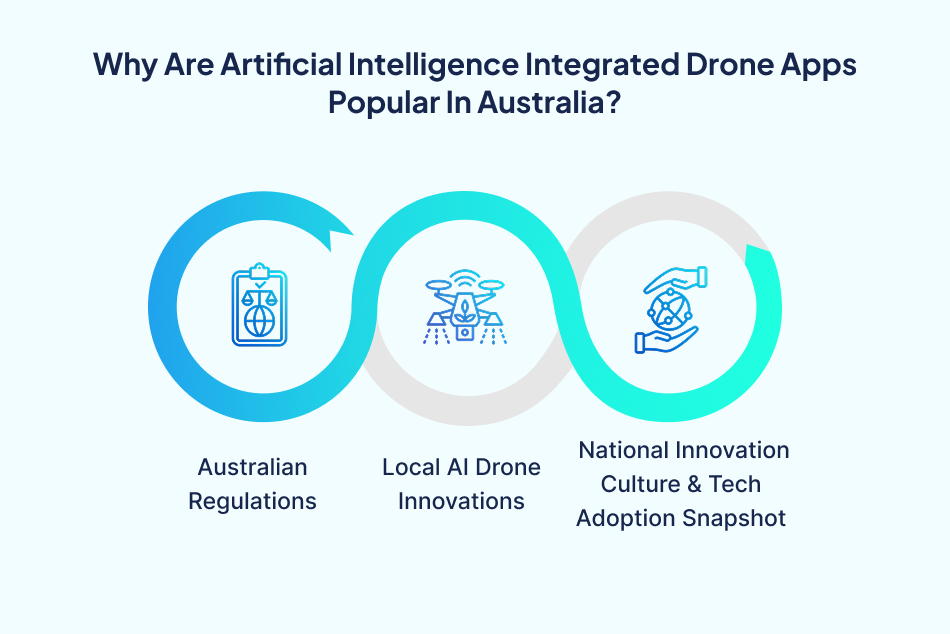
3. Australia’s Innovation Culture and Artificial Intelligence Adoption
- Culturally, Australians are also fast adopters of automation technology, and AI applications for drone operation naturally integrate into the nation’s robust innovation system.
- The synthesis of artificial intelligence software development and Android app development has enabled many businesses to design drone solutions, improving environmental preservation, agricultural yield forecasting, and traffic monitoring.
4. Australia’s Tech Adoption Snapshot With Artificial Intelligence
| Metric | 2024 Data | Impact on Drone Technology |
| Smartphone Penetration | 93% | Enables seamless Android application development for drone control. |
| Drone Market Value | AUD 1.5 Billion+ | Growth driven by AI applications in automation and logistics. |
| AI Investment Growth | 30% YoY | Fuels advanced artificial intelligence software development |
| Tech Start-ups in Australia | 3,000+ | Many focusing on drone applications and AI software development. |
Benefits of AI-Powered Obstacle Detection
The detection of obstacles with the help of AI provides the highest level of safety, autonomy, and precision, and digitalizes the work of drones in any field by creating an artificial intelligence program.
1. Improved Flight Safety With Artificial Intelligence
- Artificial intelligence software development improves environmental awareness.
- Drones fly through thick and unpredictable areas with minimal risk of collision.
2. Autonomous Navigation
- Applications based on artificial intelligence provide an efficient route planning that depends on terrain data and mapping obstacles.
- It lowers the operational cost and enhances reliability.
3. Enhanced Data Accuracy During Collection With Artificial Intelligence
- The development of artificial intelligence mobile apps can facilitate the capture of cleaner data in inspections and surveys.
- An experienced artificial intelligence software development firm guarantees optimum performance.
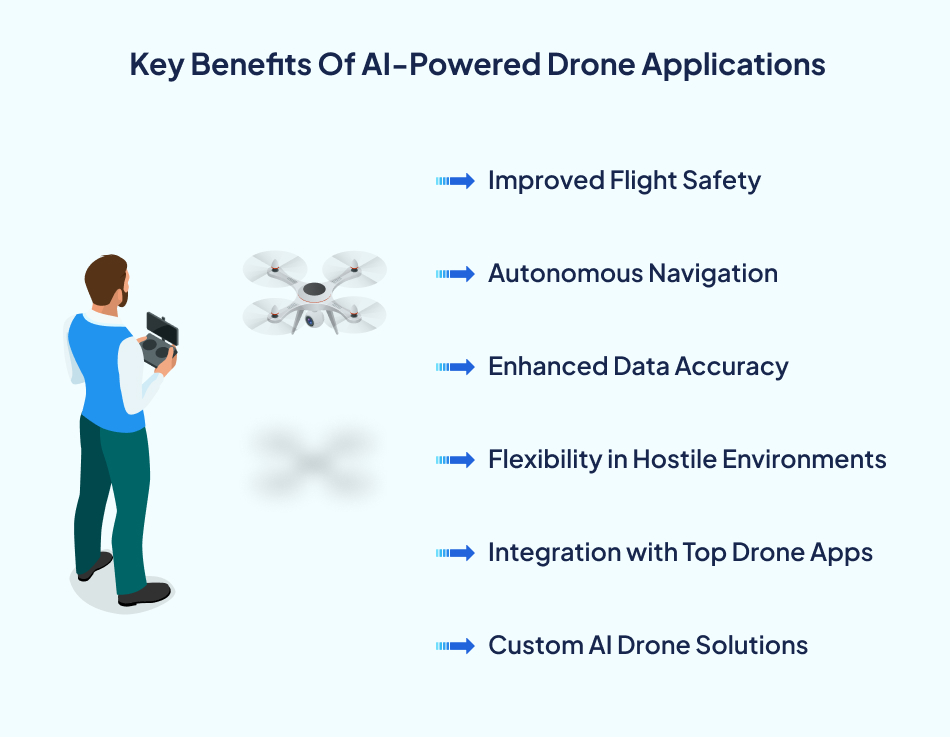
4. Flexibility in Hostile Environments
- From navigating thick woods to city canyons, AI algorithms learned from artificial intelligence app development enable drones to cope with dynamic conditions with ease.
- The contracting of expertise in artificial intelligence software development is rewriting the standards of drone performance.
5. Integration Artificial Intelligence with the Best Drone Apps
- The optimal drone apps include real-time obstacle warnings, log mission and performance.
- AI software development guarantees the flexibility and scalability of applications.
6. Custom Solutions from Drone App Development Companies With Artificial Intelligence
- Drones app development firms provide defence, agricultural, and logistics solutions in these industries.
- AI software development depends on kits that facilitate quick personalisation and scalability over time.
Traditional vs. AI-Powered Obstacle Detection in Drones
| Feature | Traditional Drones | AI-Integrated Drones |
| Detection Accuracy | Limited sensors | Enhanced with AI applications and predictive modeling. |
| Data Processing | Manual or delayed | Real-time via AI software development. |
| Learning Capability | None | Self-learning using artificial intelligence applications. |
| Platform Integration | Device-specific | Unified cross-platform solutions |
| Performance in Complex Environments | Limited | Dynamic adaptation using AI |
How to combine Obstacle Detection in drones with Artificial Intelligence Algorithms?
The drone technology is developing, and it has already developed artificial intelligence software that has turned drones into unique, safer and efficient ways of carrying out their tasks.
1. Acquisition of Sensor Data
- Visual and spatial sensors, including LiDAR, radar, and stereo cameras, are applied by AI-driven drones.
- By using artificial intelligence software development, the sensors acquire high-definition information about the environment surrounding the drone.
- The provision of AI applications enables the system to detect both stationary and dynamic objects.
2. Processing and Analysis of Data With Artificial Intelligence
- With the help of sophisticated AI software development methods such as convolutional neural networks (CNNs), drones can decipher patterns from the raw data.
- It aids in determining the distance, size, and direction of movement of the detected obstacles.
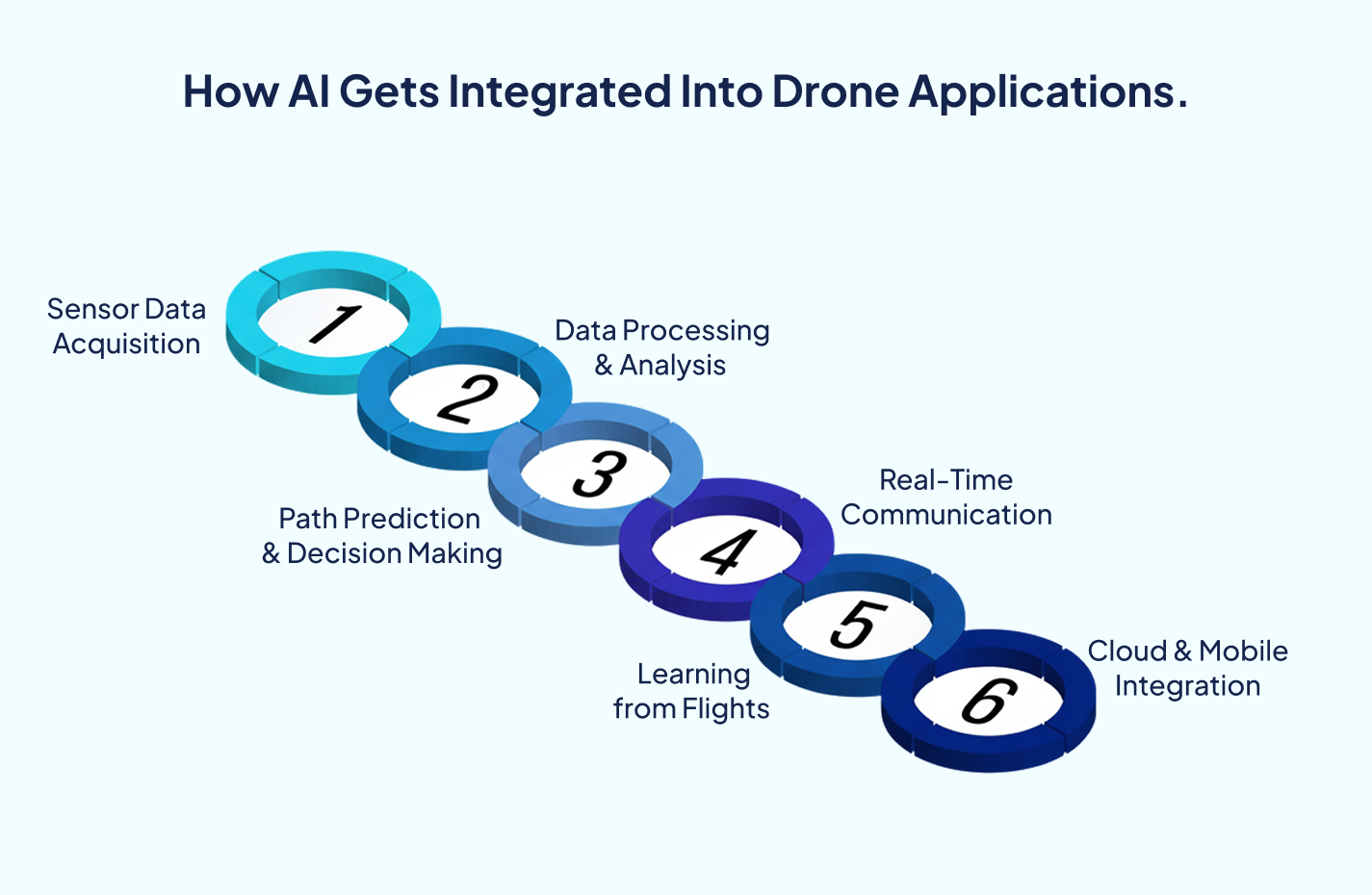
3. Path Prediction and Decision Making
- AI programs mimic several flight trajectories and choose the safest path.
- This feature is offered by artificial intelligence applications that leverage predictive analytics along with environmental mapping.
4. Real-Time Communication
- A cross-platform app development company can create interfaces that drone pilots can use to view live flight information.
- Android application development provides real-time notifications on mobile phones regarding encounters with obstacles or deviations of course.
5. Learning from Previous Flights With Artificial Intelligence
- The best benefit of AI technologies in drones is autonomous learning.
- As it flies on each occasion, the system learns to perfect its algorithms with the help of AI software development, becoming more accurate over time.
6. Integration with Cloud and Mobile Platforms
- Through the integration of artificial intelligence software development, cloud integration, and Android application development, drones can store and analyze flight logs remotely.
- Performance insights are made available to operators through cross-platform app development company dashboards, leading to increased operational safety and efficiency.
Edge AI vs Cloud AI in Drone Obstacle Detection (2026)
With the development of artificial intelligence software in 2026, drone obstacle detection systems are more likely to be based on a hybrid AI architecture, which involves the use of Edge AI to make real-time decisions and Cloud AI to learn and scale. This solution offers safer, quicker and more dependable drone use in numerous settings.
| Feature | Edge AI in Drones | Cloud AI in Drones |
| Processing Location | On-device (inside the drone) | Remote cloud servers |
| Latency | Ultra-low, near-instant | Higher due to network dependency |
| Obstacle Detection Speed | Real-time collision avoidance | Delayed response |
| Connectivity Dependency | Minimal or none | High |
| Suitability for Remote Areas | Ideal for mining, agriculture, rural Australia | Limited in low-network zones |
| Role in Artificial Intelligence App Development | Enables instant decision-making | Enables large-scale learning |
| Data Usage | Low bandwidth | High data transfer |
| Scalability | Limited by hardware | Highly scalable |
| Best Use Case in 2026 | Real-time obstacle detection and navigation | Model training, analytics, optimisation |
Challenges in AI-Based Obstacle Detection
Drones’ intelligence has become advanced, but even now, various barriers prevent the perfect work in practice and in unpredictable conditions.
1. High Computational Demands With Artificial Intelligence
Artificial intelligence software development algorithms demand powerful processors, thus making real-time detection complicated for smaller drones. AI-powered drone applications enable smarter navigation, obstacle detection, and autonomous flight control.
2. Environmental Factors
Rain, fog, and poor illumination diminish sensor precision, although AI applications are increasingly able to reduce such limitations.
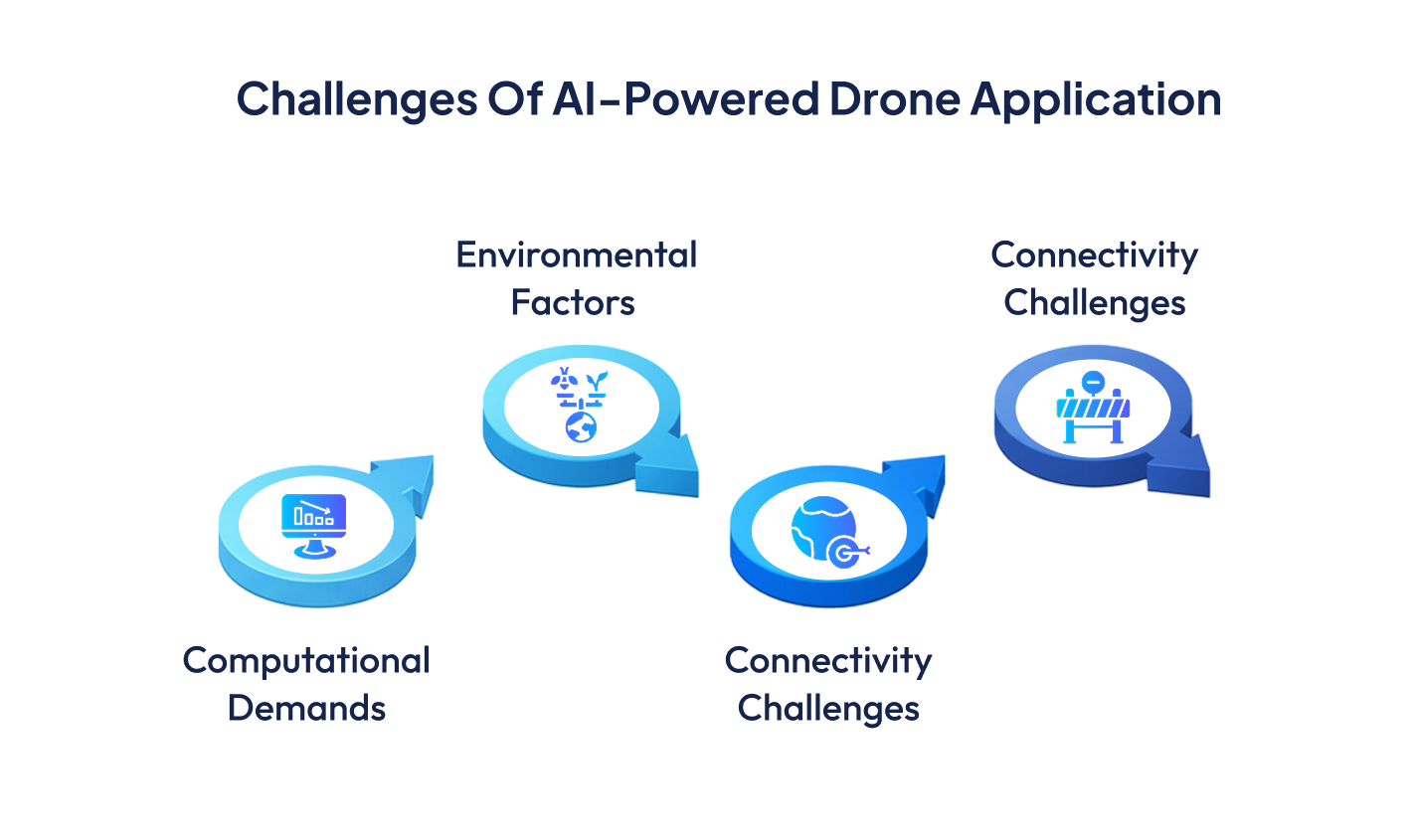
3. Connectivity and Integration Issues With Artificial Intelligence
Dependable synchronization with artificial intelligence mobile app development platforms requires robust network speeds and minimal latency for real-time activity.
4. Regulatory and Cost Barriers
International legislation and bespoke best drone app development company costs hinder scalability and slow down the complete deployment of artificial intelligence app development solutions.
The Future of Autonomous Drone
In 2026, drone technology is no longer limited to single-unit operations but is extending to AI-powered autonomous drone swarms. These swarms of drones that operate together, communicate obstacle data, and change their routes on the fly using artificial intelligence.
| Capability | AI-Enabled Drone Swarms |
| Obstacle Detection | Shared real-time data across multiple drones |
| Navigation Intelligence | Collective path planning using AI algorithms |
| Collision Avoidance | Swarm-level coordination prevents inter-drone crashes |
| Scalability | Easily deployable across large geographic areas |
| Fault Tolerance | Other drones adapt if one unit fails |
| Communication | AI-managed mesh networks |
| Learning Mechanism | Continuous improvement via artificial intelligence software development |
| Platform Integration | Controlled through cross-platform app development company systems |
AI-Powered Obstacle Detection in Agricultural Drones
Client Background
An Australian agritech company is upgrading its crop monitoring drones to detect intelligent obstacles and increase efficiency when travelling across uneven fields.
Challenge
The old-fashioned drones have a problem with dynamic terrains and the sudden appearance of objects, including trees, irrigation apparatus and animals, and also demand human operator involvement.
Solution With Artificial Intelligence
Using cutting-edge AI software development, our engineers combined LiDAR and CNN-based vision models to identify, classify, and evade obstacles in real-time. A cross-platform app development company dashboard built to monitor live data through Android and web applications.
Results
The AI-driven system reduced collision threats by 85%, optimized flight paths, and enhanced operation uptime, creating a new standard for intelligent drone applications in agriculture.
Conclusion
The implementation of AI in drone applications is transforming the agriculture, mining, and logistics industries by increasing their safety and precision efficiency. Intelligent drone solutions, real-time obstacle detection, data processing and adaptive learning can benefit businesses that partner with competent on-demand app developers.
Due to the changing technology, combining AI and drones will present new possibilities for intelligent and autonomous work. Working with professional on-demand app developers would keep your project at the innovation and performance curve. Are you willing to upgrade your processes using AI-controlled drone solutions? Contact our experts today to find solutions to your business objectives.
FAQS
Q 1. How do AI algorithms enhance drone navigation accuracy?
Ans 1- The algorithms of AI process sensor data in real-time and help drones with predictions of safe routes, collision avoidance, and adapting to a dynamic environment without problems.
Q 2. How can iOS app developers ensure smooth connectivity between drones and devices?
Ans 2- Skilled iOS app developers create secure APIs and cloud connectors, ensuring real-time connectivity between drones and mobile devices.
Q 3. What makes AI drones more reliable, compared to standard drones?
Ans 3- With humans in the process, AI-controlled drones offer precise decisions, gaining precision each time the drone is flown, reducing crashes, and showing better adaptation to random events.
Q 4. Are AI drone applications compatible with mobile platforms?
Ans 4- Yes. Talented iOS application developers make it so, allowing seamless real-time communication and control between devices.

Sundeep Mann

Get in touch
We'd love to hear from you.






 +61 42 108-3277

 contact@7pillars.com.au
 Stay Inspired with our