24 Nov 2025
Updated on November 25th, 2025
Real-Time Translation & Voice AI in Travel Booking App Development

Shaun Bell



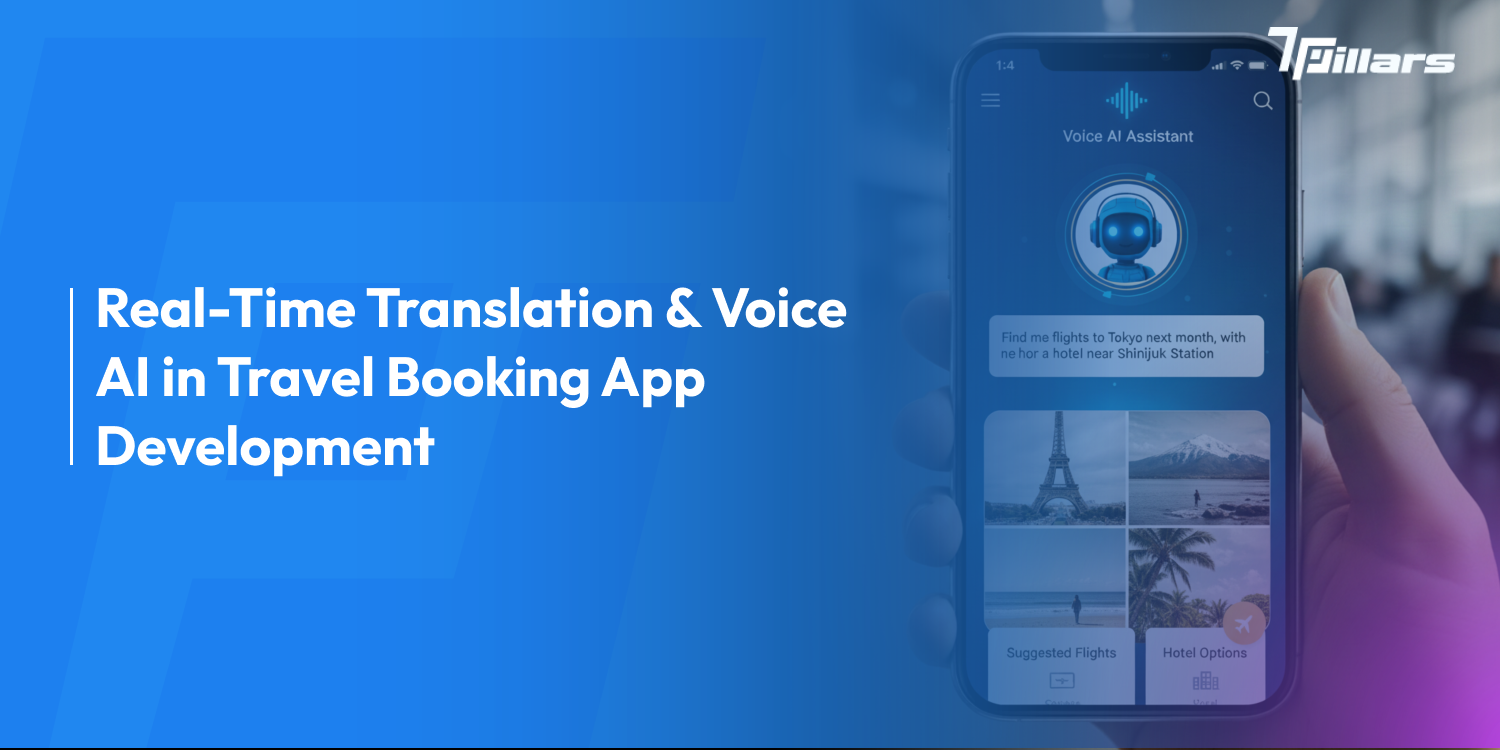
Have you ever made a reservation and been annoyed by a language barrier? It constitutes one of the greatest annoyances to tourists and wastes business for the enterprises. In Australia alone, where the travel industry is worth over $60 billion yearly, the need for better digital solutions is increasing. It is where artificial intelligence software development comes into play, changing the game. Travel startups rely on custom mobile app development services to build fast, user-friendly booking experiences tailored to global travellers.
With the incorporation of real-time translation and voice assistants, travel booking app development firms can deliver smooth, multilingual user interfaces. For Australian businesses and startups, this translates to greater access for global users and enhanced customer satisfaction. With artificial intelligence software development, companies can create apps that not only tailor travel suggestions but also eliminate language barriers among users.
The blog will discuss the role of voice AI and real-time translation in changing how people book travel, the impact of this shift on the Australian travel industry, and how brands can compete in 2025 and beyond.
Who Benefits from Real-Time Translation & Voice AI in Travel Booking App Development?
The blog will focus on startups, technology founders and companies in Australia that are interested in understanding how innovation helps to grow the travel industry in Australia. Businesses contemplating the development of travel booking apps will be able to get information on the potential of AI to enhance user experience and global accessibility.
Regardless of whether you work for a travel booking app development startup or a more established business, the strategies mentioned here can enable you to scale smarter. As technological advancement in the form of artificial intelligence software development continues to rise, this article outlines the reasons why future-ready travel applications could be a competitive edge in the Australian tourism and hospitality sector.
 AI in Travel Booking App Development
Android application development for travel booking has emerged as one of the rapidly expanding industries in the international digital economy. As travellers increasingly turn to mobile services for airline reservations, hotel bookings, and guided tours, artificial intelligence software development is revolutionizing how people engage with applications.
- Artificial intelligence applications are no longer limited to recommendations and chatbots but encompasses robust real-time translation and voice-based functionality that redefines accessibility.
- The penetration rate of smartphones in Australia is above 90 per cent, and nearly three-quarters of consumers choose mobile applications when doing e-commerce and travel booking.
- Such adoption has triggered not just startups but large-scale businesses to partner with a cross-platform app development firm to create solutions that are teeming with features.
Merging AI software development and travel booking app development can help companies reach people and transcend language barriers, a success factor in a culturally diverse country like Australia.
How Real-Time Translation and Voice AI Are Revolutionizing Travel in Australia?
The translator is also transforming travel globally through real-time translation services along with voice Artificial Intelligence, which eliminates language barriers and improves user experience in real-time.
1. Breaking Language Barriers for Global Travellers
Translation platforms powered by AI automatically translate text, menus, and voice calls, enabling tourists to talk abroad without fear of misunderstanding.
2. Ensuring Legal and Cultural Compliance in Tourism Apps
The AI software addresses Australia’s tourism regulatory requirements by automating the translation process and providing information that is easily accessible to foreign tourists.
3. Market Demand for Inclusivity and Accessibility For Travel Booking App Development
The increasing demand for inclusive and accessible travel experiences causes the implementation of AI-powered language solutions.
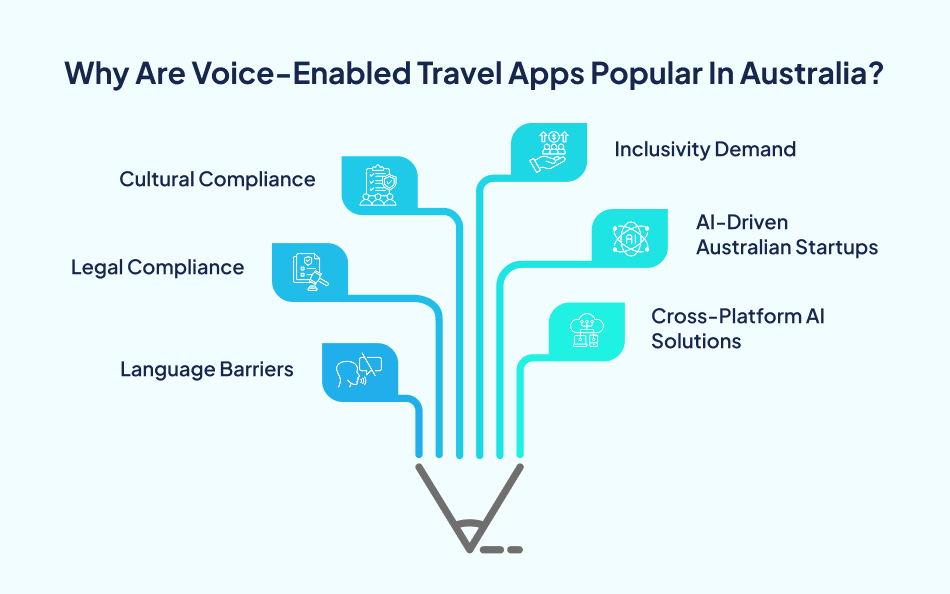 4. Australian Startups Leading AI Integration in Travel Apps
Local travel app developers integrate AI to enable a variety of languages, which facilitates user onboarding among Asian and European tourists.
5. Cross-Platform AI Solutions for Seamless User Experience
Partnership with cross-platform app development company will offer non-problematic AI implementation on both iOS and Android platforms.
Why Real-Time Translation & Voice AI Matter in Travel Booking App Development?
Language is one of the final barriers as the world moves to bring cultures nearer. Travellers can experience difficulties when using foreign platforms, reading travel documents or communicating with service providers. It is where real-time translation and voice AI come in.
The mobile apps have these features that enable users to:
- Ask their questions and get the correct answers.
- Translate instantly in their native language.
- Book orders without apprehension, no matter the language.
In the case of the travel and tourism business, this translates to increased engagement, better conversion rate, and more inclusive users.
Benefits of Real-Time Translation & Voice AI in Travel Booking App Development
Voice AI is transforming the travel business as it makes apps more user-friendly, accommodating, and efficient to an international audience.
1. Improved User Experience
The addition of voice AI will enable customers to search, book, and inquire using voice. Live translation provides information in the favourite languages, creating confidence and lessening frustration.
2. Increased Accessibility in Travel Booking App Development
Voice AI supports individuals with disabilities or limited literacy. Voice navigation is available to visually impaired users; translations enable all global users to understand services.
 3. Faster Bookings and Higher Conversion
Second language writing is slow and inaccurate. Voice recognition and translations save time during search and check out, increasing the level of trust and conversions. Many tourism businesses now depend on smart travel app solutions for Australian startups to deliver seamless, multilingual booking experiences.
4. Support for Multilingual Customer Service
Voice assistants based on AI support simple questions in multiple languages, thereby decreasing the workload of human agents. Quick, local assistance improves the travel experience.
5. Economical Travel Provider In Travel Booking App Development
Voice support (Automation) will reduce reliance on extensive customer care teams and lower expenses simultaneously, while providing good user interaction.
Traditional vs. Modern Real-Time Translation & Voice AI in Travel Booking App Development
| Feature | Traditional Apps (Pre-AI) | Modern Apps (AI-Driven) |
| Translation Accuracy | Literal, often incorrect | Context-aware using artificial intelligence applications |
| Voice Commands | Limited or unavailable | Natural, real-time interaction through AI applications |
| Personalization | Generic, static | Adaptive via AI software development |
| Accessibility | Text-based only Inclusive | Inclusive with speech and multilingual support |
| Reliability in Remote Locations | Poor connectivity needed | Works offline with advanced AI software development |
Real-Time Translation & Voice AI in Travel Booking Apps
There is a growing trend in the development of travel apps in Australia that are becoming smarter and more inclusive, catering to the diversity of users.
1. Data Collection & AI Training
Training models on multilingual data is the first step. In this, AI software development teams collaborate with natural language processing (NLP) systems to capture contextual meaning, rather than direct translations. It preserves cultural subtlety.
2. Integration of Voice AI In Travel Booking App Development
On-demand app developers include speech-to-text and voice recognition technology. Artificial intelligence software development allows apps to handle local accents, which proves beneficial in Australia’s multicultural economy.
 3. Real-Time Translation Layer
This is where artificial intelligence applications are used offline or in low-connectivity settings. For tourists in Australia’s rural areas, offline access is vital for reliability.
4. User Experience Testing
A cross-platform app development company creates design and voice functionalities that work well on multiple devices. This phase also tests accessibility compliance across various user groups.
5. Ongoing Learning & Upgrades In Travel Booking App Development
With constant AI software development, travel apps continue to advance in accuracy. Feedback loops enable AI programs to improve translations with time, resulting in more intelligent and context-driven features.
Challenges of Integrating Voice AI and Translation
Although the benefits are numerous, companies need to overcome several obstacles :
1. Contextual Understanding and accuracy
Machine translation has evolved; however, the subtlety, colloquialism or local lingo may still mislead. Voice AI can have problems with background noise or regional accents.
An Android application development firm involved in travel mobile application development must refine algorithms for the intended audience and test them thoroughly in the real world.
2. Privacy and Data Security In Travel Booking App Development
Speech recognition and language interactions belong to sensitive information. It is essential to have proper encryption, GDPR compliance and secure storage. The best travel companies must collaborate closely with technology partners to provide a solid mechanism of data protection.
 3. Low-end device performance
Not every user has a fast phone or great network connections. Lightweight AI modules or offline translation are required to provide inclusivity among all types of users in the travel and tourism industry.
Future of Voice AI and Real-Time Translation in Travel Booking App Development
The future is bright. As natural language processing (NLP) and machine learning advance, alongside the creation of 5G technology, voice and translation technology will be smarter, faster, and more user-friendly.
Trends to Look Out For:
1. Hyper-Personalized AI Travel Assistants
Consider a voice assistant that knows your travel history, tastes and preferences, and tone of voice. The leading travel firms will also soon deploy AI bots in the form of personal travel assistants, bookings, suggested tour guides and real-time updates.
2. Augmented Reality (AR) + Translation
You might pick up your phone next time and hold it over a road sign or a restaurant menu and translate the text with an overlay of the cultural context. Merging AR with voice AI will revolutionize interactive discovery for travel and tourism apps.
3. Offline Capabilities In Travel Booking App Development
With connectivity, real-time translations will be quicker, even when one is offline. The creation of such solutions by a travel mobile application development company will simplify
Real-World Use Cases
Some of the best travel companies are already implementing these technologies:
- Trip.com utilizes voice text translation to help consumers from more than 20 countries.
- Google Travel incorporates Google Assistant to respond to questions and organize itineraries.
- Booking.com has tested multilingual AI customer service chatbots.
These examples demonstrate how voice and translation technologies alter users’ interactions with travel websites.
 How a Travel Mobile Application Development Company Can Help?
By collaborating with an artificial intelligence application development company specializing in the development of travel apps, one will be able to access:
- High-level AI/ML integration skills.
- Database management
- Personalized UX development of international users.
- Testing in different locations, platforms, and languages.
- They collaborate with the best travel companies, creating future-ready applications that support the changing demands.
These companies introduce the technical benefits they require for success in the travel and tourism sphere, such as the creation of an AI-driven multilingual chatbot or the addition of voice search.
Enhancing Travel Bookings with Real-Time Translation
Challenge
An Australian travel booking app startup was struggling with language issues for foreign visitors, particularly bookings for non-English-speaking tourists.
Solution In Travel Booking App Development
Collaborating with a cross-platform app developer firm, they incorporated AI software programming and artificial intelligence solutions for real-time voice interpretation. The app enabled users to search, book, and verify reservations in their native language.
Results
In six months, bookings from Asian and European tourists increased by 40%. Embracing AI applications not only enhanced access but also made the startup a leading player in customer-focused travel technology.
Conclusion
Live translation and voice recognition are no longer a vision of the future but the indispensable ingredients of the contemporary travel booking application. The knowledge of on-demand app developers will enable businesses to develop apps to overcome language barriers, increase accessibility and provide hassle-free travel experiences. This innovation has been efficient in culturally diverse markets such as Australia, where inclusivity is crucial to user adoption.
Travel is evolving, and companies with a stake in AI-powered tools are standing apart. You can work with the best freelance app developers who will future-proof your digitization efforts. Ready to innovate? How can your travel app be on the front line?
FAQS
Q 1. How are Real-Time Translation and Voice AI changing travel booking apps?
Ans 1- These characteristics eliminate language barriers, facilitating easier global travel for users to search, book, and communicate in their own languages.
Q 2. Why do companies need to employ iOS app developers for travel apps?
Ans 2- Skilled iOS app developers can deploy AI-based features without any complexity on iOS platforms with high performance and a user-friendly design.
Q 3. Which industries gain the most from AI software in apps?
Ans 3- In addition to travel, healthcare, finance, and ecommerce are also improving considerably with AI-assisted personalization and automation.
Q 4. Is AI integration costly for startups?
Ans 4- Not necessarily modular AI solutions and scalable cloud services make it economical for small businesses to implement AI in stages.
Join the newsletter and get all the updates.
Subscribe




