Most mobile apps fail due to poor execution, not bad ideas. In the first few months, issues with performance, usability, and unclear value surface, and that’s when users drop off. It’s not unusual for apps to lose the majority of their users within 90 days.
In Australia, this happens faster. Users expect apps to load instantly and work smoothly from the first interaction. If something feels slow or confusing, they don’t stick around; they move on. That’s why many businesses bring in the best mobile app development company in Australia early, not just to build the app, but to make sure it performs properly in the real world.
The difference between apps that survive and those that don’t usually comes down to planning. Teams that work with experienced mobile app developers in Melbourne tend to focus more on structuring how the app will scale, how users will engage, and what happens after launch, instead of just getting it built.
In this blog, we’ll break down where most apps go wrong after launch, what actually causes drop-offs, and what successful teams do differently to build products that last in Australia’s competitive app market.
Building Apps That Survive
Launching an app is easy, but retaining users is the challenge. This founder’s guide is best suited to Australian founders, product teams, and businesses that want to prevent drop-offs after launching their business. Most of them need the assistance of professional mobile app developers in Melbourne to create UX, performance and retention plans before scaling.
To maintain stability, security, and performance in the long term, the best mobile app development company in Australia is always involved in businesses geared towards sustainable growth. Through the involvement of professional mobile app developers in Melbourne and a reputable mobile app development company in Australia, teams have the potential to construct apps that are capable of growing, engaging, and succeeding.

Hidden Reasons Behind Mobile App Failures
When an app fails to meet expectations, users don’t wait, they leave. It also implies poor income or a lack of definite business results following launch. It is prevalent in Australia.
- With smartphone penetration above 90%, competition is intense and users have endless alternatives.
- Competition is intense. New applications fail to draw attention.
- Numerous applications have been released without any apparent demand.
- Bad UX results in fast uninstalls.
- Poor retention policies minimise usage in the long run.
- Quick tools render development easy but not effective.
The problem isn’t development alone; it’s the lack of a clear strategy behind it. There are numerous apps developed in a professional manner that do not provide value. This is a gap that leads to the majority of failures following launch.
Why Does It Matter In Australia?
There are evident financial and compliance implications in the failure of Australian mobile apps. The market is huge but merciless.
- Australia has a smartphone population of over 23 million.
- Users expect fast load times. A delay of more than 3 seconds is a plus for drop-offs.
- The Australian Competition and Consumer Commission implements stringent laws that govern consumer laws and data protection legislation. There are fines associated with bad data management.
Why Do The Majority Of Mobile Apps Fail Post-Launch?
- No clear product-market fit.
- Weak onboarding and poor UX.
- None of the update or retention plans.
Local Success Examples
- Afterpay maximised by streamlining payments and maximising user flow.
- MyFitnessPal worked with regular updates and effective engagement capabilities.
Why Do Most Mobile Apps Fail After Launch?
The execution of mobile apps and apps often fails due to gaps that appear after launch. Most losses happen early. Statistics indicate that the average retention of an app declines to less than 25% within 30 days. The risk of failure is high in Australia due to high user expectations and stringent regulations.
1. No Product-Market Fit
The failure of apps occurs when they fail to address a definite user issue or address real demand.
- When the value is unclear, more than 70% of users churn within 90 days.
- Develop features based on assumptions and not confirmed user data.
- The Australian market offers weak differentiation, rendering apps irrelevant in competitive markets.
2. Poor Onboarding And UX
Users judge apps quickly. The first impression has a direct influence on retention rates and long-term engagement.
- Users decide within 30-60 seconds to leave the app.
- Onboarding is confusing, and the uninstall rates are over 50 per cent on day one.
- Ineffective navigation and crowded UI minimise the session time and activity.
3. Stability Problems And Performance
Technical performance has a direct influence on retention, particularly in high-expectation markets.
- A load time of more than 3 seconds raises the bounce rates by more than 30%.
- Consistent crashes result in instant uninstallation and criticism.
- Inefficient backend planning restricts scalability during traffic spikes.
4. No Retention Strategy
The failure of apps happens when they lack sustained interaction with users.
- Up to 80% of users drop off within 90 days without engagement tactics.
- None of the push notifications and updates has a deterring effect on reuse.
- The absence of personalisation leads to low user loyalty.
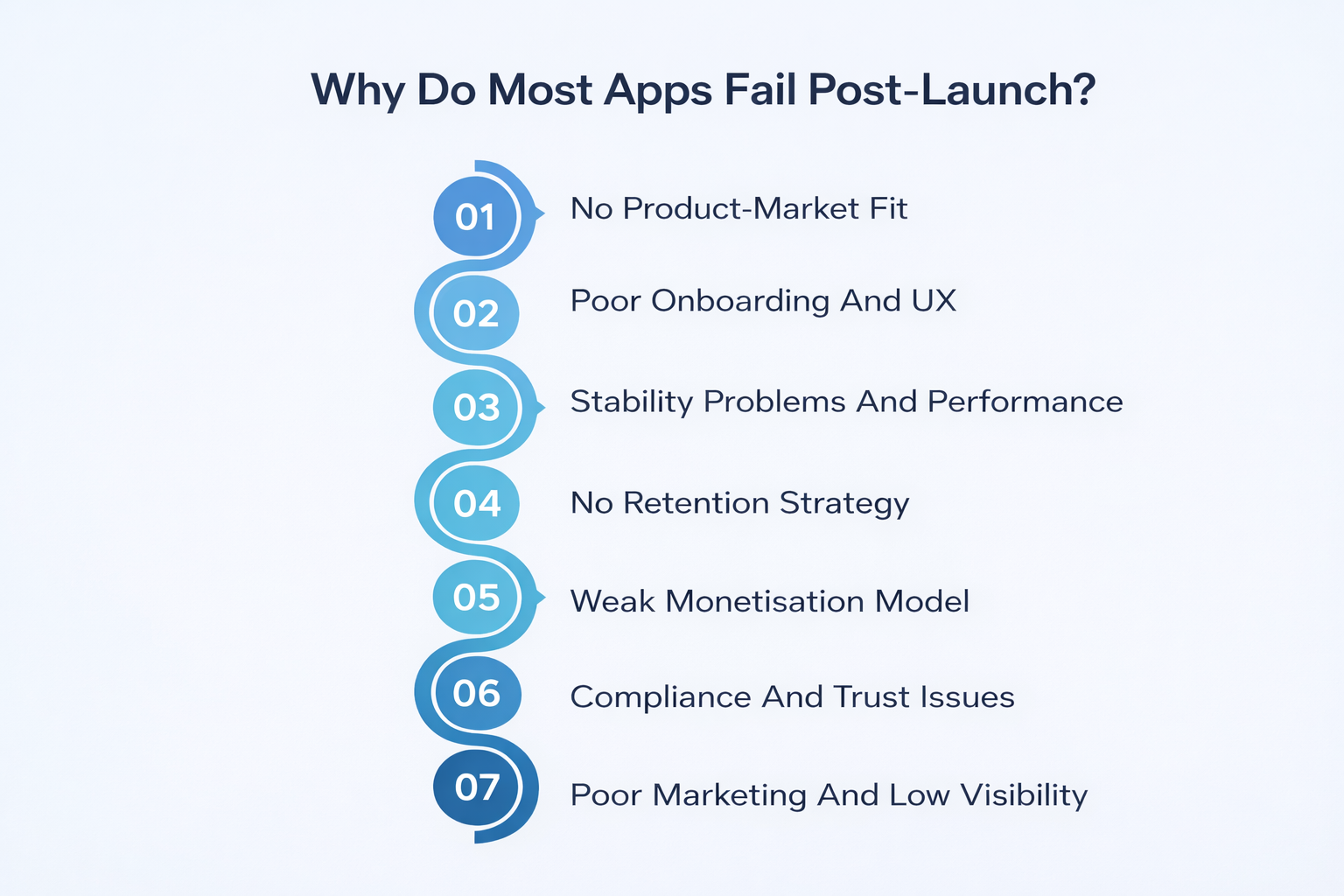
5. Weak Monetisation Model
Revenue failure happens when you don’t monetise apps with a solid and sustainable plan at launch.
- Defined revenue streams are important in recovering high acquisition costs.
- Badly executed adverts lower user retention and experience.
- Without value delivery, subscription models do not work.
6. Compliance And Trust Issues
Australia has stringent consumer and data protection regulations that make compliance with regulatory requirements essential.
- The Australian Competition and Consumer Commission enforces consumer protection and fair practices.
- The Australian Information Commissioner controls data.
7. Poor Marketing And Low Visibility
Many apps fail simply because users never discover them in a saturated marketplace and channel.
- Low organic downloads do not happen as a result of no app store optimisation.
- Weak launch campaigns restrain early momentum.
- Poor retention marketing causes high churn rates.
Real Cost of App Failure in Australia
App failure generates short-term revenue loss and long-term business harm. Expenses are not limited to development.
- In Australia, application development costs range between AUD 50,000 and AUD 250,000. Collaborating with a mobile app development firm raises initial investment.
- Correction of problems after launch can add 30 and 50% to the cost. Mobile app development rework slows down growth and affects timelines.
- The cost of customer acquisition varies between AUD 2 and 5 per install. This spend is inefficient due to poor retention.
- Applications that don’t have a defined revenue model do not cover their costs.
- Projects that even the best mobile app development company would deal with fail without monetisation planning.
- Lost market share is a result of delays and poor performance. Others are more swift and take users.
- With improved planning and implementation, a powerful app development company in Australia aims to minimise these risks.
Australian User Behaviour Insights
Australian behaviour is direct. Expectations are high. Users switch apps quickly.
- Sessions are short; Australians spend more than 4.5 hours on mobile a day. Most last under 2 minutes. Apps must deliver value fast.
- The penetration of Smartphones is more than 90, which has created competition. Mobile app developers must create apps that immediately garner attention.
- Load speed matters. Delays lead to a 30% drop-off.
- Clean design is more effective. Sydney’s major mobile app developers prioritise easy, quick user experiences.
- It is easy to switch between apps. A negative experience leads to churn, particularly in e-commerce and fintech.
- To achieve these expectations, a solid mobile app development company needs to develop with speed, clarity, and trust.
Metrics That Actually Matter
The majority of applications fail because they calculate the wrong things. Downloads do not indicate success.
- Day 1 retention should exceed 25%. Low rates signify inferior onboarding or value.
- Day 30 retention tends to decrease below 10-20% of unsuccessful apps. Good apps have more engagement.
- The Customer Acquisition Cost (CAC) should be less than the lifetime value (LTV). Most applications disregard this balance.
- Actual engagement is demonstrated by the frequency of sessions and the time spent. Skilled mobile app developers monitored them.
- The crash rates must be less than 1%. An increase in rates signifies technical instability.
- Conversion rates determine revenue success rather than installs or downloads.
- These metrics are important for a data-driven app development firm in Australia, as it aims to achieve sustained performance.
What Winning Apps Do Better?
Effective applications are post-launch centred. They focus on being value-driven, fast, and improving constantly.
- They launch with an MVP. It enables mobile application designers to test demand and then scale.
- Updates are frequent. Successful apps issue upgrades every 2-4 weeks.
- Decisions are data-driven. An effective mobile app development enterprise monitors retention and user behaviour daily.
- UX is simplified. Even the best mobile app developers in Sydney eliminate friction to enhance engagement.
- Personalisation enhances retention. Apps change content according to user behaviour and likes.
- Scalable technology helps deliver products. Many teams use Flutter mobile application frameworks because they want to deliver faster and more consistent iterations.
How to Avoid It?
To prevent a failed app, it is necessary to decide before launching and after launch. Speed is less important than execution.
1. Validate Before You Build
- Put the concept to the test with actual users before development.
- Create a minimum viable product rather than a product.
- Do not multitask. Get one problem solved.
- A skilled start-up app development company can help you validate your ideas.
2. Put The UX And Performance First
- Make the onboarding easy and quick. The app should be intuitive to use.
- Ensure that the app is compatible with devices without lag.
- Eliminate steps that can delay user operations.
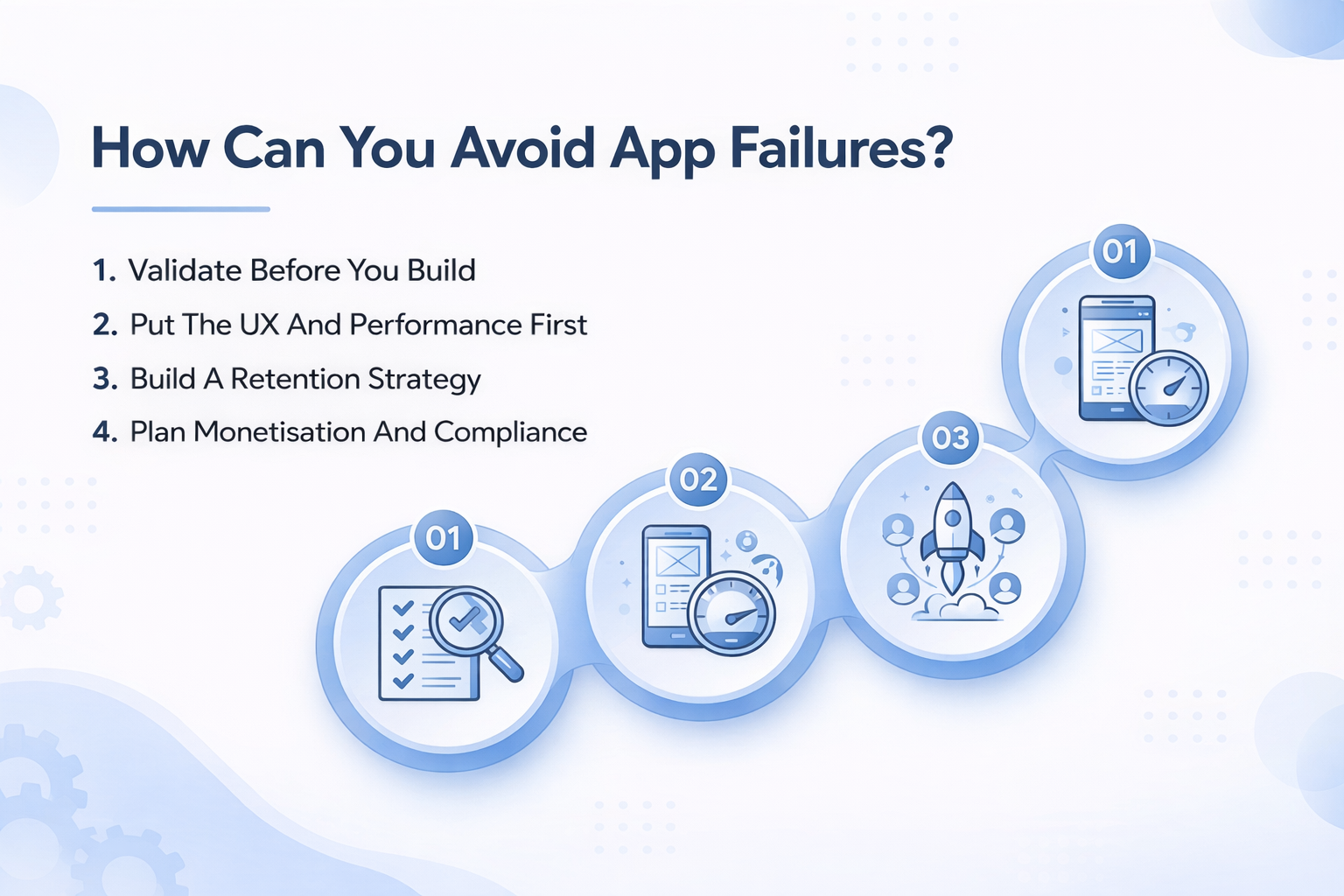
3. Build A Retention Strategy
- Engage in planning and not after.
- Make updates to enhance features using actual feedback.
- Monitor user behaviour and correct drop-off points in the beginning.
4. Plan Monetisation And Compliance
- Establish the revenue model of the app.
- Adhere to the regulations of the Australian Information Commissioner.
- Disclose information on data use to gain the user’s confidence.
Scaling a Fintech App in Australia
A fintech application enhanced retention and revenue by concentrating on execution and relentless optimisation after deployment.
Streamlined Onboarding
Like Afterpay, the app itself was simple to onboard, and took less than 60 seconds to register.
- The mobile app developers improved the UX.
- The crash rates were reduced to less than 1%.
Strategic Planning
- Individualised alerts doubled the frequency of use.
- A methodical plan by a mobile app development firm guaranteed scaling and regular updates.
- A defined plan and action for initial losses and long-term increases.
Conclusion
A majority of apps launched on mobile fail due to a lack of execution strategy. Strategy gaps, poor retention, and performance failures lead to early churn. Working with an established iOS app development firm would minimise risk and improve planning, scalability and user retention.
Continuous improvement is the key to success, not only to launch. User value, performance, and data-driven update apps perform better. The best development partner can assist in growth, whereas a stable iOS app development company can provide stability, compliance, and regular user retention.
FAQS
Q 1. What goes wrong with the majority of apps?
Ans 1. A lack of strategy, bad UX, and no retention planning lead to app failure. Even expert on-demand app developers are not able to solve clear product-market fit and poor user value.
Q 2. Why is UX important for an app’s success?
Ans 2. UX is critical. Users exit within a few seconds if the navigation is complex. Good design, such as that of modern pos software, enhances interaction and retention.
Q 3. How does technology contribute to the success of apps?
Ans 3. Technology supports performance and scalability, but it doesn’t guarantee success. Nevertheless, the success depends more on implementation than on the tools employed by on-demand app developers.
Q 4. Is it possible to enhance the retention of apps through business tools?
Ans 4. Yes. Ease of operations and enhanced user experience through the use of technology to integrate POS software can translate to better retention in the long run.
Post Views: 14











 +61 (42) 108-3277
 contact@7pillars.com.au
 294A Station Street,
