














Looking to create a mobile app in Melbourne, but confused about cross-platform and native?
It is not only a matter of technology but also finances and planning.
For start-up companies in their early stages, picking the wrong development route could result in:
- Burning through the runway too fast
- Delayed product launches
- Missed market opportunities
That is why an increasing number of start-ups in Melbourne and Sydney are moving to React Native, not due to the trend itself but because it makes more sense to how modern start-ups appear to operate.
In this blog, you’ll learn:
- Why React Native is dominating the start-up ecosystem in Australia
- Where it clearly outperforms native development
- When it doesn’t make sense
- Real cost, timeline, and ROI implications
Regardless of whether you are developing an MVP or simply scaling your product, it helps you make the correct decision that you will not regret in half a year.
From Idea to Impact
This blog is specifically for:
- Founders trying to validate an idea before the runway runs out
- Product managers under pressure to launch fast
- Teams scaling apps across Australia
- Businesses working with mobile app developers in Melbourne or Sydney
If speed and scalability matter to you, keep reading.
 What is React Native?
React Native is a cross-platform framework developed by Meta that allows developers to build iOS and Android apps using a single JavaScript codebase.
Instead of building two separate apps, start-ups can:
- Write code once
- Deploy across platforms
- Maintain faster development cycles
This is why many application development agency teams recommend React Native and blockchain technology for early-stage and growth-stage start-ups.
Cross-Platform vs Native Development
Before choosing React Native, it’s important to understand the difference.
Native Development
- iOS apps built in Swift
- Android apps built in Kotlin/Java
- Peak performance and expanded access to devices.
- Needs two different teams.
Cross-Platform
- Single codebase for both platforms
- Slight abstraction layer over native APIs
- Faster development cycles
- Reduced cost and ease of maintenance.
The Trade-off
Native = Maximum performance
React Native = Fastest speed + performance.
In the initial stages, speed is more important than micro-optimised performance to most start-ups.
Why Does Australia Build Smarter Apps?
Australia isn’t Silicon Valley, and that’s exactly why this decision matters more.
1. High Developer Costs
Hiring separate iOS and Android teams in Australia is expensive.
Typical reality:
- Senior ios app developer salaries are among the highest globally
- Agencies charge premium rates
- Talent competition is strong in both Melbourne and Sydney
React Native minimises it by concentrating efforts on one team.
2. Shorter Runways, Higher Pressure
Even the more established start-ups in Australia are usually working with less money than similar companies in the US, so they’ve had to get pretty good at making every dollar count.
That means:
- You can’t afford 9-12 month development cycles
- You need early traction to unlock funding
- Speed directly impacts survival
Even a beginning 6-10 weeks earlier can bring major results.
3. Competitive Ecosystem
Cities such as Melbourne and Sydney are generating global competitors such as Canva.
The common pattern?
They prioritise:
- Rapid iteration
- Efficient scaling
- Strong product-market fit before heavy investment
React Native aligns with this model.
Why Are Melbourne Start-ups Choosing React Native?
1. Faster Time to Market
Let’s be direct:
In 80% of start-ups, it is unnecessary to build native apps initially.
React Native enables you to:
- Build iOS and Android simultaneously
- Reduce development timelines by 30-50%
- Launch MVPs in as little as 3-5 months
And in start-up terms, speed = survival.
2. 30-40% Lower Development Costs
Instead of:
- Two teams
- Two codebases
- Double testing cycles
You get:
- One shared codebase (typically 70-90% reusable)
- Smaller team size
- Lower maintenance costs
Most start-ups use edge cases to achieve substantial cost savings with no meaningful trade-offs.
3. Easier Iteration And Faster Updates
React Native supports rapid development workflows like:
- Hot reloading
- Faster debugging
- Over-the-air updates (without full app store resubmission in some cases)
This means:
- Faster feature releases
- Quicker bug fixes
- Continuous improvement post-launch
For well-established Australian start-ups, speed matters more than initial perfection.
4. Strong Talent Pool
React Native benefits from the larger JavaScript ecosystem. That means:
- Easier hiring compared to niche native specialists
- Faster team scaling
- Lower dependency on hard-to-find talent
This is not only a practical but a theoretical advantage in Melbourne and Sydney.
5. Scales Further Than Most People Think
There’s a myth that React Native is only for MVPs.
Reality:
- It supports large-scale apps
- Handles complex workflows
- Integrates with native modules when needed
Many start-ups begin with React Native and scale successfully without rewriting.
6. Shared Business Logic
One major benefit of React Native from a long-term perspective is the extent to which you can harmonise logic across different platforms safely.
With a shared codebase, you can:
- Keep business rules identical on iOS and Android
- Avoid platform-specific feature drift
- Reduce inconsistencies in user experience and calculations
This matters because in native-only setups:
- A “small change” often gets implemented twice
- Bugs can appear on one platform but not the other
- Feature parity becomes harder to maintain over time
With React Native, start-ups reduce duplication at the logic level, not just the UI level, which lowers engineering risk as the product grows.
React Native vs Native
When React Native Is the Wrong Choice?
Let’s be clear, React Native is not universal.
You should strongly consider native development if:
- You’re building graphics-heavy apps (e.g. 3D games)
- You need deep hardware-level integrations
- You require ultra-low latency (e.g. real-time processing systems)
In these cases, performance constraints outweigh cost benefits. An Android application development firm helps you determine your goals.
What a Real React Native Development Process Looks Like?
1. Validation First (Not Coding First)
Smart start-ups:
- Validate demand
- Define core features
- Avoid overbuilding
2. UI/UX That Matches Native Standards
React Native apps must still feel native.
That means:
- Platform-specific design adjustments
- Smooth animations
- Fast interactions
3. Efficient Cross-Platform Development
- Shared frontend logic
- API-driven backend
- Modular architecture
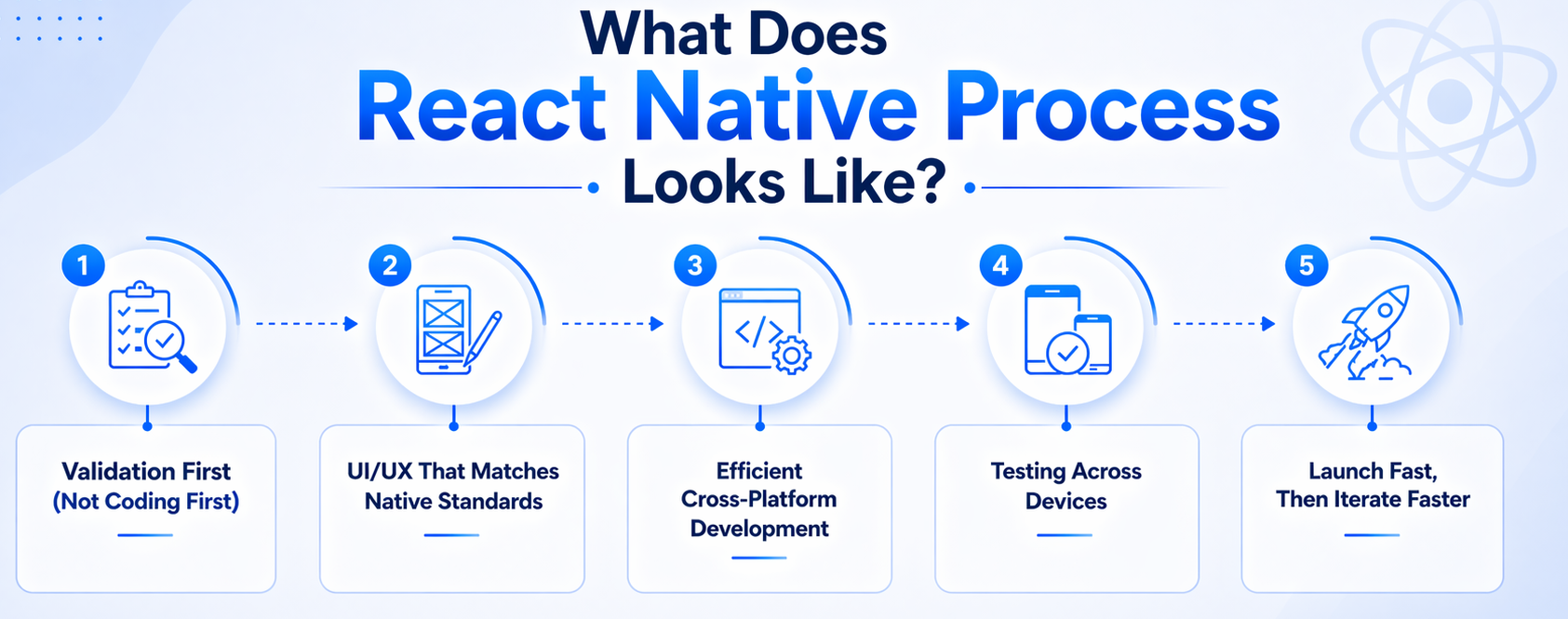 4. Testing Across Devices
- Android fragmentation
- iOS consistency checks
- Performance testing
5. Launch Fast, Then Iterate Faster
The real advantage begins after launch:
- User feedback loops
- Rapid updates
- Continuous optimisation
Cost of React Native App Development in Australia
Costs vary depending on complexity.
Basic App
AUD 40,000-80,000
- Simple features
- Basic UI
Mid-Level App
AUD 80,000-150,000
- Integrations
- Advanced features
Advanced App
AUD 150,000+
- Real-time features
- High scalability
Collaborating with the top mobile app development company in Australia will improve product quality and cost-effectiveness.
How Canva Leverage Cross-Platform Efficiency?
Canva demonstrates the importance of efficient product development and scalability.
Background
- Founded in Sydney
- Rapid global user growth
- Needed consistent experience across devices
Approach
- Focused on reusable components
- Prioritised performance and design
- Built scalable frontend systems
Outcome
- Millions of users globally
- Consistent UX across platforms
- Faster feature rollout
Due to its multi-faceted blockchain technology approach, Canvas demonstrates how new businesses emphasise scalable and efficient processes. A start-up application development company can help you develop your dream application.
ROI: Why Start-ups See Better Outcomes?
React Native isn’t just cheaper, it’s strategically smarter.
Key ROI Drivers
- Earlier launch → faster revenue
- Lower burn → longer runway
- Faster iteration → better retention
Realistic Scenario
A Melbourne start-up:
- Saves 3-35% in development costs
- Launches 2 months earlier
Outcome:
- Gains early users
- Improves investor confidence
- Reaches product-market fit faster
That’s not a small advantage, it’s a compounding one.
Mistakes Start-ups Still Make
Even with React Native, things go wrong when:
- Tech decisions are trend-driven, not strategy-driven
- Teams overbuild before validation
- Poor architecture limits scaling
- Novice developers generate problems in performance.
Selecting the best mobile app development company in Australia is more important than the framework.
Where React Native Is Heading?
React Native is evolving rapidly with:
- New architecture (Fabric & TurboModules)
- Better performance parity with native
- Strong enterprise adoption
- AI-driven features
It isn’t a fading trend; it’s maturing into a long-term solution.
The Honest Expert Take
Here’s the reality most agencies won’t say:
For early-stage start-ups, prematurely going fully native is usually a pitfall. You are maximising perfection and have not proved demand.
React Native flips that:
- Build fast
- Validate early
- Scale intelligently
And that’s exactly how a startup application development company operates.
Melbourne Fintech Start-up Scaling with React Native
Background
- Melbourne-based fintech start-up targeting young professionals
- Needed a cross-platform app within a limited budget
- Goal was to launch fast and validate the product
Approach
- Partnered with a mobile app development company in Australia
- Choose React Native for a single shared codebase
- Focused on core features for MVP launch
Outcome
- App launched on iOS and Android in 12 weeks
- Reduced development cost by 35%
- Faster iterations based on user feedback
- Scaled smoothly without major redevelopment
Conclusion
React Native proves to be an excellent selection for Melbourne-based start-ups seeking substantial development. This technology enables rapid development, reduced expenses, and app scalability as businesses expand.
Selecting appropriate technology and a professional Android application development firm in Australia is essential. A properly executed React Native software development strategy validates ideas swiftly, launching products successfully, and scaling applications. Start building your app today with the right development partner.
Also Read This:
If you’re comparing modern app development frameworks, check out Flutter vs React Native – Which Is More Cost-Effective? to understand the cost differences and choose the right solution for your business.
FAQS
Q 1. Can React Native handle app updates?
Ans 1. Absolutely, that holds for most parts. React Native offers the feature of over-the-air updates, whereby you can implement minor changes without doing a complete application update.
- Quicker bug fixing
- Improved user experience
- Minimised downtime
Q 2. Do start-ups require a team of developers to work with React Native?
Ans 2. Absolutely not in many instances. Young companies prefer to collaborate with a mobile app development company in Australia rather than hire a full team at once.
- Lower recruiting costs
- Access to skilled iOS app developers
- Fast project development
Q 3. Does React Native suit apps with feature updates?
Ans 3. Definitely yes, particularly for fast-changing start-ups.
- Easy to release updates
- Common codebase simplifies the process
- Minimises maintenance in the long run
Q 4. How does React Native impact app testing time?
Ans 4. Testing goes well as most of the code remains the same for different platforms. Yet, you should test the app for both operating systems anyway.

Sundeep Mann

Get in touch
We'd love to hear from you.






 +61 42 108-3277

 contact@7pillars.com.au
 Stay Inspired with our