In 2026, AI app development in Australia remains a strategic move that sees more businesses automate, gain predictive insights, and personalise user experiences. Through AI mobile app development, organisations in various industries are simplifying operations, minimising manual labour, and achieving a quantifiable competitive edge in increasingly digital markets in the country. A professional app development agency in Sydney can help you estimate the cost to develop an AI app.
The cost of developing AI apps cannot be understood solely by estimating the hours of the developers. Gathering of data, training of models, cloud computing, compliance, and long-term optimisation are all factors that affect pricing. Collaboration with proficient AI mobile app developers in Sydney should ensure technical precision, scalable design, and sensible budgeting in compliance with Australian industry standards and regulatory user demands.
It is a guide on how to approach an AI mobile app development company with clarity in planning, architecture and deployment maintenance. Assessing the technical complexity, data readiness and operational requirements at the initial stages, businesses can manage the cost of creating AI apps at an affordable price and create reliable intelligent applications that fulfil the needs of the present and the future.
Developing Apps with Confidence
The current guide is for start-up founders, entrepreneurs, product managers, and enterprises considering AI mobile apps in the Australian market. It covers the entire lifecycle of intelligent products- ideation and validation, deployment and post-launch optimisation.
You will gain clarity on:
- What sets AI applications apart from regular mobile applications?
- The app development cost organisation in Australia for AI.
- The reason behind the differences in pricing among different start-up companies for app development is.
- The scope and timelines estimation by AI mobile app developers in Sydney.
- Contemplated methods of cutting costs and maintaining scalability.
AI-based applications require more advanced pre-planning, yet they also offer a more significant ROI in the long run if properly done.
Why Are App Development Costs Hard to Estimate?
Unlike conventional applications, AI applications are constantly changing. Data, feedback loop, and retraining cycles enhance their performance. This dynamic aspect complicates the estimation of costs.
Common challenges include:
- Extreme pricing schemes or vague pricing strategies by an app development company in Sydney.
- Misunderstanding between AI model development and mobile interface development.
- Inaccurately calculated costs of cloud infrastructure and data processing.
- Letting long-term optimisation, retraining, and compliance costs fly.
The AI app development cost is determined by stringent data protection regulations, increased labour rates, and improved security expectations, which are prevalent in Australia.
 Custom App Development in Australia
The cost of custom-made application development is also an AI-specific pricing analysis in the Australian market. Regardless of whether you are creating more traditional software or advanced AI applications, the underlying cost structure is similar, with AI being the source of even greater complexity.
- The term custom app development in Australia refers to the creation of software that best fits operational business requirements, user processes, and long-term business growth plans.
- Custom apps, unlike off-the-shelf solutions, are created, developed, and supported specifically for one organisation, which directly affects cost.
What are the Motivations for the costs of custom app development in Australia?
Various underlying conditions influence pricing using a start-up app development company or an enterprise vendor:
1. Local Labour Rates
Australian mobile app developers will charge more per hour due to their experience and knowledge of regulatory standards.
2. Regulatory Compliance
The planning and engineering costs increase due to privacy laws and industry requirements.
3. Application Scope
The number of features, user roles, and workflows has a direct impact on hours for development.
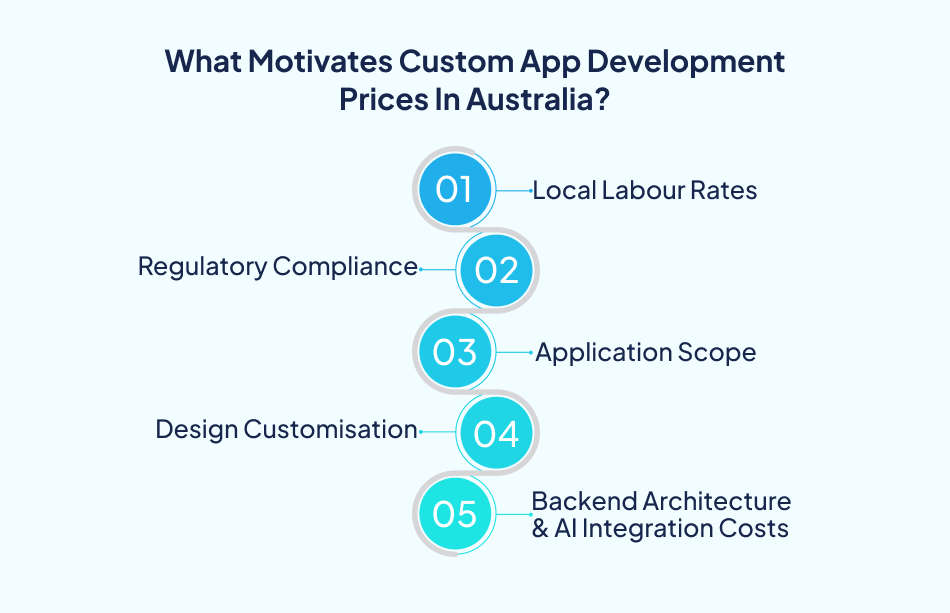 4. Design Customisation
Bespoke UI/UX Sydney requires investigation, testing, prototyping, and development.
5. Backend Architecture
Bespoke APIs, databases, and integrations increase the infrastructure and engineering expenses.
These initial costs are incurred when adding AI to data engineering, models, and continuous optimisation.
Custom App vs AI App Development Cost
Although every AI mobile application development is custom by definition, not every custom application involves AI. The most important distinction is in intelligence and adaptability.
What makes Australian Custom App Prices Higher than the world average?
Australian companies tend to observe higher quotes than in overseas markets. It is due to:
- Higher developer wages
- Greater levels of security and testing.
- Preeminence in long-term maintainability.
- Increased responsibility and legal adherence.
Nonetheless, the rebuilds usually decrease when a trusted start-up app development company in Australia is involved in the work, the scalability is stronger, and the ROI itself increases, specifically in the case of artificial intelligence applications.
This knowledge of the baseline helps estimate the realistically priced AI without relying on false, low-cost estimates when developing a mobile app.
What Is AI App Development?
AI mobile app development involves creating applications that can mimic human intelligence with algorithms, data and predictive models. These systems are ever analysing the behaviour of users and mutating them.
Characteristic abilities can be:
- Personalised recommendations
- Natural language processing.
- Image and video recognition
- Workflows of automated decision-making.
It is not the complexity of the artificial intelligence app that defines the best one, but rather the correctness provided in addressing a business problem. Custom mobile app development Sydney has helped transform the industry.
 AI Market in Australia: Key Stats
The Australian AI market is fast expanding, with companies embracing intelligent systems and investing in innovation.
- The Australian artificial intelligence market is estimated to be approximately AUD 7.25 billion as of 2025, a 51% CAGR over the next ten years, which may bring its size to AUD 446.79 billion in 2035.
- There is a boom in the uptake of AI technologies, with a survey indicating that 40-52% of Australian businesses integrate AI into their business processes.
- R&D investment in AI by governments and companies remains on the increase, as AI research budgets are projected to surpass AUD 1 billion annually by 2026, a sign of the seriousness with which it addresses innovation and practical implementation.
- Greater adoption facilitates the demand for AI mobile app development and experienced AI mobile app programmers, where companies aim to capitalise on the benefits of data insights, automation, and personalised digital services.
This steady growth also means that there is a healthy market condition to invest in AI development to remain competitive in the future.
Why Invest in AI App Development?
The development of AI apps is no longer an experiment but a business strategy for owners who want to grow, automate, and personalise online experiences in competitive marketplaces such as Australia.
1. Smarter User Experiences
- Artificial intelligence offers hyper-personalisation of user behaviour, location, and preferences.
- It assists in better interaction, retention, and conversion of apps in the long term.
2. Operational Cost Effectiveness
- Automates workflow, analytics and customer support.
- Lowers long-term operations expenditure at the expense of a higher cost of development.
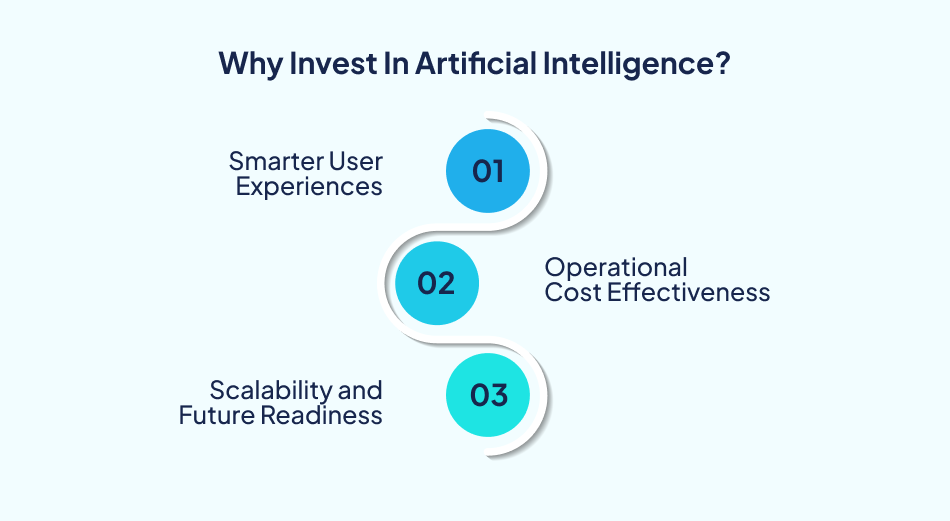 3. Scalability and Future Readiness
- The applications of artificial intelligence adapt to the growing number of users.
- Remains competitive with your product due to changing digital needs.
Projects in early AI applications provide companies with long-term innovation and established ROI.
Cost of Technology-Wise AI App Development in Australia
AI development in Australia depends on the underlying technology, the complexity of data, and infrastructure considerations. The various AI functionalities will require specialised knowledge, computing power, and coordination, which have a direct impact on the budgets of AI mobile applications development.
1. Computer Vision Solutions(AUD 70,000-AUD 300,000)
Medical image computer vision, object detection and face recognition require huge labelled datasets and high-end computational capabilities with GPUs.
- Greater overall price for real-time video analytics.
- Cloud and optimisation charges.
2. NLP (AUD 50,000-AUD 200,000)
NLP and voice assistants are AI technologies providing sentiment analysis.
- Reduced prices of pre-prepared APIs.
- Custom models are more profitable.
| AI Technology |
Use Cases |
Cost Range (AUD) |
Cost Impact Level |
| NLP |
- Chatbots
- Voice Assistants
|
50K-200K |
Medium |
| Computer Vision |
- Face recognition
- Object detection
|
70K-300K |
High |
| Predictive Analytics |
- Forecasting
- Risk Analysis
|
80K-250K+ |
High |
| Generative AI |
- AI content
- AI code
- Recommendations
|
90K-300K+ |
Very High |
3. Machine Learning and Predictive Analytics(AUD 80,000-AUD 250,000+)
These AI applications help predict future trends and make automatic decision-making.
- It is supposed to be data-engineered and model-checked.
4. Generative AI Applications(AUD 90,000-AUD 300,000+)
Generative AI applications result in the creation of text, images, and code suggestions.
- APO-based models minimize the start-up cost.
- Individualised models cost significantly more to build AI applications.
The partnership with skilled AI mobile app developers meets the needs of the Australian market by offering scalable and affordable AI services.
Key Cost Influencers Across AI Technologies
Various technical and operational considerations define the cost of AI app development in Australia. Whether businesses invest in computer vision, NLP, or predictive analytics, some fundamental aspects have a direct impact on the overall AI for mobile app development budget.
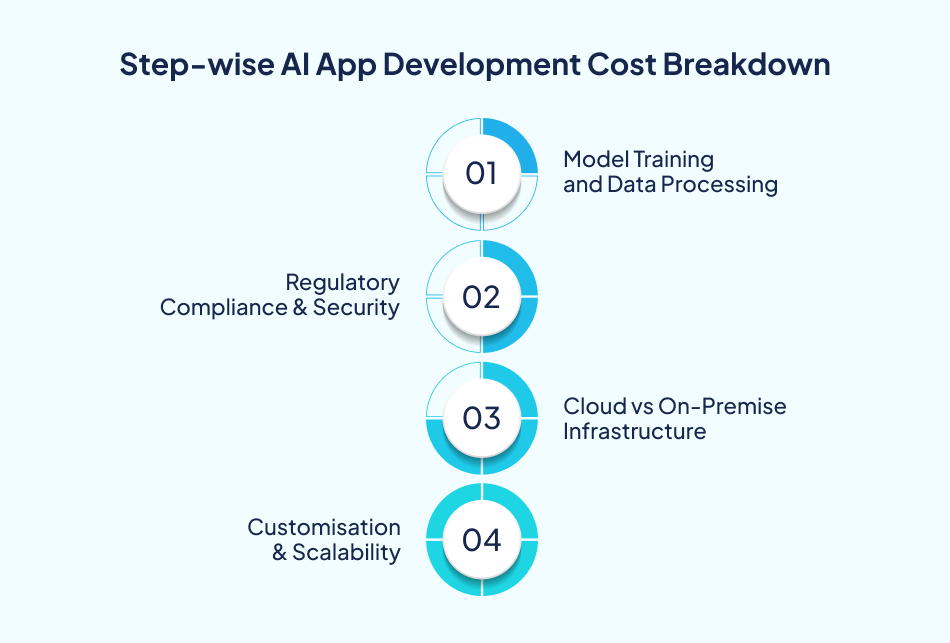
1. Model Training and Data Processing
Critical datasets and computing power for AI systems.
- Cleaning, labelling, and data collection.
- Intensive model training on GPUs.
- Incessant correcting of accuracy.
- Cycles of testing and validation.
Big data and sophisticated algorithms are also part of the cost to develop an AI app.
2. Regulatory Compliance & Security
Australian companies should adhere to the rigid rules of data privacy.
- Privacy Act compliance
- Safe storage and encryption of data.
- Healthcare, fintech approvals (industry-specific).
- Continuous audit and monitoring expenses.
Compliance requirements are an added burden in terms of time and finances.
| Factor |
Pre-Trained AI Models |
Custom AI Models |
| Initial Cost |
Lower |
Higher |
| Development Time |
Faster |
Longer |
| Accuracy |
Moderate |
High |
| Scalability |
Limited Customisation |
Fully Customisable |
| Long-Term ROI |
Moderate |
High |
3. Cloud vs On-Premise Infrastructure
The AI is highly affected by infrastructure decisions related to mobile app development costs.
- With subscriptions, cloud platforms are scalable.
- On-premise systems have larger initial hardware costs.
- Specific server maintenance and optimisation.
4. Customisation & Scalability
AI architecture design and scalability in the future have a direct effect on the cost of AI app development.
- Ready-made APIs save start-up costs.
- Individual AI models demand more research.
- Scalable architecture planning raises initial cost.
- Constant renewal and performance improvement.
A talented AI mobile app developer will ensure that AI helps develop a scalable mobile app development platform that provides both innovation, performance and long-term ROI.
Breakdown of AI App Development Costs
The total expense of AI app development includes two variables: the complexity of the development and the distribution of costs throughout the development process. The end investment depends on features, level of automation, algorithm and long-term maintenance.
Cost Breakdown by Levels of Complexity
The application of AI can be highly technical or broad. Complexity increases with data requirements, infrastructure requirements, and the effort to develop it.
1. Basic AI Apps ($50,000-$75,000)
- Simple machine learning or rule-based automation.
- Minimal data processing and formulated processes.
- Fitting MVPs, chatbots or recommendation features.
2. Mid-Level AI Apps ($100,000-$200,000)
- NLP or computer vision.
- Integration with a third-party API and Cloud services.
- It’s perfect for SaaS environments, e-commerce, and on-demand app development.
3. Enterprise AI Solutions ($250,000-$500,000+)
- High-level model training, real time data processing and automation.
- Strict security, scalability and compliance needs.
- Applied in fintech, health, logistics, and platform on a large scale.
- This is the best solution for AI fitness app development cost.
| App Complexity |
Features Included |
Estimated Cost (AUD) |
Timeline |
| Basic AI App |
- Chatbot
- Simple Automation
- API-based AI
|
40,000-80,000 |
3-4 Months |
| Mid-Level AI App |
- Predictive Analytics
- Custom Dashboards
|
80,000-180,000 |
5-8 Months |
| Advanced AI App |
- Computer Vision
- NLP Real-Time
- ML models
|
180,000-350,000+ |
8-12+ Months |
Cost Breakdown by Development Stages
The creation of AI does not represent an upfront cost, but a staged investment. Every step leads to performance, precision and success in the long run.
1. Planning (10-15%)
This phase establishes the project and eliminates future rework.
- Identification of business goals and feasibility analysis.
- Choice of AI models, AI tools, and frameworks.
- Preliminary architecture design and technological advice.
Estimated Cost: $15,000-$30,000
2. Design (15-20%)
Design is concerned with usability and simplification of complicated AI-driven insights.
- UI/UX Sydney, app wireframes and data flow charts.
- Mapping of user- algorithm interaction.
- Visualisation of AI results in simple interpretation.
Estimated Cost: $20,000-$40,000
3. Development (40-50%)
It is the most resource-intensive stage with the highest cost in the development of the AI app.
- Preprocessing of data and training of the model.
- The API integrations and the backend development.
- Frontend Implementation and learning pipelines.
Scalability, speed and security testing.
Estimated Cost: $100,000-$250,000
 4. Launch (5-10%)
The launch stage helps ensure that the AI system is reliable when operating under real-life conditions.
- Setting up the cloud infrastructure and server.
- Deployment, beta release and onboarding.
- Initial optimisation and performance monitoring.
Estimated Cost: $10,000-$25,000
5. Maintenance & Updates (10-15%)
The artificial intelligence systems require periodic updates.
- Retraining and performance monitoring model.
- Security improvements and enhancements.
- New data, regulations, and user behaviour adaptation.
Estimated Cost: $15,000-$40,000
In the cost estimation of AI app development in Australia, companies must take into account the initial development and ongoing optimisation. The right time to invest is scalable, has a higher ROI, and has competitive potential in the long run.
Factors Influencing the Development Cost of an AI App
An AI app is not predetermined in terms of development. It depends on technical complexity, data demand, infrastructure options, and the skill level of AI mobile apps developers. The knowledge of these cost drivers can enable businesses to plan manageable budgets and achieve high ROI in AI for mobile app development.
1. Complexity and App Features
The range has a direct influence on the cost of AI app development, particularly where high intelligence is required.
- Simple AI and automation are less expensive.
- Predictive analytics, NLP or computer vision raise the cost to develop an AI app.
- Complex model architectures are necessary in real-time decision-making and personalisation.
- AI applications used by the enterprise require superior security and scalability.
- More advanced features need more time to develop, test, and optimize them.
2. Data Availability and Data Processing
The basis of AI in developing mobile apps and a significant cost factor is data.
- The labelled datasets minimise development time.
- Unstructured or poor data inflates the preprocessing costs.
- Time pipelines, real-time data infrastructure.
- There are additional costs related to data storage, compliance and data security.
- The larger the volume of data running, the greater the costs of infrastructure and maintenance.
3. Selection of AI Models and Algorithms
The kind of AI models employed is very important in the overall costs.
- Ready-made models reduce the development cost of AI apps.
- Tailor-made models enhance precision; however, they are costly.
- Deep learning and neural networks have high computational requirements.
- Recurring costs increase in model retraining.
- Often, more complex algorithms can justify a higher price by being more performant and automated.
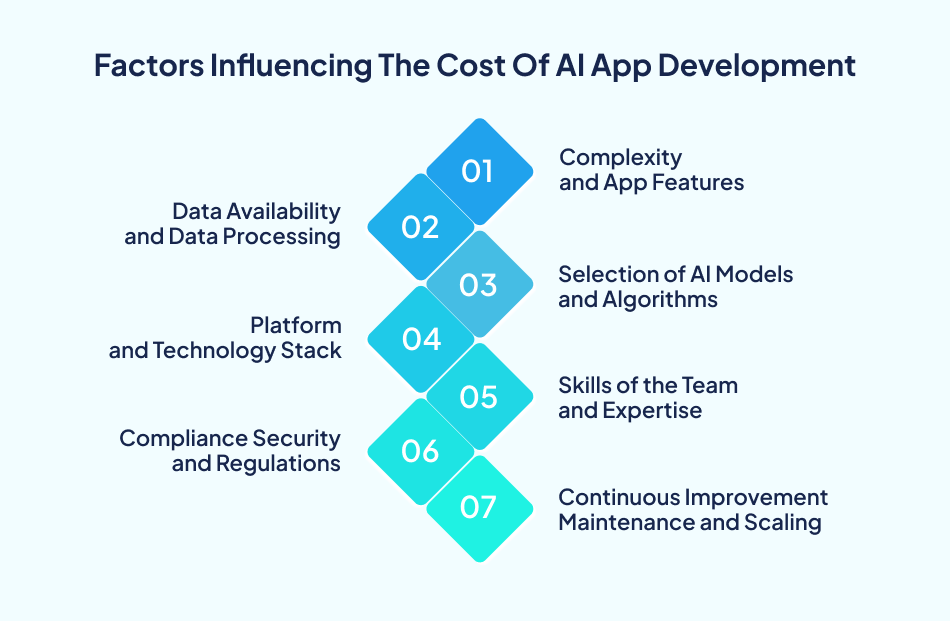 4. Platform and Technology Stack
The pricing of the AI mobile apps development largely depends on technology decisions.
- Native and cross-platform development impact build time.
- AI applications on the cloud need continuous server and usage expenses.
- Third-party APIs integration contributes to a licensing fee.
- IoT and edge AI integrations drive up hardware dependencies.
- The stack picked has an impact on initial investment.
5. Skills of the Team and Expertise
One of the largest areas of cost is the employment of qualified AI mobile app developers.
- Data scientists, ML engineers and AI architects increase costs.
- Bigger groups will speed up the delivery, but increase the overall expenses.
- Seasoned staff minimise rework and technical debt.
- The experience is the guarantee of precision, functionality, and sustainable use of AI applications.
6. Compliance, Security, and Regulations
Regulation (Compliance requirements) makes it more complex, particularly in industries that are regulated.
- Developing and testing is more effort-intensive.
- Encryption and security audits increase infrastructure cost.
- Industry-specific regulations require specific protection.
- Continued compliance inspection contributes to maintenance costs.
- These expenses are necessary in the development of reputable and legally viable AI applications.
7. Continuous Improvement, Maintenance and Scaling
AI apps need investment continually.
- Retraining and updating the models boost spending in the long term.
- Increases in user bases require increased cloud resources.
- There is accuracy in performance monitoring.
- AI apps are competitive due to feature upgrades.
- The concept of continuous optimisation is not an optional cost in the development of an AI mobile app.
What’s Really Behind AI App Development Costs?
The cost of the AI application development exceeds the initial construction costs.
1. App Maintenance
AI applications need regular updates.
- Periodic retraining of the models with new data entries.
- Budget fixes, optimisation, and performance enhancement.
- Security updates and compatibility patches.
- Continued aid of the AI mobile application developers.
Maintenance would provide the same line of operation, helping avoid the degradation of models with time.
2. App Hosting
Hosting is an operating expense that varies in accordance with usage and data processing requirements.
- AI model execution cloud infrastructure.
- Big data and log storage.
- Real-time prediction compute resources.
- Disaster recovery systems, backup systems.
Cloud-based AI mobile application development is a commonly used tool, and hosting can be a costly affair.
| Cost Component |
One-Time/Recurring |
Estimated%of Total Budget |
| Model Training |
One-Time+Updates |
15-25% |
| Cloud Hosting |
Recurring |
10-20% annually |
| Maintenance |
Recurring |
15-20% annually |
| Compliance & Security |
One-Time+Ongoing |
10-15% |
| Marketing |
Variable |
10-25% |
3. App Promotion and Marketing
Developing an AI application will be worthwhile only if users embrace it.
- Artificial Intelligence (AI) app App Store Optimisation.
- Paid campaigns and acquisition of users.
- Conversion and engagement tracking analytics tools.
- Continuous content and performance optimization.
- An experienced app development agency in Sydney can help you estimate the cost to develop an AI app.
Marketing expenses depend on the growing competition and expansion goals.
 4. Legal and Licensing Fees
Mandatory requirements and certification are crucial in app development.
- Privacy and compliance auditing.
- Licensed charges of third-party AI tools and APIs.
- Guarding of intellectual property and patents.
- Regulatory approvals relating to the industry.
Legal expenses help shield both the users and companies against compliance risks.
5. Other Operational Costs
Numerous concealed operational costs impact the general cost of AI app development.
- Artificial intelligence and support desks.
- Uptime/performance monitoring.
- Traffic burst scaling of infrastructure.
- In-house training programs and the use of AI.
These expenses ensure that the AI application runs well at scale.
Core Features of an AI App
Any successful artificial intelligence app depends on its core features.
User Panel Features
1. Account & Onboarding
- OAuth (secure login), biometric, 2FA.
- Profile setup
- Role-based access
Onboarding is fairly affordable with basic features; however, with enterprise-grade security, the cost to develop an AI app rises. A team of custom mobile app development Sydney helps you integrate the latest features in your app.
2. Personalised Dashboard
- AI-driven content feed
- Real-time user insights
- Activity tracking
Applied in fintech, fitness apps, and recommendation engines.
3. Smart Search and Navigation
- NLP-based search
- Voice commands
- Context-aware results
It increases the cost of developing an AI mobile app, making it more expensive with the NLP integration.
4. Interactive AI Features
- Chatbots
- Smart assistants
- Predictive recommendations
Typical for the best artificial intelligence app experiences.
5. Feedback and Analytics in Real-Time
- User behaviour tracking
- Performance metrics
- Adaptive recommendations
Admin Panel Features
1. User & Role Management
- Access control
- User segmentation
2. AI Model Monitoring & Control
- Model performance tracking
- Retraining management
- Best for educational app development
3. Analytics & Reporting
- Business dashboards
- Revenue tracking
- Enterprise AI apps need these characteristics.
Technology Stack for Building an Artificial Intelligence App
The technological stack has a direct relationship with scalability, and it is expensive.
1. Frontend Technologies
The frontend defines AI for mobile app development.
Mobile & Cross Platform Frameworks
- Swift (iOS)
- Kotlin/Java (Android)
- React Native
- Flutter
Cross-platform will lower the development cost, but can restrict the optimisation of deep AI.
2. Backend & API Layer
Widespread backend technologies:
- Node.js
- Python (FastAPI, Django)
AI apps typically require:
- REST APIs
- GraphQL
- AI inference APIs
The complexity of the backends has a significant impact on the cost of developing an AI app.
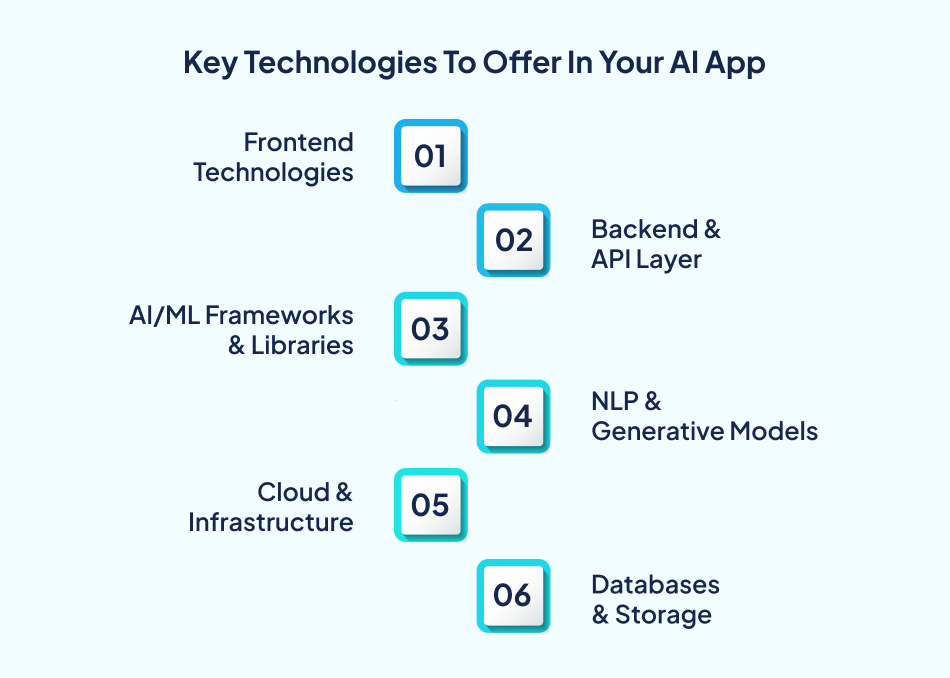 3. AI/ML Frameworks & Libraries
- TensorFlow
- PyTorch
- Scikit-learn
- OpenCV
Complex frameworks enhance the performance of models and increase development time.
4. NLP & Generative Models
- OpenAI APIs
- Custom LLMs
- Speech-to-text engines
These have a drastic impact on the cost of developing an AI app because of the API usage price.
5. Cloud & Infrastructure
Cloud Platforms:
- AWS
- Google Cloud
- Microsoft Azure
Cloud hosting includes:
- GPU servers
- AI model deployment
- Autoscaling
The infancy expenses constitute a significant portion of the budget for AI mobile app development.
6. Databases & Storage
- MongoDB
- PostgreSQL
- Embeddings in Vector Database.
AI-based recommendation engines increase the cost of vector databases.
Hidden Costs Behind AI App Development
Most businesses only consider coding and first-time deployment when estimating the cost of development of an AI app. Nevertheless, the true cost of using the AI app development includes the hidden and recurring costs. Such expenses can be very expensive in terms of ROI in the long term unless managed adequately.
A detailed breakdown-
1. Cloud Service and Hosting Fees
In comparison to traditional mobile apps, AIs have more infrastructure requirements.
Key Expenses:
- Model training servers- GPU/TPU.
- AI inference servers
- Data storage (data in a structured form and data in an unstructured form)
- Such databases are embeddings of vectors.
- Auto-scaling infrastructure
- Content delivery networks (CDNs).
For example, the best artificial intelligence app generated with large language models can cost thousands of dollars a month to use the GPU.
Why does it increase the cost?
Infrastructure is not a once-only project. Directly related to the number of users are server costs, which in turn influence the overall cost of developing an AI application in the long run.
2. APIs and Integrations
The majority of AI applications depend on external services.
Common Integrations:
- Payment gateways
- AI APIs (image recognition, speech recognition, NLP).
- Maps & geolocation services
- SMS/email services
- Analytics platforms
- CRM or ERP systems
- POS software integrations
A significant number of these services increase costs:
- Per API call
- Per 1,000 requests
- Per user session
In the case of high-traffic AI applications, API contributes to operational cost.
3. Continuous Support and Maintenance
AI systems require continuous building.
Ongoing Costs Include:
- Bug fixes
- Updates on the OS (iOS/Android updates)
- Framework upgrades
- Server monitoring
- Performance optimisation
Having an experienced AI mobile app developer means that maintenance will be smoother.
Maintenance is normally between 15-25% of the original development per year.
 4. Model Retraining & Performance Monitoring
To be accurate, AI models have to be updated regularly.
- Data drift
- Changing user behaviour
- Market changes
- Patterns of fraud development (AI in Fintech).
Costs include:
- Retraining infrastructure
- Data re-labeling
- Performance testing
- A/B testing
It will be one of the largest silent cost contributors to the development of the AI mobile app.
5. Security, Compliance and Legal Fees
Sensitive data processed by AI apps must be highly compliant.
Additional Costs:
- GDPR compliance
- HIPAA (health apps) compliance.
- PCI-DSS (payment systems)
- Legal documentation
- Data protection audits
- Penetration testing
For example:
- AI in Fintech needs tough financial adherence.
- Privacy has been a concern in AI fitness applications processing health data.
- Governance may substantially increase AI app development cost.
6. App Store & Platform Fees
Many businesses forget Platform-related charges.
Includes:
- Apple Developer Program Fee
- Google Play Developer Fee
- App store commissions (15-30%)
- In-app purchase charges
Such charges affect revenue margins, particularly in the case of AI apps that are subscription-based.
7. DevOps & Monitoring Tools
Smart software needs sophisticated surveillance:
- Application performance monitoring (APM).
- Error tracking
- Model performance tracking
- Log aggregation
- CI/CD pipelines
In scaling products, DevOps engineers work on a full-time basis.
8. User Interface
The retention of AI apps directly depends on user experience.
Costs may arise from:
- Redesigning dashboards
- It will add layers of personalisation.
- Increasing the explainability of AI.
- Conducting user testing
Design iterations are unavoidable if you want to develop the optimal artificial intelligence application.
Cost of Industry-Wise AI App Development in Australia
The cost of developing an AI app in Australia depends on industry regulations or laws, the sensitivity of the data, the requirements of the infrastructure, and the complexity of the integration. Companies working with a mobile app development company in Sydney must consider specific sector requirements and then estimate the total budget.
1. Healthcare & MedTech
AI solutions in healthcare require high accuracy and strict observance.
- TGA, HIPAA and GDPR compliance requirements.
- Store and encrypt patient data.
- Deep learning-based diagnostics.
- Connectivity to hospital management systems.
2. FinTech
The best artificial intelligence apps in finance focus on security and fraud detection.
- Live transaction monitoring.
- KYC and AML compliance
- Risk assessment models powered by AI.
- Blockchain and safe API integrations.
| Industry |
Compliance Level |
Estimated Cost (AUD) |
Complexity |
| Healthcare |
Very High |
120K-400K+ |
Very High |
| FinTech |
High |
100K-350K |
High |
| Retail |
Medium |
60K-200K |
Medium |
| EdTech |
Medium |
50K-180K |
Medium |
3. Retail & E-Commerce
Retail AI improves personalisation and automation.
- Recommendation engines
- Inventory prediction models.
- Customer support chatbots.
- Omnichannel integration
4. Education & EdTech
AI enhances effective learning and participation.
- Individualised learning algorithms.
- Voice and natural language processing tutoring systems.
- Gathering analytics dashboards.
- Cloud-based scalability
Collaboration with experienced AI mobile app developers will result in scalable AI mobile app development solutions to meet the needs of the Australian market and minimise the cost of AI app development.
Development Team & Regional Cost Comparison for AI Apps
The cost of AI app development in Australia depends on regulations, data sensitivity, infrastructure requirements, the complexity of integration, and the demands of a particular sector.
Key Roles Required in AI App Development
In contrast to conventional mobile applications, an AI mobile application development needs expert individuals.
Core Team Structure
1. Project Manager
- Defines scope and roadmap
- Supervises timeframes and budgets.
- Co-ordinates team-to-team communication.
2. UI/UX App Designer Sydney
- Flows experience designs.
- Develops artificial intelligence-friendly dashboards.
- Enhances customisation and convenience.
- UX design simplifies the navigation for users
This position is necessary for developing the most suitable artificial intelligence application with high retention rates. A skilled team of ui/ux app designers Sydney can help you create a unique interface.
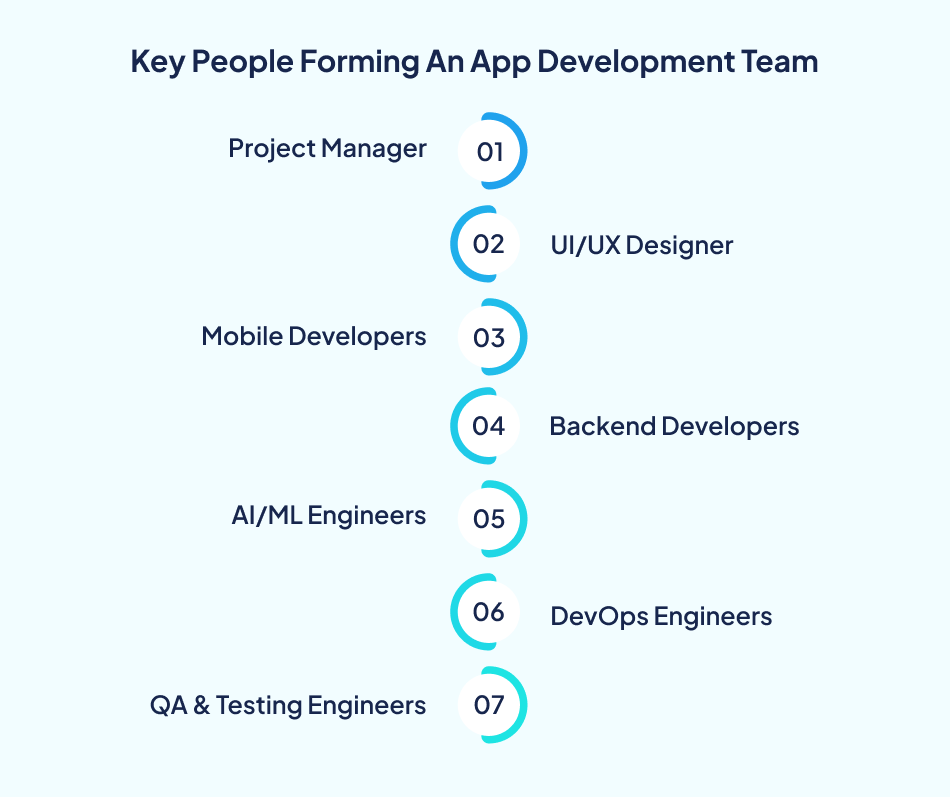 3. Mobile Developers
- iOS developers (Swift)
- Android (Kotlin /Java) developers.
- The cross-platform developers (Flutter/React Native)
A team collaborating with an Android application development company will affect the general AI app development cost.
4. Backend Developers
Eco-friendly build APIs and server logic.
- Manage databases
- Integrate AI modules
The complexity at the backend has a direct influence on the cost of making an AI app.
5. AI/ML Engineers
Procreate and train machine learning models.
- Adopt NLP and computer vision.
- Optimise the inference of AI.
Such experts are the most highly paid in artificial intelligence projects.
6. DevOps Engineers
- Administer cloud infrastructure.
- Implement CI/CD pipelines.
- Supervise performance and scaling of the monitors.
DevOps plays a significant role in ensuring infrastructure efficiency and long-term AI app development costs do not exceed the budget.
7. QA & Testing Engineers
- Functional testing
- AI model validation
- Security and compliance test.
Regional Cost Comparison
The rates charged by fintech app developers depend on the geographic location. One of the most impactful variables in the cost of an AI app development is the place.
1. United States
Average Hourly Rate:
$100-$250+ per hour
Advantages:
- Good ecosystem of strong AI research.
- Quality engineering talent.
- Established start-up and business climate.
Challenges:
- Maximum development and recruiting expenses.
- High cost of long-term retention.
Most enterprise-level artificial intelligence applications are particularly prevalent in regulated industries.
2. UAE (Dubai & Gulf Region)
Average Hourly Rate:
$40-$120 per hour
Advantages:
- Expanding technology ecosystem.
- Strategic regional access
- Middle-class pricing compared with the US.
Challenges:
- Less extensive AI research base than the world tech centres.
- Applicable to mid-size and large organisations that operate in the Middle East.
3. India & South Asia
Average Hourly Rate:
$20-$60 per hour
Advantages:
- Big AI and software engineering talent pool.
- Cost-effective development
- Well-established outsourcing market.
A large number of start-ups work with a start-up app development firm in India to streamline the budgets of AI mobile app development.
Challenges:
- Needs systematic project management.
- Coordination of time zone with Western clients.
Best when it comes to MVP; AI fitness app development cost, student educational app development, and scalable AI applications with budget limits.
4. Eastern Europe
Average Hourly Rate:
$40-$100 per hour
Advantages:
- Good engineering education.
- Competitive AI expertise
- Good alignment with the European time zone.
Frequently used in the high-quality mid-range pricing models.
In-House VS Outsourced Development
This is because your hiring model dramatically determines the overall cost of developing an app using AI.
1. In-House AI Development Team
Cost Components:
- Salaries
- Office infrastructure
- Employee benefits
- Equipment and tools
- HR overhead, administrative overhead.
Advantages:
- Complete development authority.
- Good identification with business objectives.
- Long-term product ownership
Challenges:
- High upfront investment
- Longer hiring cycles
It is the most appropriate model for enterprises that develop long-term AI platforms.
 2. Outsourced Development Team
Collaboration with an Android application development company or mobile app developers in Sydney can help you work on a budget.
Advantages:
- Lower upfront investment
- More rapid development process.
- Flexible team scaling
- Availability of a variety of technical knowledge.
Challenges:
- Reduced direct control
- Vendor dependency
Start-ups should consider outsourcing when considering costs to build an AI app on a small budget.
3. Hybrid Model
A blend of internal management and offshoring.
Typical structure:
- In-house product manager
- AI and development team outsourced.
- It would be a balance between quality and cost-effectiveness.
Effects of Team Choice on the Cost of Full AI App Development?
Your choice of team has an impact on:
- Development speed
- AI model performance
- Long-term scalability
- Maintenance expenses
- Infrastructure optimisation
- Product quality
For example, Fintech AI solutions developed in the US can be much more expensive than outsourcing to South Asia.
How to Develop an Artificial Intelligence App?
In contrast to conventional applications, AI applications require a system of learning, model optimisation, and solid architecture on the back end.
Here is the step-by-step instruction on how each step affects the AI app development cost.
1. Define The Business Objective
Any successful AI product begins with a problem statement.
Key Questions to Answer:
- What issue will artificial intelligence address?
- Who is the target audience?
- What information will be driving the AI system?
- What can be measured to describe the success?
For example:
- In Fintech, AI can help detect fraud or credit.
- A workout app can be an AI-based platform that suggests workouts.
- Adaptive learning can be the target of educational AI development.
The proper definition of scope helps to avoid cost overruns and minimise the total cost of developing AI apps.
2. Conduct Market & Competitor Research
Before building, analyse:
- Current AI applications in your market.
- Feature gaps in competitors
- Monetisation strategies
- User expectations
It also affects the extent of the development cost of an AI application, identifying the necessary complexity.
3. Choose The Right AI Approach
Not all apps need deep learning.
AI Implementation Options:
- Rule-Based Systems
- Single logic-based automation.
- Reduced the expense of creating an AI application.
- Basic chatbots or workflow tools are appropriate.
Pre-Trained AI Models
- APIs use NLP, vision or speech.
- Faster development
- Higher recurring API costs
- Tailor-Made machine learning models.
Built From Scratch
- Requires data scientists
- Increased initial cost of the development of the AI apps.
- Greater level of control and scale.
The decision between these options largely impacts the cost of AI mobile app development.
4. Data Preparation And Data Collection
The power of AI models is as great as the security.
This stage includes:
- Data sourcing
- Cleaning and normalisation
- Labelling and annotation
- Compliance verification
- Bias detection
Lack of good data preparation will cause inaccuracy in predictions and increased retraining costs in the future.
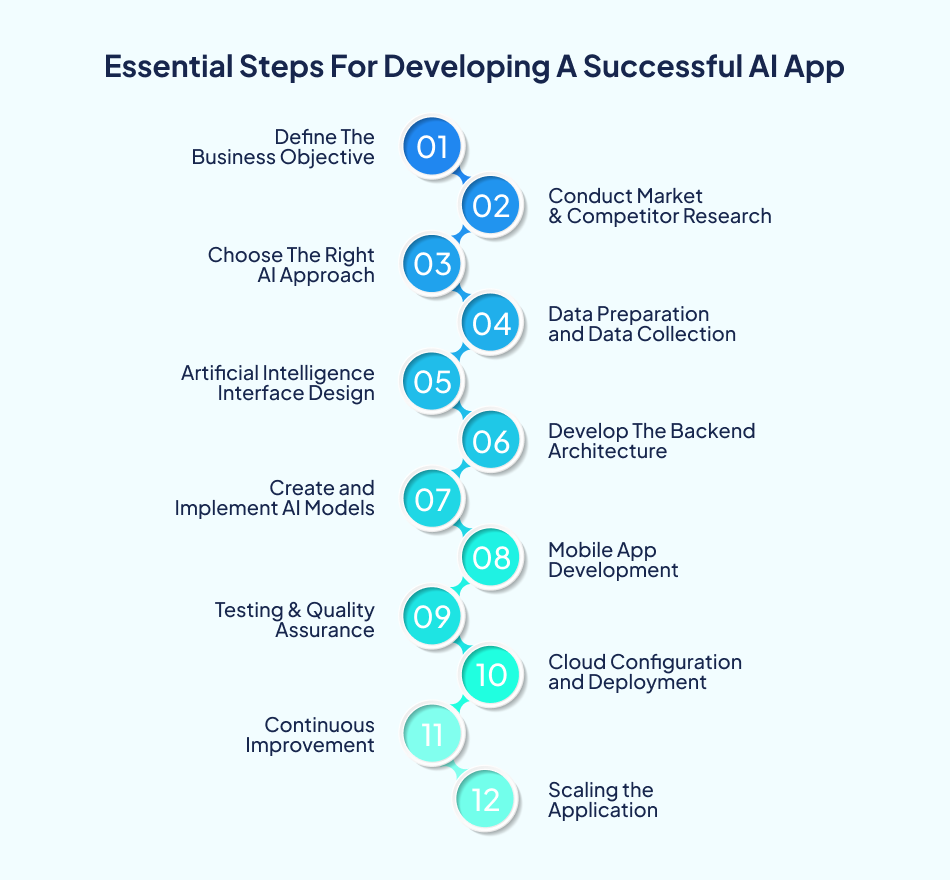 5. Artificial Intelligence Interface
AI applications must have user-friendly interfaces.
Critical Design Factor(s):
- AI explainability
- Clear feedback mechanisms
- Real-time visualisation of response.
- Personalisation dashboards
Hiring top iOS app developers enables the appropriate integration of AI into mobile devices.
6. Develop The Backend Architecture
The backend handles:
- API communication
- AI model integration
- Database management
- Authentication/authorisation.
- Cloud infrastructure
Widely used technologies on the backend are:
- Node.js
- Python (Django, FastAPI)
- Java Spring
- .NET
The complexity of backends has a direct impact on the prices of developing an AI app.
7. Create And Implement AI Models
It is the developmental core stage.
Key Tasks:
- Model selection
- Training and validation
- Hyperparameter tuning
- API deployment
- Real-time inference setup
AI modules may include:
- NLP chatbots
- Recommendation engines
- Computer vision
- Predictive analytics
- Generative AI
In the case of developing advanced AI apps, the GPU cloud infrastructure adds a high cost to the development of an AI app.
8. Mobile App Development
It includes:
Frontend Development:
- Native iOS development
- Native Android development
- Cross-platform development
The AI in mobile apps development must have good communication between the frontend and AI APIs so that the system is minimal and easy to use.
9. Testing & Quality Assurance
AI applications need more testing layers than conventional software.
Types of Testing:
- Functional testing
- AI model accuracy testing
- Performance testing
- Security testing
- Load testing
- Unfairness and evaluation assessment.
Testing will help verify that the artificial intelligence app can help achieve reasonable accuracy.
10. Cloud Configuration And Deployment
Deployment includes:
- Cloud hosting setup
- Auto-scaling configuration
- Load balancing
- Database optimisation
- CDN setup
Cloud expenses are a recurrent component of the price to build an app based on AI.
11. Continuous Improvement
The AI systems need constant updates.
Post-Launch Activities:
- Performance monitoring
- Model retraining
- User behaviour analysis
- Feature optimisation
- Security patching
- AI apps are constantly evolving as opposed to the static ones.
Maintenance normally consumes 15-25 per cent of the initial cost per year.
12. Scaling the Application
When user traffic grows:
- Infrastructure must scale
- AI inference must optimise
- The databases need to be able to withstand more load.
- Scalability planning averts unforeseen increases in the price of AI applications.
How to Optimise AI App Development Cost in Australia?
To minimize AI app development cost, one must plan their development, make smart technology decisions, and work with the best mobile app development firm. With efficiency, scalability and gradual implementation, businesses are in a position to manage budgets without affecting performance.
1. Start with a Clear MVP
Minimum Viable Product (MVP) is the process of confirming your idea by launching it to the market.
- Prioritise core AI features
- Avoid Unnecessary integrations
- Test market demand early
- Minimise first-time AI mobile app development costs.
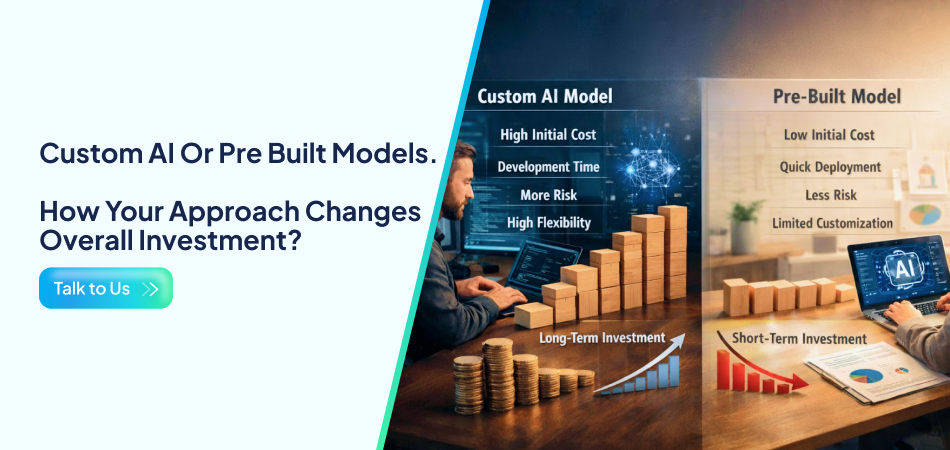
2. Use Pre-Trained AI Models
Use existing APIs to create models.
- Faster deployment
- Lower R&D costs
- Less infrastructure requirements.
Perfect for start-ups that handle AI application development expenses.
 3. Select Scalable Cloud Infrastructure
The cloud systems maximise the AI in the creation of mobile applications through the provision of scalable prices.
- Pay-as-you-go pricing models
- Scalability in the case of growth is easy.
- Less hardware expenditures.
- Better monitoring of performance.
4. Collaborate with Senior Developers
It is advisable to work with a reputable AI application development firm to have an efficient architecture and minimum rework.
- Better project planning
- Prolonged maintenance services.
- Scaling of features in a cost-effective manner.
Proper design and expert advice greatly streamline the cost of AI app development without compromising long-term growth.
Artificial Intelligence Monetisation in Australia
To drive revenue associated with AI solutions, a strategic approach based on user behaviour and market demand is required. An expert mobile application development firm will assist companies in creating scalable monetisation frameworks. The right choice of strategy ensures that your AI mobile app development in Sydney will yield sustainable ROI.
1. Subscription-Based Model
Subscriptions offer a reliable stream of revenue.
- Pricing levels are set monthly.
- Premium AI-driven features
- Free trial as a way of boosting conversions.
- Productivity and SaaS are a perfect fit.
2. Freemium Model
Offer simple services without payment and implement high-tech AI services.
- Unlock premium analytics
- Advanced automation tools
- Individualised machine suggestions.
| Monetisation Model |
Revenue Predictability |
User Acquisition |
Best For |
| Subscription |
High |
Medium |
SaaS & Productivity Apps |
| Freemium |
Medium |
High |
Consumer AI Apps |
| In-App Purchases |
Variable |
High |
AI Utility Apps |
| Enterprise Licensing |
High Value |
Low Volume |
B2B AI Solutions |
3. In-App Purchases
Additional features or digital resources for users.
- AI-generated reports
- Additional storage or processing capability.
- Custom AI integrations
- Pay-per-use AI services
4. Advertising & Partnerships
Monetise by using focused strategic partnerships.
- AI-powered personalised ads
- Associate marketing schemes.
- Brand partnerships
- Campaign optimization with data.
5. Enterprise Licensing
Sell Artificial Intelligence to companies.
- Custom pricing models
- White-label AI products
- Ongoing support contracts
- Enterprise integration, which is scaled.
A trustworthy AI mobile app development company in Sydney ensures that your monetisation plan maximises the proceeds.
How to Select an AI App Development Partner?
The choice of the appropriate AI app development company will directly affect the quality, scalability, and cost of AI app development. Before settling on any app development company in Sydney to outsource AI mobile app development projects, consider the following:
1. Measure Technical Expertise
Technical underpinning is required for efficient AI to develop mobile applications.
- ML, NLP, and computer vision Experience.
- Capabilities of cloud and data engineering.
- Proven AI project portfolio
- IT mobile app developers.
2. Assess Industry Experience
Familiarity with the industry minimises such risks as compliance and rework.
- Knowledge of Australian laws.
- Work experience in your area of business.
- The best practices of data security.
- Interaction with the current systems.
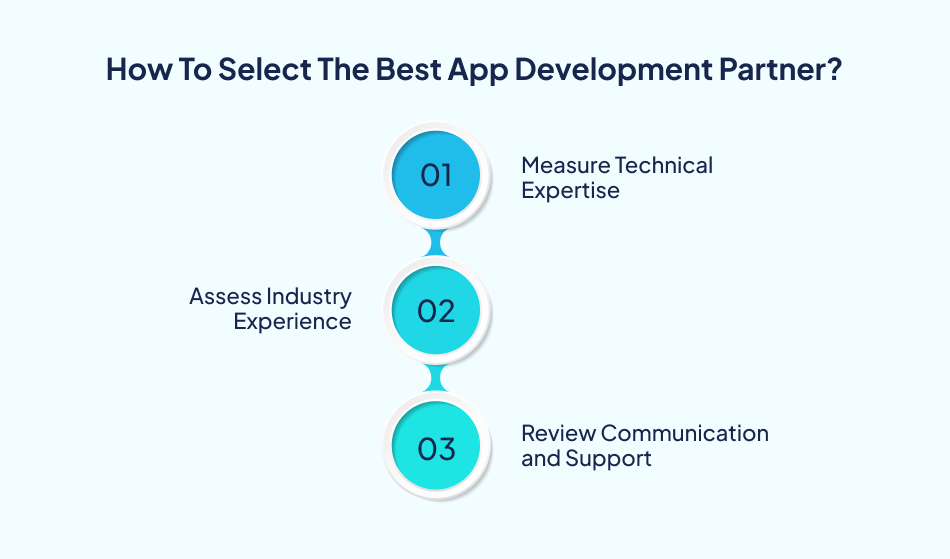 3. Review Communication and Support
Effective communication removes gaffes during delivery.
- Agile development process
- Clearly defined cost estimation.
- After-sales maintenance.
- Scalability and upgrade planning.
AI-based Retail Analytics Application
One of the Australian retail brands collaborated with a seasoned AI application developer to create a predictive analytics technology that enhanced inventory optimisation and customised customer interactions.
Challenges
- Failure to forecast the demand accurately.
- Overstocking and delay in supply chains.
- Poor customer behaviour intelligence.
Solution
- Combined machine learning prediction systems.
- Sales data analytics in real time.
- AI-based personalised recommendations.
Results
- Excess inventory has decreased by 28%.
- 18% increase in online sales
- Better ROI and overall cost of AI app development.
Conclusion
AI app development in Sydney needs planning, realistic budgeting, and the latest technologies. Infrastructure and compliance, monetisation and scalability, all these factors affect long-term success. Collaboration with skilled professionals and the use of react native software development can guarantee a quicker deployment, cross-platform performance, and manageable development expenses.
With the increasing rate of AI adoption, competitive advantages can also be measured by businesses that emphasise scalable architecture and performance optimisation. To minimise risk, maximise ROI and time-to-market, it is better to select the appropriate AI app development company or include the React Native software development plan in your roadmap in an ever-smarter digital economy.
FAQS
Q 1. Is POS software integration expensive in AI app development?
Ans 1. The price of an AI application to be integrated with a POS system varies based on the complexities, feature customisations, and data synchronisations.
Q 2. Is the POS software system in an AI app safe to use?
Ans 2. When done correctly, integrating POS software into AI apps leverages encryption methods (encrypted APIs), secure payment gateways and a dollar amount for financial and customer information.
Q 3. What industries benefit most from AI and POS software integration?
Ans 3. The application of intelligent automation coupled with POS software helps the retail and hospitality fields benefit from smarter operations.
Q 4. Should companies outsource iOS app developers?
Ans 4. Incorporating skilled iOS app developers ensures scalability of architecture, secure payment, and seamless AI utilisation within Apple devices.















 +61 42 108-3277


 +61 42 108-3277

 contact@7pillars.com.au
 Stay Inspired with our