



Let's have a
Quick Chat
with you!
Quick Chat
with you!
You have our ear and we can't wait to hear about your idea! Share your details here and we will make sure to schedule a coffee date with you soon.

The mobile-first economy in Australia is expanding at an unprecedented rate. With millions being spent on various mobile applications, this trend is expected to continue each year until 2026. This mobile app development guide will help you navigate through the entire process. The best app development company in Australia can help you turn your business around for success.
Increased rivalry has forced companies to hire professional mobile app development partners who can deliver scalable, high-performance products. However, the main challenge is understanding app development in Australia in 2026.
The problem is that app development costs in Australia are not straightforward. Even similar estimates quoted by an app development company in Australia differ dramatically. A single estimate might appear reasonably priced, whereas another might be high, and businesses are not sure whether they are paying for top functionality, a set of standards, the expertise of their staff, or unforeseen costs after the launch.
In the absence of transparency, most organisations are unable to know what they are actually investing in and whether the investment is commensurate with the long-term value. The emergence of AI-driven features, escalating developer rates, data privacy regulations, system fragmentation, and continued management has transformed the entire cost model of mobile apps in 2026.
This mobile app development guide targets decision-makers, who are supposed to have financial clarity before investing resources. It explains costs, price differences, and how Australian conditions affect your budget so you can plan confidently.
 Where Do App Projects Go Off Track?
Mobile app development in Australia is subject to a variety of recurring issues that impede or slow progress achieved by the team and increase risk:
When you go through this mobile app development guide, you will:
In simple terms, mobile app development is a software development process for digital assistants and hardware devices including tablets, mobile phones, and similar devices that function due to software systems embedded in them. Mobile app development involves a detailed study of understanding the hardware constraints, such as speed, CPU (central processing unit), etc., to ensure the security and success of the developed app.
A mobile application has several technical layers that interact to bring a consistent, secure, and scalable user experience. The majority of the best mobile applications are created with three main components to operate in harmony and appeal to users.
This interface of the mobile application is what users interact with directly. It emphasises design, usability, and performance.
| Component | Responsibilities | Technologies Used | Key Features |
| Front-End |
|
|
|
| Back-End |
|
|
|
The back-end does the logic, data mining, and security of the mobile application.
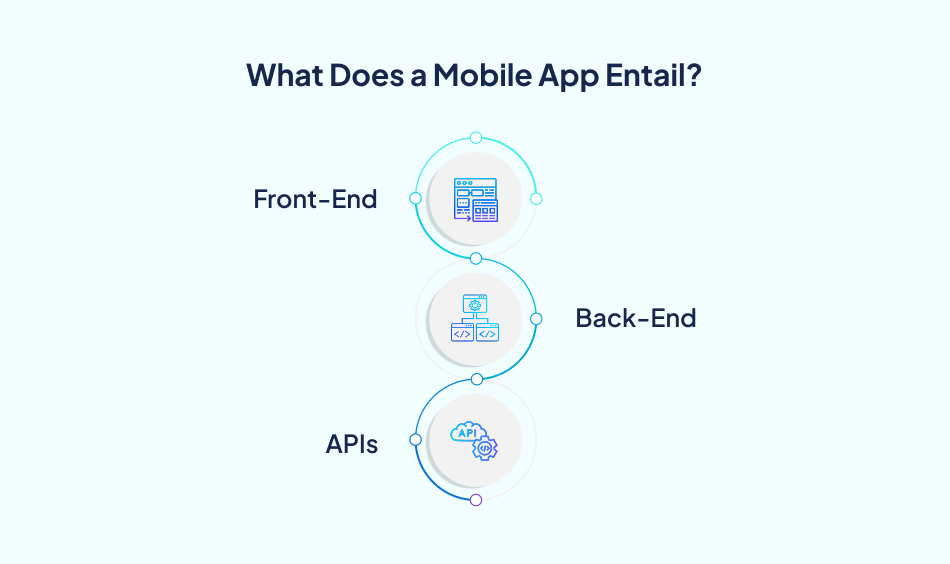 3. Application Programming Interface (API)
APIs serve as an interface between back-ends and front-ends.
Technology has turned simple tools into powerful apps. The evolving demands and technology have influenced the design, construction, and scale of the app industry over time.
Who would have thought apps would go on to become a massive hit among users in the coming time? Those who adopt new technologies are curious about the next trends.
Over 15 years ago, what looked like a bleak future for app development, with few apps having core features dipping their toes in the market, has adapted tremendously over time. As things evolve, application development has made life easy by enabling people to access real-time tasks.
One of the earliest individuals who believed in apps was Steve Jobs. He said that a turnaround will occur in the industry in future. Come today! The future is the present, and it is superior.
With people trusting mobile apps, their development has taken off over the years, leading to a surge. In the coming few years, expect a further increase in demand, reaching approximately $ 11 billion by 2027.
 Types of Mobile Apps
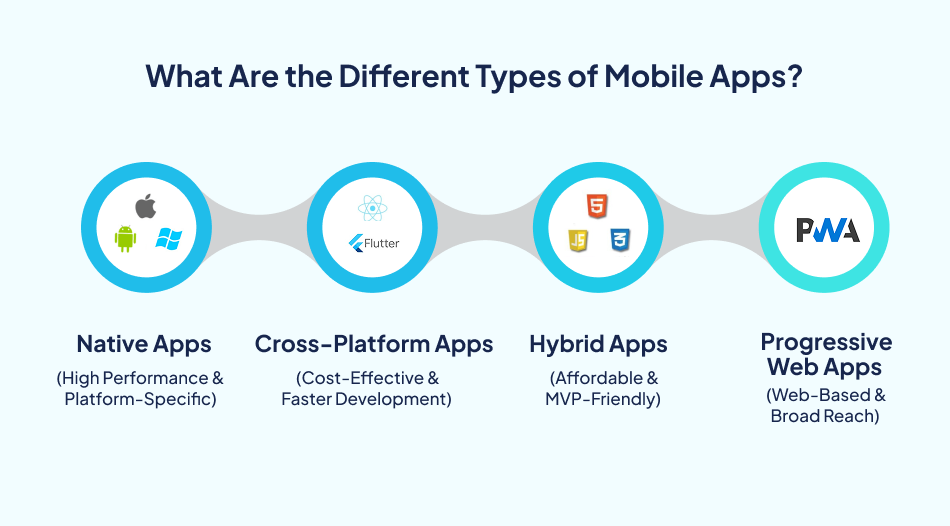
You must also learn that there are varying types of apps before you even start thinking about creating a mobile app. It is also essential to know that each app has various functions, and then make a choice on which one suits you best. Four major types of apps exist, solving their own problems and a set of challenges.
Native mobile apps are the most basic ones, built to target a single platform. Native applications are often developed for a single platform, such as Android or iOS, using its approved language and code. Due to their tight integration with operating systems, native applications offer a seamless experience, high-quality animations, and control over features.
To solve the problem of writing different code to develop for distinct platforms, developers created cross-platform applications to save on cost and time. These apps have React Native or Flutter as their framework to help bridge the code without compromising much on quality.
Hybrid apps are the solution for clients interested in a combination of both Native and cross-platform at an affordable rate. These applications are cost-effective and more efficient than any other application.
Progressive apps are primarily web apps that function like mobile apps. They can operate in an offline state similar to apps, with push notifications and home screens among other functionalities, often opening in a web browser.
 Why Must You Invest In App Development?
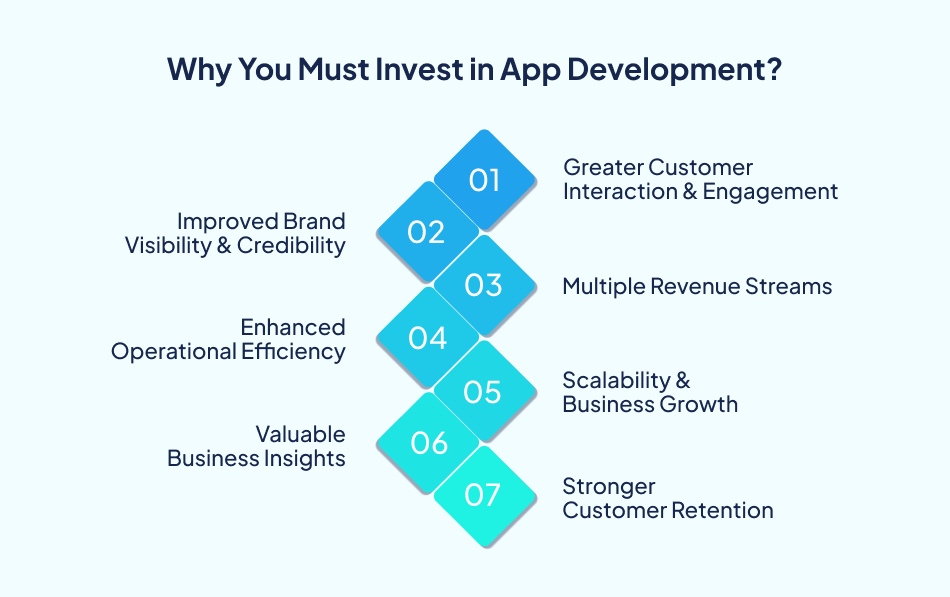
Are you considering investing in app development? Every entrepreneur who wants to invest in a profitable app faces the challenge of understanding the benefits of developing apps. The following are some of the advantages that you can gain by investing in app development.
Mobile apps are indeed beneficial to both users and brands, providing convenience. By optimising customer engagement, you also enhance brand visibility.
Businesses can gain brand recognition and trust in the long run by being on user devices with a mobile application. A professionally developed app implies quality and innovation, and it can help companies to position themselves as reputable and inventive in their sector.
Mobile applications can help VR development companies to go beyond the usual sales format by providing monetisation flexibility. These sources offer a stable income and enable users to select value-added services to meet clients’ needs.
Mobile applications simplify internal operations by automating routine tasks and centralising business activities. It saves on manual labour and enhances productivity within teams.
Apps expand along with the business. They can add new features, users, and integrations without interfering with their performance. It ensures mobile apps are an investment for the future.
 6. Acquiring Valuable Business Insights
Mobile applications give real-time information that helps businesses gain insight into user behaviour and performance patterns. These lessons help make more prudent choices and continuous improvement.
Mobile apps can enable businesses to establish long-term relationships through value-based features and frequent availability. Retained users contribute to long-term growth.
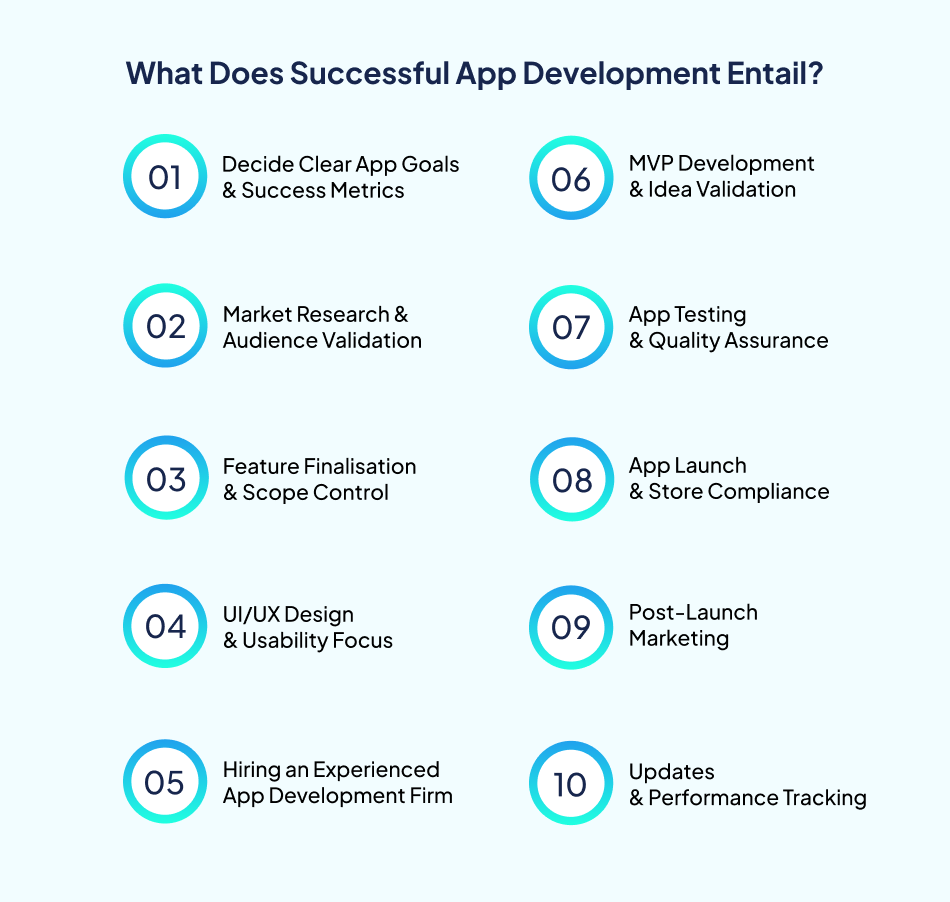
The process of creating a successful mobile app is not a matter of writing code but rather a highly organised process. It is strategic planning, research, design validation, testing, and continuous improvement. Our mobile app development guide will help you plan your journey to success. An effective app development service will help organisations realise this journey and implement every step with certainty.
The basis of any successful app initiative is clear goals. In the absence of specific goals, companies experience scope creep, misaligned expectations, and wasted costs. Goals help identify the end state that the app should reach and the measure of success.
Market research ensures that your app is developed using reality, not ideas. Reducing the risk of failure is an effective way to understand what your competitors, trends, and audience expect.
Features are essential in defining the utility and success of an app. Although they might look attractive on the surface, features that are not necessary to the product add development time and cost, but not value. The choice of strategic features makes it focused and efficient.
Even before users can access the functionality, visual attractiveness and navigation can determine how much they use the app or uninstall it. A balanced design is seamless and attractive for users. Functionality and beauty are good design.
 5. Contract An Experienced App Development Firm
The success of your app largely depends on the choice of the development partner. A competent workforce helps companies remain focused on their vision, market and technological changes.
It may be risky to launch a full-fledged application without proving it. Minimum Viable Product enables companies to validate their idea at a very low cost. The top mobile app development company in Australia helps companies to scope out an MVP in a prudent manner.
Testing provides the reliability of your app on all devices and settings. Bugs, performance problems, and security vulnerabilities are typical at the early stage. You must be upfront and tackle them.
The opening of an app needs to be thoroughly planned and implemented in accordance with platform requirements. The requirements of app stores are high, and failure to acknowledge them may slow down the submission or block it. An organised launch plan preconditions the popularity and acceptance.
The app’s life begins after launch in the competitive market. Continuous information about marketing, updates, and performance is critical to sustained growth. Even well-developed applications fail to achieve success without the post-launch initiatives.
Mobile applications development depends on one or several technical layers that interact to provide seamless functionality and performance. All the lifecycle stages add to stability, scalability and security. These components get matched with business objectives through a systematic process followed by an application development company.
The interface is the interactive and front-end of an application. It ascertains the navigation, interaction and experience of the users with the product. A trusted mobile app development company in Australia ensures that front-ends are consistent.
Typical front-end technologies are:
A Google UI system that helps create high-performance applications with the same source code.
React native is a JavaScript-based framework that currently allows the creation of cross-platform applications without immediate performance compromises.
iOS has its own language for secure and high-performance applications.
| Aspect | Front-End | Back-End |
| Definition |
|
Server-side system of the app |
| Main Role |
|
Manages logic, data & security |
| Responsibilities |
|
Data storage, Authentication, Business logic |
| Technologies Used |
|
Node.js, Python, Java.NET |
| Key Features |
|
Scalable architecture, Secure data handling, High performance |
| Integration Points |
|
API endpoints,
Database management, Third-party services |
The back-end is concerned with data management, application code and system communications. It ensures that each customised mobile app can withstand different workloads.
Typical back-end technologies are:
An enterprise-level, secure, powerful language that helps in back-ends.
Python is a rapidly growing language with a well-supported data-driven application.
Ruby on Rails is the name of a framework that speeds up the back-end development by embedding a convention-based framework.
Application data is stored and organised in databases. The database enhances performance and reliability. A professional mobile application development service ensures optimal data architecture.
Popular database technologies are:
It is a popular relational database that allows the storage of structured data.
An advanced relational database that is said to be reliable and even scalable.
A NoSQL database made to fit in flexible and unstructured data.
The real-time database depends on the cloud and instant data synchronisation.
Deployment, scaling and maintenance are supported using cloud infrastructure. DevOps practices ensure faster updates and guaranteed system reliability. Managed through the services of a professional application development company.
Examples of common cloud and DevOps technologies are:
Provides infrastructure and cloud hosting services which scale.
Offers cloud solutions and integrations at the enterprise level.
Known as the service of analytics and a scalable back-end.
Provides a means of deploying applications in a containerised manner.
 5. Security and Authentication
Security safeguards sensitive user data and averts unauthorised connections. Any custom mobile app requires strong authentication.
Popular security technologies are:
Authorisation protocol depending on securing third-party access.
Authenticate the exchange of data with tokens.
Facilitate the use of fingerprints and faces.
Encrypts information during transit.
Before launching, perform testing to guarantee stability, performance and security. An effective mobile application development service incorporates testing into the development process.
Specific methods of testing would be:
Test mobile apps across platforms.
Selenium helps in functional testing and regression testing.
Aids in unit testing of the back-ends.
Test the apps on the actual devices.
Analytics assists in performance monitoring, usage, and error finding. In mobile app development, a data-driven agency maximises results by using insights.
Examples of some analytics tools are:
User behaviour and events tracker.
Identifies crashes and stability issues.
Checks the performance of the back-ends.
Measures user engagement.
 Building a Secure Application for Your Business
A secure application builds user confidence and supports long-term scalability. An organised mobile application development service has most businesses engaging an application development agency to develop a custom mobile app that fulfils the regulatory, security, and performance requirements. This mobile app development guide will help you build a secure app.
Key focus areas include:
The choice of the appropriate type of app influences costs, scalability, and time-to-market. Before a business determines the best model of custom mobile app development within a mobile application development service, a reputable mobile application development company conducts business goal assessments.
The typical business inquiries include:
Scalable solutions offered by a mobile application development company.
Native applications are developed for iOS or Android systems efficiently and securely. Most businesses prefer to do mission-critical custom mobile application projects through native development with an experienced application development company.
Key characteristics:
Cross-platform development enables businesses to serve numerous platforms with a single codebase. It is an affordable strategy of releasing a personalised mobile application in a short time with the assistance of an application development company.
Key characteristics:
Usually provided as a flexible mobile application development service through a mobile app development agency.
| Parameter | Native App Development | Cross-Platform App Development | Hybrid App Development | Progressive Web App Development |
| Definition | Apps built specifically for a single operating system | One app built to run on both Android and iOS | Web-based app wrapped inside a native container | Web applications that behave like native apps |
| Tools & Technologies | Java, Kotlin, Swift | Flutter, React Native, Xamarin | Ionic, HTML5, CSS | JavaScript, HTML, CSS |
| Advantages | Superior performance
Full access to device APIs |
Single codebase
Faster development |
Shared codebase
Hardware access |
Lower development cost
No app store installation |
| Performance | Best speed and stability | Slightly slower than native | Slower than native | Depends on internet and browser performance |
Progressive Web Apps (PWAs) are browser-based apps with functionality. They are best suited for businesses with lightweight custom mobile app requirements that do not require dependence on the application store, commonly suggested by an application development agency.
Key characteristics:
Part of the general mobile application development services in use today.
Hybrid applications are made of both web technologies and native containers, with a trade-off between speed and cost. Numerous startups adhere to this custom mobile application strategy under the guidance of an application development agency.
Key characteristics:
The standard approach is to have it developed by a top mobile app development company in Australia.
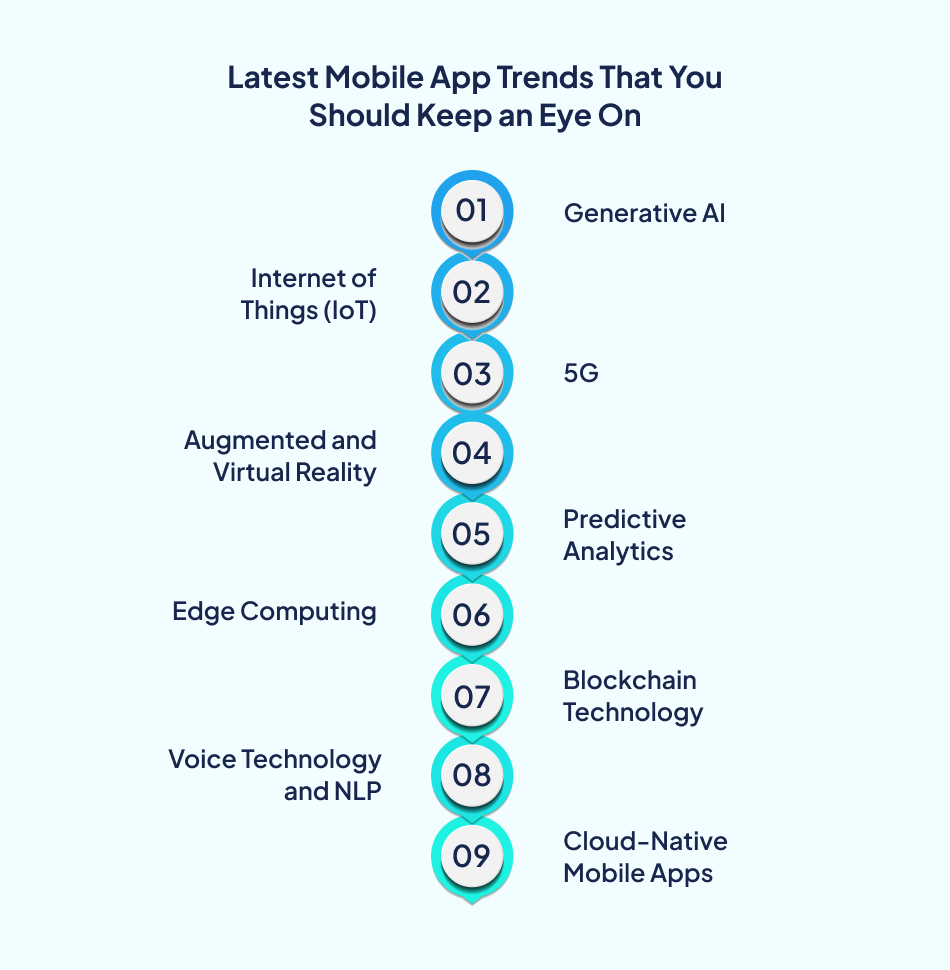
Generative AI is changing the way mobile apps generate content, react to users and personalise experiences. Chatbots for automated design recommendations save time and effort, while also improving engagement.
IoT also supports mobile applications that receive real-time information. This tendency is essential in sectors such as healthcare, logistics, and smart homes, where mobile applications will serve as control centres of the linked ecosystems and will provide improved visibility of the operations.
With 5G, there is a significant enhancement in the use of mobile apps, as it provides ultra-fast speeds and reduces latency. It enables developers to create real-time applications that are infeasible, especially in streaming, gaming, and AR applications.
AR and VR complement mobile applications with smooth and interactive experiences. These technologies are used in retail, education, and real estate businesses to engage customers, simulate product visualisation, and provide training.
 5. Predictive Analytics
Predictive analytics enables mobile applications to make predictions of user behaviour based on historical and real-time data. It helps VR development companies make better choices, maximise user experiences and decrease churn rate by providing prompt and relevant content.
Data processing and storage happen near the user’s central servers only. It minimises latency and enhances the performance of an app, most notably apps that need immediate responses, such as healthcare tracking and smart gadgets.
Blockchain technology increases the level of trust and transparency in mobile applications with decentralised systems. It is also finding its way into the financial, healthcare, and supply chain applications to ensure the integrity of data and secure transactions.
Voice-enabled apps are faster and more accessible. NLP applications understand human linguistic expression and respond to improve user usability and inclusivity.
Cloud-native applications are scalable and can easily increase user demand. They enable businesses to implement updates, improve speed, enhance reliability, minimise infrastructure expenses, and contribute to long-term digital expansion.
The selection of the company that will develop your mobile application is a very critical decision that directly determines quality, cost, timelines and scalability. There are three possible ways to conduct business, each with its benefits and challenges.
In-house development of an app provides control over the development process and knowledge storage. It is the best option when dealing with large organisations that have constant needs regarding apps and have the resources to keep a team of skilled developers to train and manage internally.
Offshore agencies offer a broader pool of talent at relatively reduced costs. The choice is common among organisations that want scalability and acceleration without developing their own team, but it also needs proper communication and quality standards management.
Freelancers work on small projects, prototypes or MVPs with low budgets. They are capable of bending and are cheaper to install, but they have availability, scalability, and maintenance in the long run.
The selection of the appropriate development partner is a guarantee of quality performance and future success. An organised process of evaluation saves from expensive errors.
Key characteristics:
Evaluating the company’s capabilities will help determine the reliability and quality of delivery before engagement.
Key characteristics:
Proper questions help to clarify the expectations and minimise project risks at the initial stages.
Key characteristics:
Elimination of pitfalls prevents time, cost, and re-work loss during development.
Key characteristics:
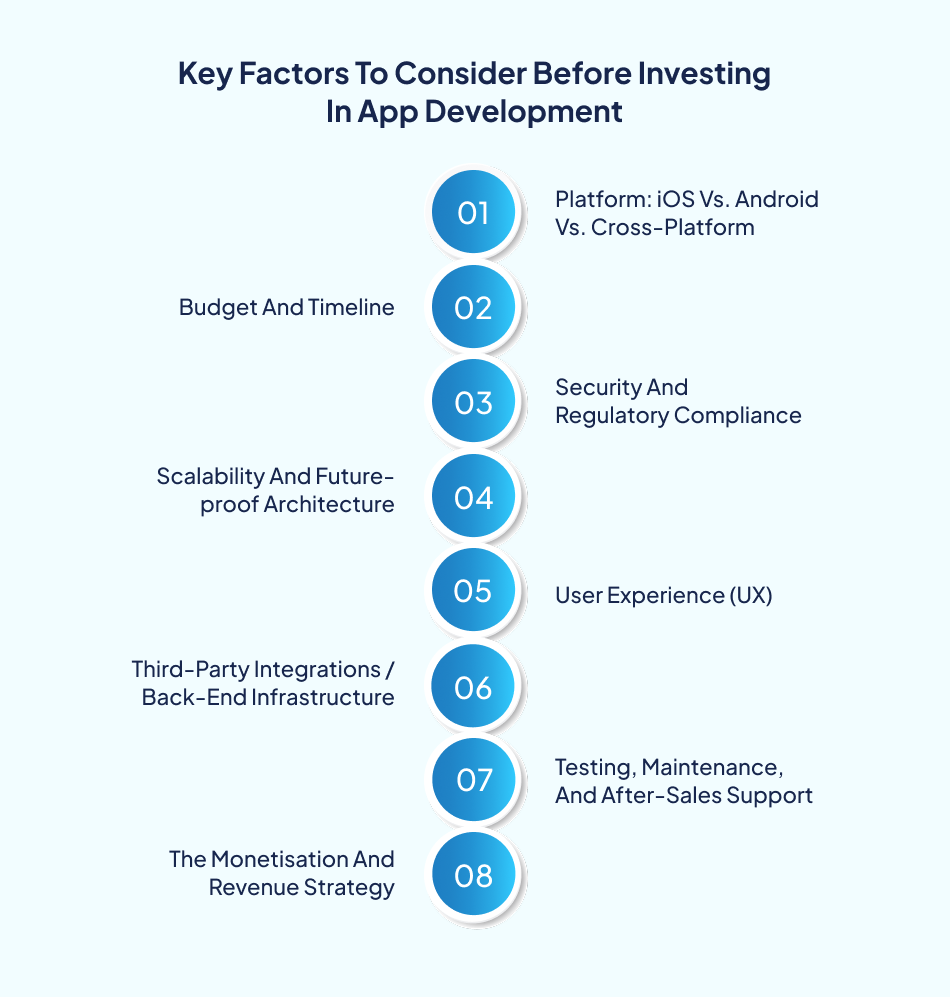
To create a mobile app, it is not just about lines of code. Strategise it around technology, design, security, scalability and the business goals. The following will be the main areas that any successful mobile app development process should address.
The selection of an appropriate platform will define reach, cost, and pace of development.
 3. Security And Regulatory Compliance
Cost of mobile app development depends on project requirements and choices. Strategic planning helps control budget overruns.
Key characteristics:
Complex apps need more functionality, logic, and time to develop, which is costly.
The price is differentiated based on the target application: iOS, Android, cross operating systems, or new technologies.
Animations, custom UX and branding increase the effort and development cost of design.
There are advanced back-ends, APIs, third-party services, and data management systems, which increase the cost of development and infrastructure.
The contract investment helps upgrade regularly, add security patches, performance, and platform compatibility.
| Cost Factor | Description | Estimated Cost |
| App Type & Purpose | Informational, e-commerce, SaaS, Enterprise | $30,000-$250,000+ |
| Platform | iOS, Android, or both | Single: $30k-$80k
Both: $60k-$150k |
| App Complexity | Basic to advanced features | $30k-$250k+ |
| UI/UX Design | Branding & animations | $5k-$30k |
| Backend Infrastructure | APIs, cloud, databases | $10k-$80k |
| Third-Party Integrations | Payments, analytics, chat | $5k- $50k+ |
| Geographic Rates | Dev location based pricing | $25-$250/hr |
| Maintenance | Updates & bug fixes | 15%-20% yearly |
| Testing & QA | Manual & automation testing | $5k-$20k+ |
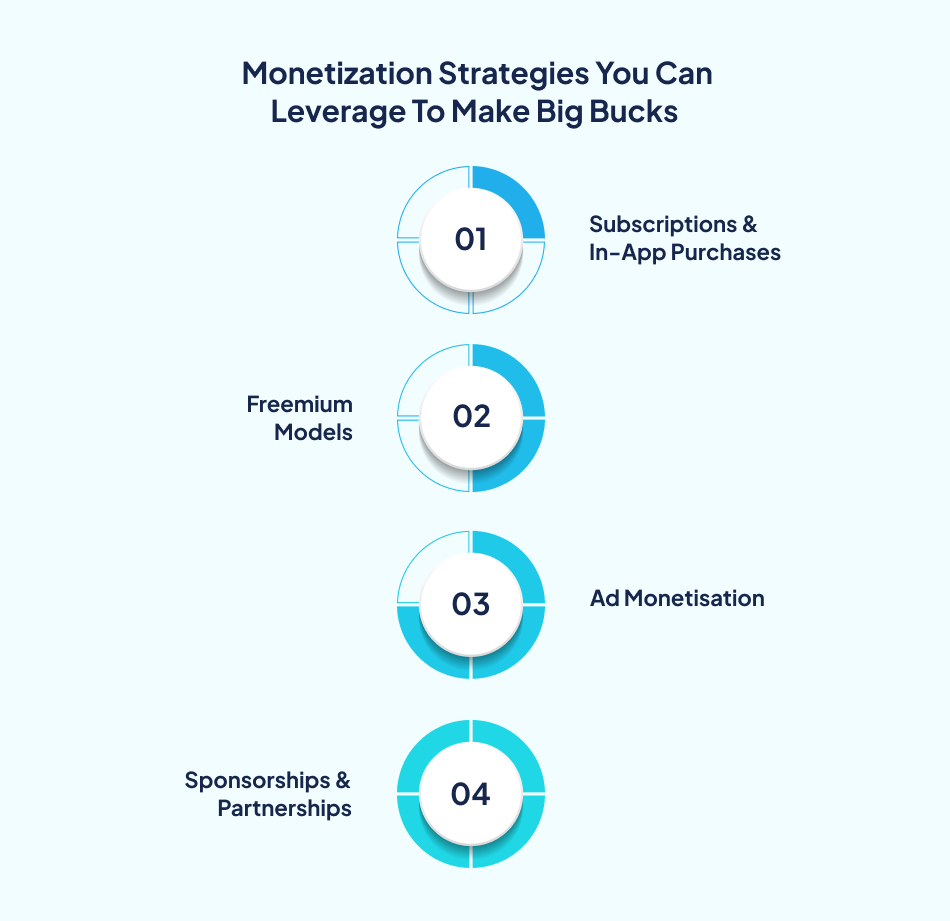
An effective monetisation plan will enable the companies to recoup the costs of developing their mobile applications and generate sustainable revenue. The choice of an appropriate model is conditional on its audience and user behaviour. The following are the best mobile application monetisation strategies employed by companies today.
The plan allows users to access the simple features free of charge and the advanced features at a fee.
Freemium apps attract a massive number of users as they offer free basic functionality.
 3. Ad Monetisation
The Australian app development businesses face technical, financial, and operational difficulties throughout the app lifecycle. When not properly planned, these challenges impact timelines, budgets, and user experience. Qualified mobile app developers in Australia can help overcome these challenges.
One of the common issues associated with app development in Australia is the high cost of development, particularly of custom and feature-filled apps.
Solution
In app development in Australia, security risks are significant threats, particularly in data-driven apps.
Solution
Rejections by the app store would delay the launch of app development in Australia and increase the expenses.
Solution
 4. Scalability And Performance Of Apps Problems
In Australia, performance problems are a barrier to growth in app development.
Solution
The Android fragmentation makes app development difficult in Australia.
Solution
The firm wanted to introduce a secure and expandable mobile application to enhance customer communication and shopping under a strict timeframe.
The company had operational and technical constraints that impeded online expansion and customer satisfaction.
Key characteristics:
A systematic development policy was embraced to match technology with business objectives and a scalability perspective.
Key characteristics:
The app development process was performance-driven, security-focused, and quick deployment without quality.
Key characteristics:
The app had brought about quantifiable enhancements in the interaction and the efficacy of activities.
Key characteristics:
The development of an effective mobile application is not only about code writing but also about making intelligent choices throughout the app development process. Long-term success is a result of planning, security, scaling, and performance-driven development. Collaborating with already proven on-demand app developers and a trusted development service will enable companies to remain nimble, minimize risk, embrace change, maximize value, and guarantee scalable expansion and competitive edge.
After all, everything depends on the support. With a long history of on-demand app developers and a reliable mobile application development service, you have a clear path from idea to impact. We hope you are now ready to proceed boldly. You can start by having a friendly discussion with us about the best way to develop your app vision.
Q 1: Why is the step-by-step approach essential to mobile app development?
Ans 1: An organized strategy will reduce risks, regulate prices, and quality. It also enables companies to test ideas, design features rationally, and coordinate well with the iOS app developers to ensure predictability and easier rollouts.
Q 2: Does it support business systems?
Ans 2: Yes. The mobile app development guide covers backend data planning, APIs, and scalability necessary for tools such as POS software, secure data flow, and seamless user experience across devices and platforms.
Q 3: When are specialized developers required in businesses?
Ans 3: Enterprises involve professionals during the initial planning and design. Skilled iOS app developers ensure best platform practices, performance optimization, and compliance with Apple guidelines through lifecycle development.
Q 4: Does this guide apply to the retail or hospitality apps?
Ans 4: Absolutely. The mobile app development guide handles real-time data processing, security, and integrations, which are essential in apps that work with POS software, helping businesses to develop scalable, reliable solutions that meet business requirements.


Partner with us to bring your vision to life.



 +61 (42) 108-3277
 contact@7pillars.com.au
 294A Station Street,
