











You do not need to build an entire ship to see if it can sail in the ocean. Similarly, you do not need to build a full-fledged application to see if your idea will work or not.
Many businesses in Australia often encounter huge losses just because they invest heavily in apps that won’t perform well in the market. That’s the reason why practical business owners consider MVP (Minimum Viable Product) to test if their idea will work or not.
MVPs help businesses in validating their idea before investing large sums of money in developing a final product. Through MVPs, businesses can enter the market faster, test the app on the ground, and gather user feedback to implement in the final product.
When businesses decide to go for an MVP, the next question that comes to mind is “What is MVP Development Cost?” That’s exactly what we’re going to cover in this blog today. We will discuss:
- What is an MVP?
- How much does it cost?
- What factors influence the MVP Development Cost?
- How does AI impact the cost to build an MVP?
- How to reduce MVP app Development Cost?
After the reading, you will have all the necessary information you should have to make a worthwhile decision. So, let’s start with a quick overview of what an MVP actually is.
What is an MVP?
An MVP (Minimum Viable Product) is the first version of a product. It only covers the main functionality required to solve a problem. The objective behind developing an MVP is to test whether the idea will work or not. Additionally, it also helps in knowing the market demand and gathering feedback from the initial users to reflect in the final product.
Benefits of an MVP
- It helps to evaluate if the idea turns out to be profitable or not.
- MVPs allow you to enter the market early.
- It also aids in gathering feedback from initial users to implement in the final product.
- It reduces the risk of expensive losses by checking the viability of the product.
- It attracts investors for final product development.
So far, you know what an MVP basically is. Now, let’s explore how much it will cost you.
How much does it cost to build an MVP?
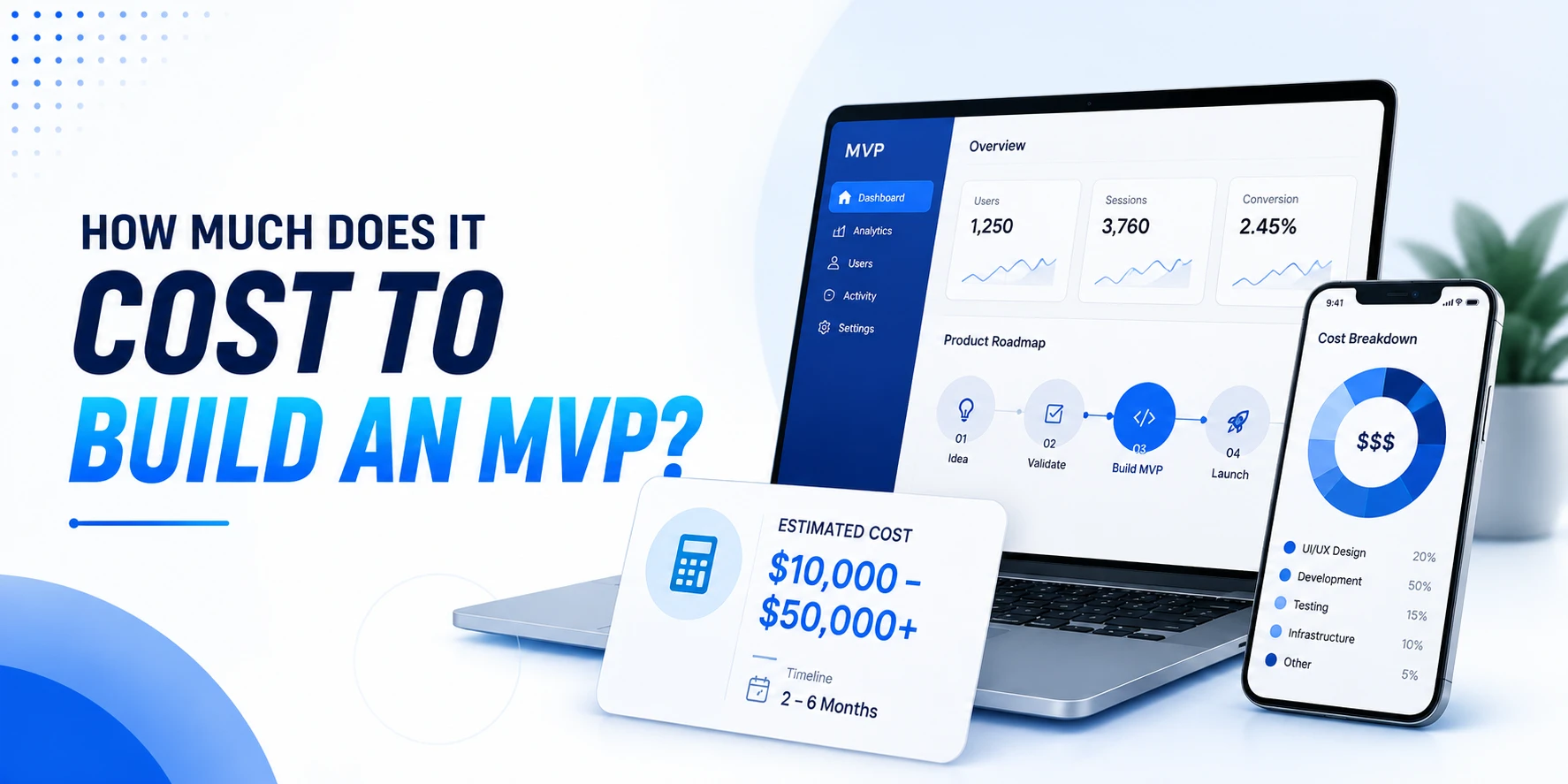
You can expect anywhere between $15,000 and $100,000 to develop an MVP mobile app in Australia. However, every MVP development company has its own way to calculate price estimations. It is because of certain factors that vary depending upon the company’s location and the engagement model they have. So, here are some factors that influence the overall MVP app development cost:
Feature Complexity
The larger part of the cost of MVP development depends upon the complexity of its features. As MVPs only involve the core features to solve a problem, the cost relies on how much effort the development team has to make to design and develop it. For example, building an integrated dashboard where multiple users collaborate seamlessly can take much time and effort to build. On the other hand, a dashboard for a specific user is easy to build and requires less time and effort, costing you way less than the integrated one.
Platform Selection
Another major factor that influences the MVP development cost is platform selection. If you go with individual apps for Android, iOS, and web, it will cost you more. Because every platform requires its own codebase to function, on the other hand, if you want to build a cross-platform application, it will cost you comparatively less than native apps.
Development Team
There are four major categories of development teams for MVP applications, and each one of them involves different pricing models.
In-House Development Team
In-house development means you have to hire your own app development team. It is the costliest method in the list. You have to pay the salaries, benefits, and everything an employer has to provide to its employees. Additionally, you also have to cover the cost of hardware, software, and other resources they will use to develop your MVP app.
Freelancers
You can hire freelancers as well to develop your MVP. You can save a lot in this category, but you have to compromise credibility and reliability in the process.
Local Teams
Some companies provide developer hiring facilities as well. They provide you with a team of designers, developers, testers, and project managers for a specific project. This method is cheaper than hiring your own development team but still costs more compared to the next category below.
Outsourcing MVP Development
Most businesses choose this model because it is the most cost-effective way to build an MVP for your business. It involves delegating your project to an app development company to build your project from start to finish.
Third-Party Integrations
Integrations play a significant role in driving your MVP development cost. If your app doesn’t require integration with other services, it will cost you less. But if the functionality depends upon other integrated services such as GPS maps, payment gateways, and custom backend services, the cost will go up.
Security and Compliance
Security and compliance requirements also drive the MVP development cost. If you’re dealing in the finance or healthcare sector, security becomes non-negotiable in order to stay compliant. So, an MVP with robust security measures requires more time and effort to build, which eventually increases the cost.
So now you know the factors that influence the MVP app development cost. Let’s discuss the influence of AI on overall cost calculation.
How does AI Impact your MVP Development Cost?
AI impacts the overall cost of MVP app development in two different ways. First, it helps in lowering the cost when developers utilise AI-powered tools for development and testing. Second, it increases the cost when you require core AI features in your MVP mobile application.
How does AI help in reducing the cost?
Artificial Intelligence AI helps in reducing the effort developers have to make in the development process. It’s used for designing user-friendly interfaces, generating code that is frequently used, and performing unit, integration, and API testing. This helps in reducing approximately 15% to 30% of overall development cost.
How does the cost increase through AI?
Conversely, AI also increases the overall MVP development costs when you require core AI-powered features within the application. AI features such as content generation, conversational chatbots, personalised recommendation engines, etc require LLM integration or custom model training, which requires additional time and resources that reflect on the overall cost of MVP development.
We’ve covered the factors that influence the overall development costs; now let’s explore the ways to reduce your MVP app development cost.
Also Read: How Much Does it Cost to Develop an App in Australia?
How to Reduce MVP Development Cost?
The cost of developing an MVP can be reduced in several ways. Most importantly, reducing costs does not mean compromising the quality of applications. So, let’s have a look at some factors through which you can reduce MVP development cost:
Prioritise Core Functionality Only
MVPs are for checking the viability of an idea. So, they only need to have the core functionality required to solve a problem.
For example, if you are building a food delivery app, the MVP should only have features like:
- User Registration
- Food Menu
- Order Placing
- Payment
It doesn’t need to have unnecessary features such as a referral program, live chat, loyalty rewards, etc.
Start with One Platform
iOS dominates the Australian mobile market with 55% to 60% of total market share. So, if you don’t require separate apps for iOS and Android, you can build your MVP for iOS. This way you can target a larger user base. For MVPs, you can evaluate the viability of your idea by targeting a single platform first.
Use Existing Services Instead of Building Everything
Most of the apps require universal functionalities that are available as open source or publicly available. And you do not need to build these features from scratch. For Example: Instead of building your own authentication mechanism from scratch, you can use Firebase authentication, which is publicly available. Similarly, you can use Stripe for payments and Twilio for SMS, etc.
Keep the Design Simple
MVPs don’t need to be equipped with fancy animations and modern designs. A simple and usable layout is enough to test if the app will work or not. That said, you can avoid more effort in designing the layout or UI of the MVP you want to build. This way, you can reduce some part of your MVP development cost.
Choosing the Right Developer
This factor is often overlooked by a lot of businesses in Australia. You have to choose an experienced development partner for MVP development. It may cost more upfront compared to those with less experience. You can avoid spending on costly system crashes, frequent system overloads, and other unforeseen circumstances.
Once you are aware of these factors, you can save a lot of money by making wise decisions for your MVP development.
Why 7Pillars for MVP Development?
7Pillars has positioned itself as one of the best mobile app development companies in Australia. With over 10 years of proven experience, we’ve delivered more than 150 successful projects in Australia. We focus on client-centricity, customisation, and commitment to app success, all at affordable rates. Equipped with some of the best app developers in Sydney, we help you build your MVP without exceeding the estimated budget. Moreover, we produce digital solutions that lead to actual business results rather than just writing a codebase and making it functional.
If you are looking to test the viability of your idea through an MVP, 7Pillars can be a game-changing partner for your business. As a goal-oriented MVP development company, we focus on core functionality that is required to solve a problem. From basic MVPs to fully functional advanced applications, we aim to build solutions that aren’t only impactful but also affordable. So what are you waiting for? Get in touch and let’s turn your idea into reality.
Frequently Asked Questions
Q1. Does the MVP development cost include post-launch maintenance?
Ans: No. In most cases, the initial MVP development cost covers design, development, testing, and deployment. Ongoing maintenance, bug fixes, security updates, and feature enhancements are usually priced separately.
Q2. Can I upgrade my MVP into a full-scale product later?
Ans: Yes. A well-built MVP is designed to be scalable. Once you’ve validated your idea and collected user feedback, you can gradually add new features without rebuilding the application from scratch.
Q3. How long does MVP development usually take?
Ans: The development timeline depends on the project’s complexity. A basic MVP typically takes 8 to 12 weeks, while more advanced MVPs with integrations or custom features may take 3 to 6 months.
Q4. Is cross-platform development more affordable than native development for an MVP?
Ans: Yes. Cross-platform frameworks allow developers to use a single codebase for both Android and iOS, which can reduce development time and overall costs compared to building two separate native applications.
Q5.How can I get an accurate MVP development cost estimate?
Ans: The best way is to discuss your business idea, required features, preferred platform, and timeline with an experienced MVP development company. A detailed project discovery session helps provide a realistic and transparent cost estimate.

Sundeep Mann

Get in touch
We'd love to hear from you.



 +61 42 108-3277

 contact@7pillars.com.au
 Stay Inspired with our