











📌 Key Takeaways
- A Tinder-like app needs more than a swipe feature; matching, messaging, safety, and privacy matter too.
- Start with an MVP covering profiles, matching, swiping, messaging, and verification.
- Choose your tech stack based on features, budget, and expected user growth.
- A typical development process covers research, design, development, testing, launch, and iteration.
- Matching quality, fake profiles, moderation, privacy, and scalability are key challenges.
- Dating app development can cost around AUD 25,000 to AUD 150,000+ in Australia.
- Development can take 3–4 months for an MVP and 8–12+ months for an advanced app.
- Plan monetisation through subscriptions, in-app purchases, ads, or paid features.
- Budget for ongoing hosting, maintenance, APIs, security, and updates.
- Choose a dating app development company with relevant experience, strong security practices, and reliable support.
Three million Australians use a dating app on any given day. This figure comes from a report by the eSafety Commissioner, Government of Australia. Tinder built a large share of that market on its own. And this popularity is the reason why so many founders ask how to get into dating app development in Australia.
It’s not about copying Tinder’s swipe screen with some similar features. The core is to develop a dating app that can offer reliable matchmaking. Additionally, there are certain things that you can’t afford to ignore when you’re dealing with a dating app business in Australia. This includes adherence to safety and privacy laws, user information security, and reliable monetisation models that bring you income streams to support your business growth from the start.
So today, our goal is to provide you with all the necessary information revolving around this business and how a dating app development company can help you make it profitable and worthwhile.
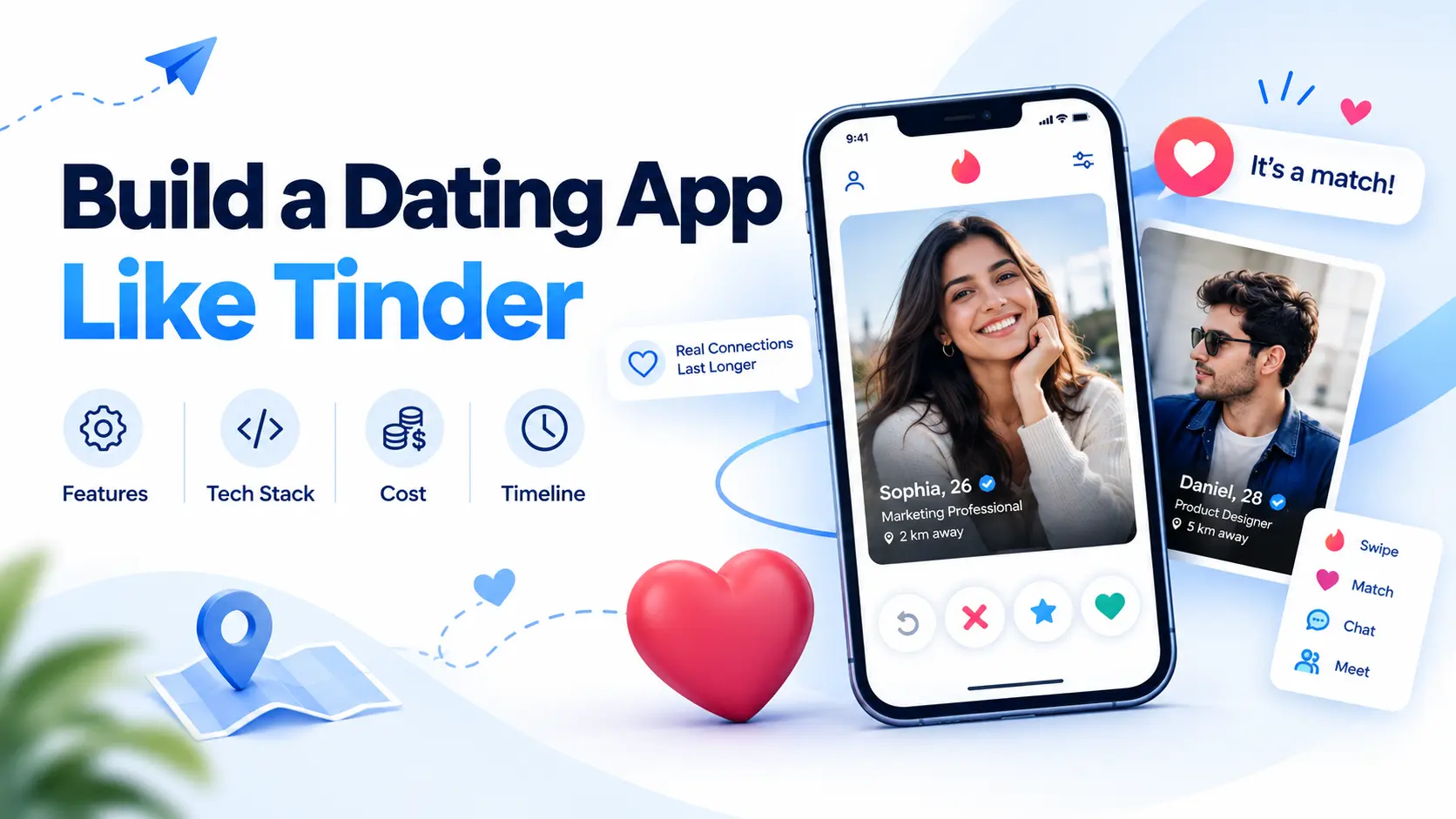
Let’s start with the features you require to develop a dating app like Tinder.
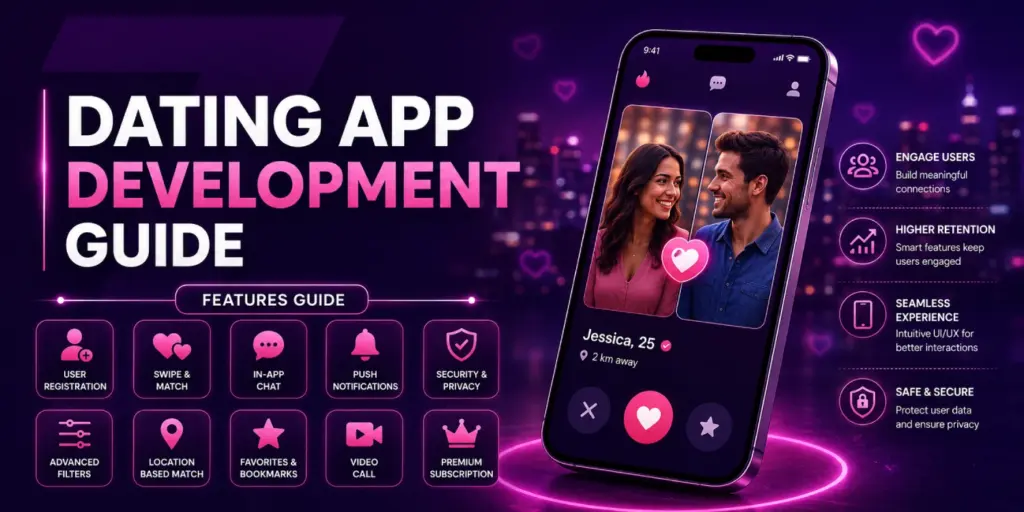
What Features Do You Need to Build a Dating App Like Tinder?
Copying Tinder’s screens is the easy part. What is harder, and what most Tinder clone app development projects get wrong, is building the mechanics underneath those screens well enough that people want to keep using the app.
Profile creation and onboarding
New users decide within the first two minutes whether an app is worth their time. Keep onboarding short: a photo and a short bio are enough to start. Preferences can come later, once the person is already inside the app. Phone number verification at signup helps too, mainly because it cuts down on fake accounts before they ever get created.
Location and matching
Every match starts with location. The app needs to work out roughly where a user is, then surface people nearby without giving away an exact address. Get the radius wrong, or make the location check too slow, and users notice immediately. A dating app development company can help you build such logic if they’ve already built something with similar logic roots.
The swipe itself
It sounds trivial, but the swipe is not. Animation lag of even half a second changes how the whole app feels. Building this properly, so it responds instantly no matter how many users are online at once, takes real engineering effort, not just a good-looking front end.
Real-time messaging
Two people match, then what? A chat window, obviously, but a good one needs to read receipts and image sharing, and it needs to load fast. Founders who develop a dating app for a younger Australian audience often add voice notes and GIFs here too, since text-only chat tends to fizzle out fast.
Safety and verification
This part is not optional, whatever the budget looks like. Reporting tools and blocking need to be in the first release, not bolted on after launch. Some form of identity check should be there too. Selfie verification, where a live photo is checked against the profile picture, has become close to standard across the category.
An admin dashboard
Someone has to review reports and manage subscriptions. Someone also needs to keep an eye on what is happening across the platform generally, and that person needs decent tools to do the job. A slow or clunky admin panel means moderation lags, and moderation lag is exactly how bad behaviour sticks around longer than it should.
Monetisation Channels
Most companies that build a dating app plan the money side before writing a line of code. Subscriptions and boosted visibility cover most of the revenue for apps in this category. Small purchases, like extra likes, sit on top as a secondary stream.
These features are the baseline for dating app development in 2026. A good dating app development company can advise you that video profiles and AI matching scores can wait until after launch, along with most other add-ons.
Planning a Tinder-Like Dating App?
From features and matchmaking to technology, development cost, and scalability, we can help you turn your dating app idea into a clear development plan.
What Is the Best Tech Stack for Building a Dating App?
The technology behind a dating app does not show up on screen, but it decides how the app performs once real users start swiping, matching, and messaging at the same time. Here is what a typical dating app development company is working with:
Frontend
- React Native
- Flutter
Backend
- Node.js
- Django
- Ruby on Rails
Database
- PostgreSQL
- MongoDB
- Firebase
Real-time Messaging
- Socket.io
- Firebase Cloud Messaging
Geolocation Features
- Google Maps API
- Mapbox
Cloud Hosting
- AWS
- GCP
- Azure
Payment Gateway
- Stripe
None of these tools are fixed rules. A dating app development company will usually adjust the stack based on budget, expected user volume, and the specific features a client wants at launch.
How to Develop a Dating App Like Tinder?
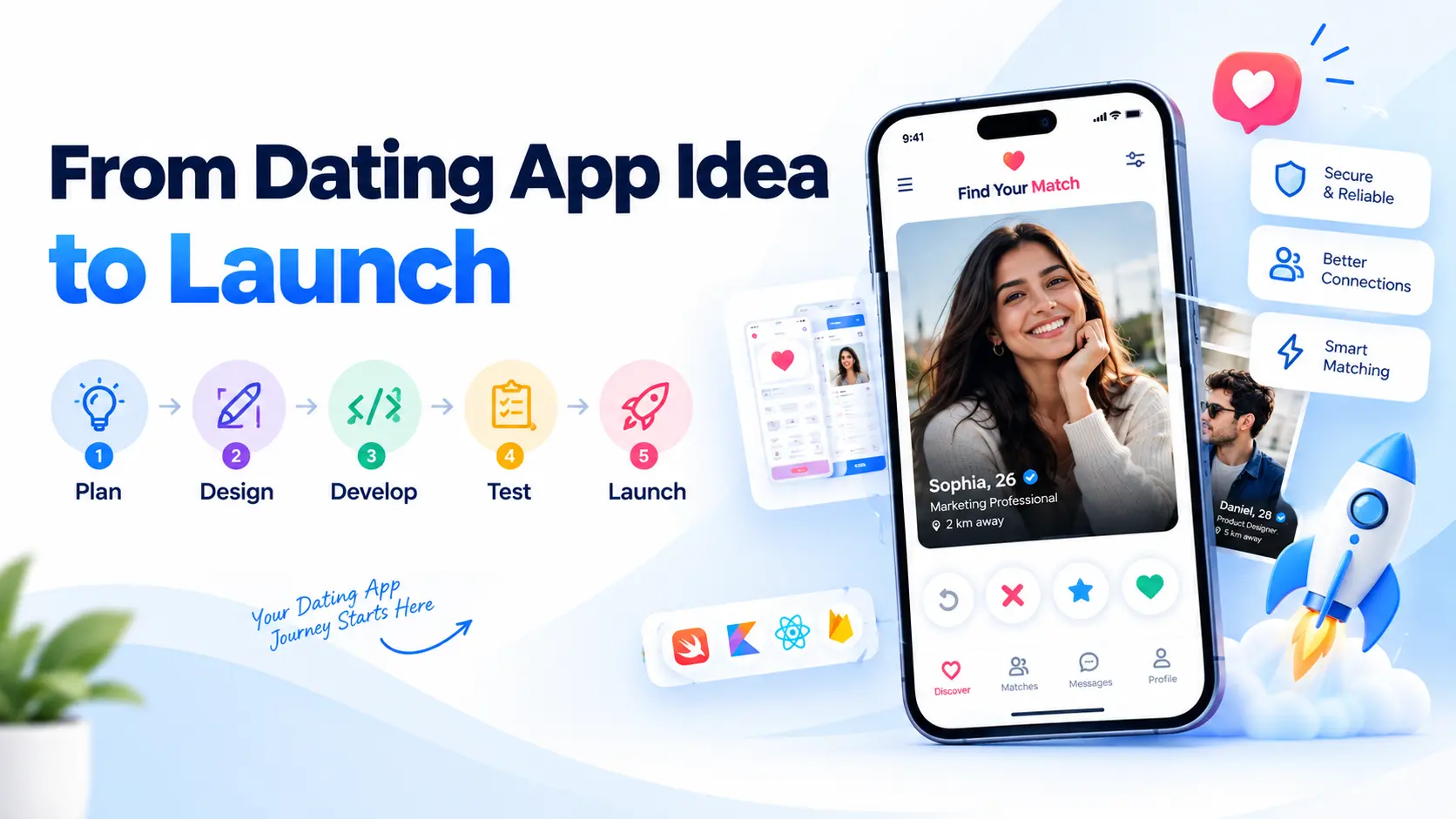
Founders often assume dating app development starts with design. Well, it does not. It starts with defining exactly who the app is for, because a dating app built for professionals in their thirties needs different features than one aimed at university students.
Market research and positioning
Before anyone writes code, dating app developers need to know what makes this app different from Tinder itself. Without a clear answer, the app has no reason to exist in an already crowded market.
Wireframes and UI design
Screens get mapped out next, usually starting with the profile setup flow and the swipe screen, since these are what a new user sees first. A rough prototype at this stage saves far more money than fixing design mistakes after development has already started.
Choosing the tech stack
This is where the decisions covered above get finalised, based on the app’s expected scale and the client’s budget. A dating app development company typically uses a similar tech stack, but the final choice depends upon the project scope and the development team’s capabilities.
Building the MVP
Most Australian companies that build a dating app start with a minimum viable product rather than every feature at once. Core matching, messaging, and basic profiles go in first. Everything else can wait.
Testing
Bugs in a dating app are not just inconvenient; they cost trust fast. QA testing covers matching accuracy, message delivery, and how the app behaves under load, before a single real user ever opens it. A reliable dating app development company invests a good amount of time and effort in testing so that problems do not show up in production.
Launch and iteration
Once the app goes live, dating app development does not stop. User behaviour after launch usually reveals gaps that no amount of planning would have caught, and teams that want to build your own dating app successfully tend to treat the first few months after release as part of the build, not the end of it.
What Are the Biggest Challenges in Dating App Development?
Every dating app faces the same handful of problems eventually, no matter how polished the pitch deck looked at the start.
Matching quality
It sits near the top of the list. A swipe interface is easy to build. Getting the actual matches right is not. Basic algorithms match people on surface details, age, distance, maybe shared interests typed into a bio. AI-Matchmaking goes further, learning from swipe patterns and message behaviour over time, though building it properly takes real data science work, not just a checkbox labelled “smart matching” in a features list.
Fake profiles
Fake profiles are the next headache, and they never fully go away. Bots, catfish accounts, people running scams through stolen photos. Photo verification and phone number checks cut the volume down, but nothing eliminates it entirely, and any team that promises otherwise is not being honest.
Content moderation
Moderation follows straight from that problem. Someone has to review reports, and it has to happen fast, because a user who gets harassed and waits three days for a response simply leaves. Automated filters catch the obvious cases. Human review still handles the messy ones that automation gets wrong.
Scalability
Scalability catches teams off guard more often than it should. An app that runs fine with five thousand users can buckle at fifty thousand, particularly around real-time chat and location queries, which behave very differently once the load actually shows up.
Privacy
Privacy carries its own weight, especially under Australian data laws. Location history, photos, message logs. All of it is sensitive, and a breach here does more damage to a dating app than to almost any other category of software, given how personal the data actually is.
Retention
Retention might be the hardest problem of them all, mostly because it is a strange goal to design for. Success, in a sense, means a user finds someone and leaves. Apps that hold attention long term usually lean on features that keep single users engaged even between matches, not just louder push notifications.
None of this is simple to execute well, and that is exactly why technical complexity runs through every one of these challenges at once, rather than sitting off to the side as a separate item on the list.
How Much Does It Cost to Build a Dating App Like Tinder in Australia?
In Australia, you can expect anywhere from AUD 25,000 to over AUD 150,000. The price strictly depends on the app’s scope, feature complexity, and the location of dating app developers. The table below gives a general sense of what founders in Australia typically pay at each level of complexity.
| App Type | Core Features | Estimated Cost (AUD) | Typical Timeline |
| Basic MVP | Profile setup, swipe and match, basic chat | $25,000 to $45,000 | 3 to 4 months |
| Mid-range app | MVP features plus geolocation filters, push notifications, in-app purchases | $45,000 to $80,000 | 4 to 6 months |
| Advanced Tinder-style app | Mid-range features plus video profiles, AI matching, advanced safety and verification tools | $80,000 to $150,000+ | 8 -12 months |
These figures cover design and development only. They do not include ongoing hosting, third-party API fees, or maintenance, which are addressed later in this guide. They also assume work through an Australian dating app development company; offshore teams can bring the number down, though usually at the cost of communication speed and code quality.
What Factors Affect Dating App Development Costs?
Two apps with an identical feature list can still end up with very different price tags. The gap usually comes down to a handful of decisions made early in the dating app development process.
Platform choice
Building for iOS and Android separately, using native code for each, costs more than a single cross-platform build. Most founders choose a cross-platform Flutter app development approach now, mainly to keep the budget manageable without giving up much in performance.
Feature complexity
A basic swipe function is cheap to build. AI-based matching, video calling, or facial recognition for verification are not, and each one adds real weeks to the timeline. An AI app development company can build a well-equipped dating app with robust AI & ML implementations.
Also Read: The Guide to AI Dating App Pricing for 2026
Design requirements
A template-based UI is faster and cheaper. A fully custom interface, with original animations and a distinct visual identity, takes longer and costs more, though it also tends to hold user attention better once the app is live.
Backend architecture
An app built to handle a few thousand users needs less infrastructure than one built to scale into the millions from day one. Tinder clone app development projects aimed at rapid growth often over-invest in backend scalability before they have proven demand, which is not always money well spent.
Also Read: How much does it cost to build a Tinder Clone Dating App?
Third-party integrations
Payment gateways, SMS verification, and mapping APIs all come with their own fees, and some charge per user or per transaction. These costs are small individually but add up once the app gains real traction.
Team location
An Australian dating app development company generally charges more per hour than teams based in India or Eastern Europe. The trade-off is usually communication, time zone alignment, and a lower risk of quality issues later in the project.
Post-launch support
Dating app development rarely ends at launch. Bug fixes, security patches, and feature updates all cost money on an ongoing basis, and founders who leave this out of the initial budget are often surprised by it within the first year.
How Long Does It Take to Build a Dating App Like Tinder?
Ask ten agencies this question, and you will get ten slightly different answers, but the pattern underneath them is fairly consistent. Scope decides the clock, in the same way it decides the budget.
| App Type | Development Scope | Estimated Timeline |
| Basic MVP | Profiles, swipe and match, basic messaging | 3 to 4 months |
| Mid-range dating app | MVP features plus geolocation, notifications, in-app purchases | 4 to 6 months |
| Advanced Tinder-style app | Full feature set including AI matching, video profiles, advanced safety tools | 8 to 12+ months |
Before any of that clock even starts running, there is planning. Then there is a phase in the dating app development process called discovery and requirement gathering, which can take up to 1 – 3 weeks on average. Dating app developers often find this part gets squeezed more often than it should. Founders trying to develop a dating app on a tight deadline should treat that testing window as fixed.
How Can You Monetise a Dating App Like Tinder?
Dating apps like Tinder, Bumble and Hinge often make money through channels such as:
Subscriptions
Subscriptions carry most of the weight for apps in this category. Tinder Plus and Tinder Gold made the model familiar to nearly everyone. Users pay monthly, get more swipes, see who liked them first, that kind of thing. It works because the value is obvious the moment someone opens their wallet.
In-app purchases
Smaller purchases sit alongside that. Boosts push a profile higher up the stack for a short window, usually thirty minutes, and people buy them right when they are motivated to be seen. Super Likes do something similar on a smaller scale, letting one profile stand out from a pile of ordinary swipes.
Advertisements
Ads work too, though carefully. Free users can be shown ads between swipes, but overdo it and those same users just delete the app instead of upgrading. There is a line, and it is easy to cross without noticing.
Verification Badges
A few platforms now charge for a verification badge on top of standard checks. Not huge money on its own. Still, it adds up, and it gives paying users something visible to show for the fee.
A mobile app development company in Melbourne that builds such apps successfully rarely bets everything on one of these. A mix, usually subscriptions plus one or two smaller add-ons, tends to outperform any single model on its own. That is worth deciding before the first wireframe gets drawn, not after the app is already live and the revenue numbers look thin.
How to Choose a Dating App Development Company?
This decision probably matters more than any single feature on the list above it. So, you have to follow certain steps while selecting a dating app development company.
Explore Relevant Portfolio
Start with the portfolio, and be specific about it. Not just any dating app the company has shipped, but one with real complexity behind it. A Tinder app developer who has built live chat at scale understands problems that never show up in a portfolio full of static, feature-light apps.
Tech Stack
Ask about the tech stack directly, and pay attention to how the answer lands. Dating app developers who know what they are doing explain their choices in plain terms. Vague answers, or ones buried in jargon, usually mean the company is hoping you will not ask a follow-up question.
Security
Security deserves its own conversation. A dating app holds photos, location history, sometimes payment details. A dating mobile app development company worth hiring should be able to talk through encryption and Australian privacy compliance without stumbling.
Communication Process
Watch how they communicate before the contract is even signed. Slow replies during a sales pitch rarely speed up once money has changed hands. Weekly check-ins and one clear point of contact matter more than most founders expect when walking in.
Pricing
Finally, weigh price against scope, not price on its own. The lowest quote in the pile is rarely the safest one. Somewhere, that gap gets made up, whether through thinner code, weaker security, or support that disappears the moment the invoice is paid.
Get this choice right, and the rest of the project tends to go smoothly.
Wrapping Up
Building a dating app like Tinder is not an easy task. It requires careful planning and execution with real data availability from day one. In this blog today, we provided you with all the necessary information you require to make informed and data-driven decisions in this domain.
If you have an idea for a dating app and want to know whether it holds up, talk to a reliable dating app development company. 7 Pillars has built dating apps like Weived that handle real-time matching, live chat, and payments at scale, and we can tell you what your idea will take in time, in cost, and in effort, before you commit a single dollar to development.
Ready to Build Your Dating App?
Whether you're starting with an MVP or planning a full-scale Tinder-like platform, 7Pillars can help with product strategy, UI/UX, integrations, and ongoing support.
Frequently Asked Questions
How much does it cost to build a dating app like Tinder?
The cost depends on features, platforms, UI/UX, matching technology, integrations, and scalability. A dating app development company can provide a more accurate estimate after defining the product scope.
How long does it take to build a dating app like Tinder?
A dating app can take 3 months to over a year to develop, depending on its features, platforms, integrations, and complexity. An MVP generally takes less time than a full-scale Tinder-like app.
What features are needed to develop a dating app like Tinder?
Core features include user profiles, swipe-based discovery, matching, real-time chat, location-based recommendations, verification, notifications, and an admin dashboard. Advanced apps can also include AI-powered matchmaking and premium features.
What technology is used for Tinder clone app development?
Tinder clone app development can use technologies such as React Native or Flutter for mobile apps, Node.js or Python for backend development, databases such as PostgreSQL or MongoDB, and cloud platforms such as AWS or Google Cloud.
How do I choose the right dating app development company?
Look for dating app developers with experience in mobile development, backend architecture, matchmaking, security, scalability, and post-launch support. Review their relevant portfolio, development process, communication, and ownership terms before choosing a partner.

Sundeep Mann

Get in touch
We'd love to hear from you.




 +61 42 108-3277

 contact@7pillars.com.au
 Stay Inspired with our