







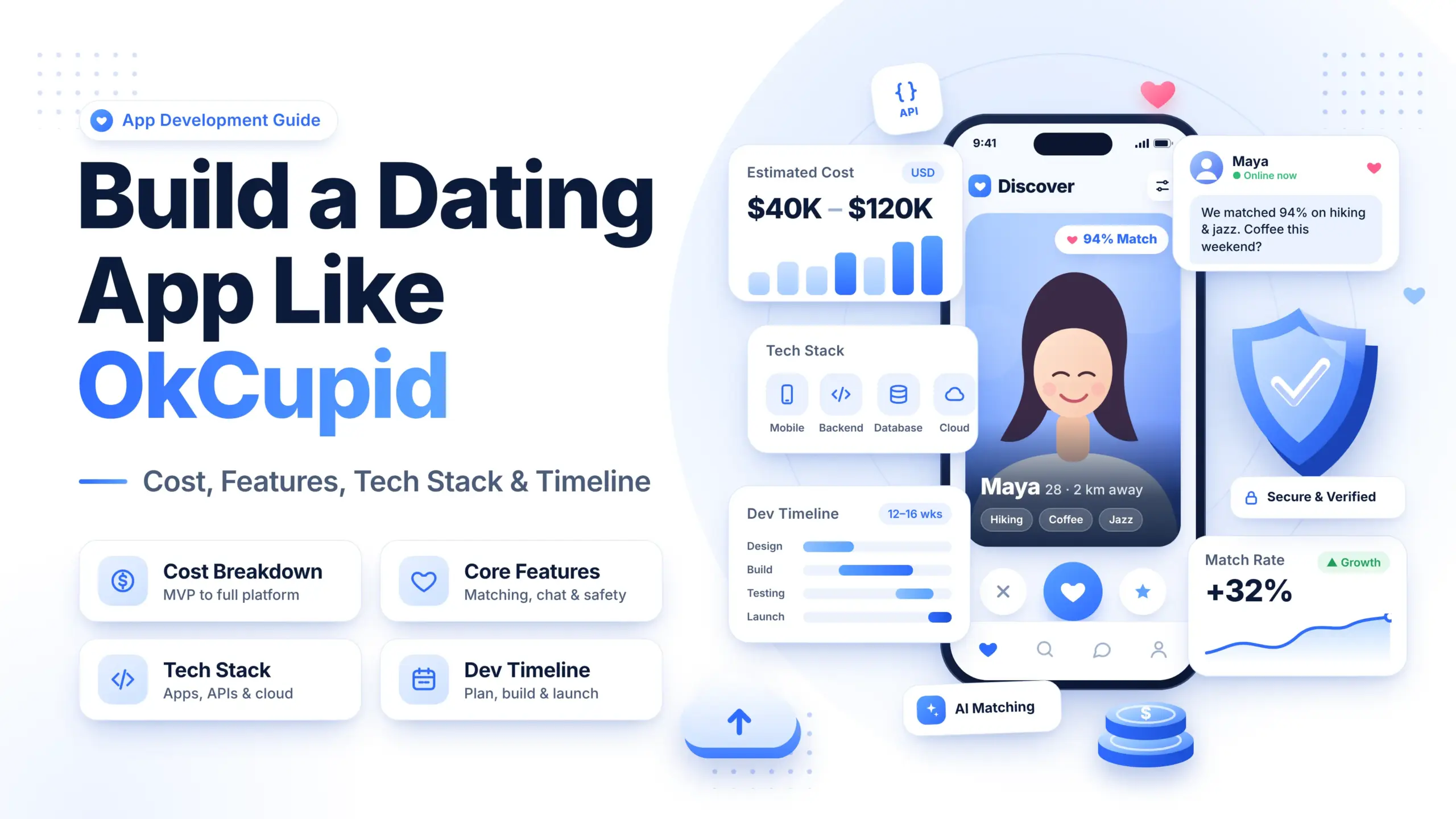



📌 Key Takeaways
- A basic dating app can cost around AUD 15,000 – 40,000, while a more advanced platform can move beyond AUD 300,000, depending on features, AI, platforms and integrations.
- An OkCupid-style app needs more than profiles and chat. Its core value comes from question-based matching, compatibility scoring and personalised recommendations.
- A dating app development company needs to design privacy, age-gating, verification, reporting and moderation into the product from the beginning.
- A practical MVP should focus on profiles, compatibility questions, matching, chat, reporting and an admin panel before adding advanced AI or video features.
- Australian launches need to consider the Privacy Act and Australian Privacy Principles, online safety expectations, app-store policies and the handling of sensitive user information.
- The right architecture should support real-time communication, matching, location, notifications, payments and future AI features without rebuilding the platform later.
OkCupid is known for building its matching experience around questions and compatibility rather than relying only on photos, location and swiping.
Users can answer questions about interests, values, preferences and other personal topics. Those answers can then contribute to compatibility calculations and recommendations.
That makes an app like OkCupid an interesting development project because the main technical challenge is not simply creating another dating interface. The product needs a matching system that can turn user-provided information into useful recommendations.
For a business planning to develop a dating app, this changes the development priorities.
The product needs:
- Detailed user profiles
- Compatibility questions
- Matching rules and scoring
- Personalised recommendations
- Search and discovery
- Real-time messaging
- Profile and identity verification
- Reporting and blocking
- Moderation tools
- Push notifications
- Subscription or payment functionality
- Analytics and an admin dashboard
A dating app development company should therefore start with the matching model and safety architecture, not just the visual design.
Why Build a Dating App Like OkCupid in Australia?
The stronger approach is to take the underlying product model, including compatibility-driven matching and build it around a specific audience, market or relationship problem.
For example, your product could focus on:
- Professionals looking for long-term relationships
- A particular city or region
- Specific interests or communities
- Relationship compatibility rather than casual matching
- Niche dating communities
- AI-assisted compatibility
- More transparent matching recommendations
This is where a dating app development company can help turn a broad idea into a defined product.
The goal of dating app developers should be to answer one question before development: Why would someone use this app instead of an established dating platform? That answer should influence the matching model, onboarding flow, monetisation strategy, and MVP.
How to Develop a Dating App Like OkCupid?
To develop a dating app like OkCupid, you need to follow a practical development process that looks like this:
1. Define the Audience and Positioning
Decide who the app is for and what problem it solves.
2. Design the Matching Model
Define the questions, compatibility rules, filters and recommendation logic before development begins.
3. Plan the MVP
Separate essential functionality from features that can be introduced later.
4. Design the UX
Map onboarding, profile creation, questions, discovery, matching, chat and safety flows.
5. Build the Backend
Create APIs, authentication, databases, matching services, messaging infrastructure and admin tools.
6. Develop the Mobile Applications
Start iOS and Android app development experience using native or cross-platform architecture.
7. Integrate Verification, Payments and Other APIs
Add identity services, payments, maps, notifications, analytics and communication APIs as required.
8. Test Security and Safety
Test authentication, APIs, matching, chat, reporting, moderation and abuse scenarios.
9. Prepare for App Store Submission
Apple and Google both have policies that affect user-generated content, safety, payments, privacy and age-related functionality.
10. Launch, Monitor and Improve
The first release is not the end of dating app development.
Use real product data to understand:
- Which matches lead to conversations
- Where users leave onboarding
- Which filters are used
- Which reports are increasing
- Which features drive subscriptions
- Where the matching model needs improvement
A typical dating app development company follows these steps to develop a reliable matchmaking app like OkCupid.
How Much Does It Cost to Develop a Dating App Like OkCupid?
The dating app development cost depends heavily on how close the product is to a full compatibility platform.
For a basic dating app, the cost can be anywhere between AUD 15,000 – 40,000, while more complex builds can move considerably higher.
| App Type | Typical Scope | Indicative Cost (AUD) |
| Basic dating app MVP | Profiles, basic matching, chat, location | 15,000–40,000 |
| Mid-level dating app | Matching, subscriptions, notifications, admin panel | 40,000–150,000 |
| Advanced compatibility platform | Detailed matching, verification, richer UX, advanced backend | 150,000–280,000 |
| AI-powered dating platform | Advanced AI matchmaking, analytics, automation and integrations | 200,000–300,000+ |
These are indicative development ranges. The final dating app development cost depends on the exact scope, platforms, design complexity, integrations, AI requirements and development model.
blog_cta_1
For an OkCupid-style product, the matching system itself can become a major cost driver. A simple rules-based questionnaire is very different from a recommendation engine that learns from user behaviour.
What are the Factors that Drive Dating App Development Cost?
Several decisions can move the budget significantly. Have a look at the major cost drivers that can increase the load on your pocket.
Matching logic
Basic filters cost less than compatibility scoring, recommendation engines and behavioural learning.
Platform
Android and iOS app development both affect the amount of frontend development required.
Verification
Photo verification, identity checks and other verification workflows add third-party services and development effort.
Chat and communication
Real-time messaging, voice calls and video calls require additional backend infrastructure and APIs.
Moderation
Reporting, blocking, content review and automated detection need both product functionality and operational processes.
AI
When an AI app development company integrates a dating app with AI matchmaking, fraud detection, recommendation systems and personalised experiences, the cost increases significantly.
Admin tools
A serious dating platform needs more than a user-facing app. Administrators need dashboards for reports, users, moderation, analytics and platform management.
Third-party services
Payments, maps, SMS, authentication, verification and communication APIs can introduce both development and recurring usage costs.
For a deeper breakdown of AI-related expenses, link to AI dating app pricing guide here.
What Should an OkCupid-Style MVP Include?
A common mistake is trying to build the entire platform before validating whether people actually want the product. A better MVP focuses on the core compatibility loop that dating app developers have to focus on. It is basically the user journey in simple terms.
Sign up
↓
Build profile
↓
Answer questions
↓
Receive compatibility-based recommendations
↓
Match
↓
Chat
↓
Report/block when necessary
To support that journey, the MVP can include:
- Account registration and login
- User profiles
- Profile photos
- Compatibility questionnaire
- Matching percentage or compatibility score
- Basic search and filters
- Like/match functionality
- Real-time chat
- Push notifications
- Report and block
- Basic profile verification
- Admin dashboard
- Basic analytics
Advanced AI matchmaking, video calls, sophisticated gamification and complex recommendation systems can be phased in after the initial product has real user behaviour data.
This approach can keep the initial dating app development cost closer to the lower end of the available range while giving the business room to validate its idea.
What Features Do You Need to Build a Dating App Like OkCupid?
Dating apps like OkCupid are equipped with a lot of features. These features aim to provide users with an enhanced experience with worthwhile matchmaking capabilities. Let’s have a look:
Compatibility-Based Matching
This is the feature that gives an OkCupid-style platform its identity. Instead of matching users only through age, location and appearance, the platform can compare answers across selected questions and calculate compatibility.
A rules-based scoring model can be enough for an MVP. More advanced recommendation models can then use behavioural data to improve recommendations over time.
Detailed User Profiles
Profiles should give the matching system enough useful information without forcing users through an unnecessarily long onboarding process.
Depending on the product, this could include:
- Photos
- Bio
- Interests
- Relationship preferences
- Lifestyle information
- Values
- Location
- Compatibility questions
- Deal-breakers
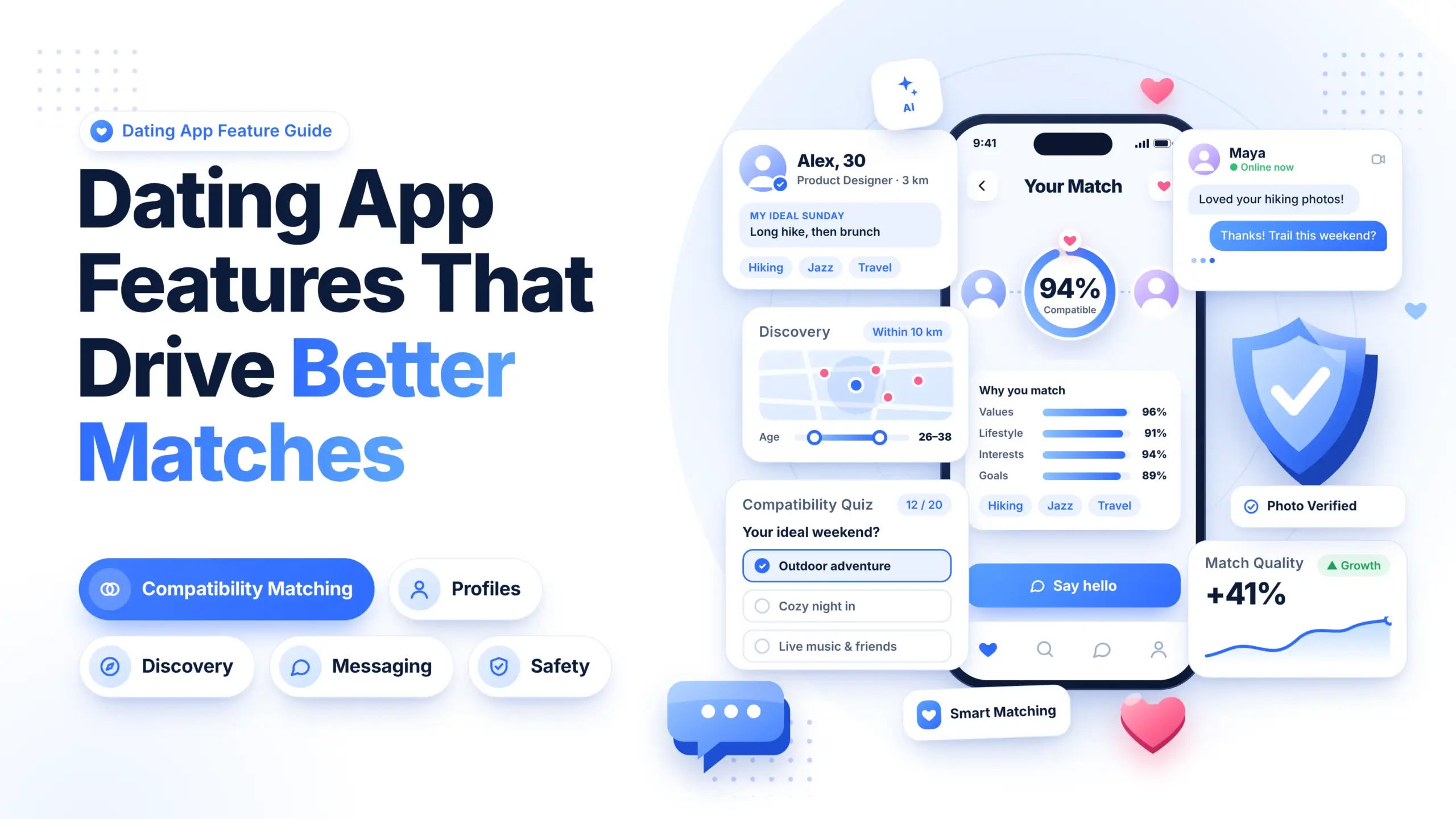
Search and Discovery
Users need control over who they discover.
Common filters include:
- Age range
- Location
- Relationship preference
- Interests
- Lifestyle
- Compatibility score
The more filters and ranking logic you introduce, the more complex the backend becomes.
Messaging
Real-time chat is central to the dating experience.
The backend should support:
- Match-based conversations
- Message delivery
- Read status
- Push notifications
- Blocking
- Reporting
- Media sharing where required
Similar to social networking app development, the dating app should have all the features to thrive in the market.
Verification and Identity Checks
Dating platforms need mechanisms to reduce fake accounts and increase user confidence.
Depending on the risk model, verification can include:
- Email or phone verification
- Photo verification
- Identity verification
- Liveness checks
- Suspicious-account detection
- Device or behaviour signals
Verification should be designed alongside privacy requirements rather than added at the end.
Reporting, Blocking and Moderation
Safety functionality should not be treated as a secondary feature.
Users should be able to:
- Report profiles
- Report messages
- Block users
- Mute users
- Flag inappropriate content
- Request support
Administrators need corresponding tools to investigate reports, restrict accounts and manage moderation workflows.
What Australian Privacy and Safety Requirements Should a Dating App Consider?
A dating platform can collect highly personal information, including relationship preferences, photographs, location, identity information and potentially sensitive information. That makes privacy architecture part of the product itself.
Under the Australian Privacy Principles, dating app developers need to consider why information is being collected, whether collection is reasonably necessary, how individuals are notified, how information is used or disclosed and how it is protected. The OAIC’s current APP guidance also emphasises data minimisation when collecting personal information.
For an Australian dating app development company, this means the development plan should cover:
- Privacy notices and consent
- Data minimisation
- Secure storage
- Access controls
- Data retention
- Third-party data processors
- Overseas data transfers where relevant
- User access and correction mechanisms
- Breach response processes
Age Restrictions and Age-Gating
Age controls should exist from the beginning of the product design. eSafety’s online-dating guidance frames dating-app use around adults aged 18 and over. At the same time, Australia’s social-media minimum-age rules should not simply be described as applying to every dating service; their scope depends on which platforms are covered by the legislation.
There is also a separate app-store consideration that the dating app development company has to consider: Google Play currently requires apps whose core functionality is dating or matchmaking to use its tools to block minors.
For an Australian dating app, the safer product approach is therefore to design a robust age-gating and age-verification flow, rather than relying on a simple date-of-birth checkbox.
The exact verification method should depend on the product, risk profile, legal advice and platform requirements.
Online Safety and User Protection
A dating platform should have safety controls covering:
- Reporting
- Blocking
- Moderation
- Abuse escalation
- Fake-profile detection
- Scam detection
- Image-based abuse reporting
- Suspicious behaviour detection
- Support workflows
eSafety’s online-dating guidance specifically highlights risks such as dishonest identities, abuse and image-based abuse, and points to reporting and blocking mechanisms as important safety tools.
What Security Architecture Does a Dating App Need?
Dating apps are attractive targets because they combine personal profiles, private conversations, location data, authentication credentials and payment information. Security therefore needs to be built across the application, API and backend.
A dating app development company should consider:
- Secure authentication
- Role-based access control
- Encryption in transit and at rest
- Secure API authentication
- Input validation
- Rate limiting
- Secure session management
- Protection against account takeover
- Secure storage of tokens and credentials
- Dependency and SDK security
- Logging and monitoring
- Regular security testing
OWASP’s Mobile Application Security Verification Standard covers areas including storage, cryptography, authentication, network communication, platform interaction, code quality, resilience and privacy.
What Is the Best Tech Stack for Building a Dating App?
The best tech stack for building a dating app depends on the product’s scale, real-time requirements, development team and future roadmap.
A typical architecture could include:
| Layer | Possible Technologies |
| Mobile app | React Native / Flutter / Native iOS & Android |
| Backend | Node.js / Laravel |
| Database | MySQL / MongoDB |
| Real-time communication | WebSockets / Firebase |
| Cloud | AWS / GCP |
| Payments | Stripe or equivalent |
| Maps | Google Maps APIs |
| Communication | Twilio or equivalent |
| AI/ML | Python-based services and ML frameworks |
| Analytics | Product and cloud analytics platforms |
For a product that needs both iOS and Android while keeping the first build efficient, cross-platform app development can be considered. For a large organisation with more complex internal systems, this is also where enterprise app development company expertise can become relevant.
How Long Does It Take to Build a Dating App?
Development time depends on the scope. A basic MVP at roughly 14 -16 weeks, a mid-level application at 5 – 8 months, and a full-featured platform with AI, video and analytics at around 9 –12 months or more.
| Build Type | Typical Timeline |
| Basic MVP | 14–16 weeks |
| Mid-level app | 5–8 months |
| Advanced platform | 9–12+ months |
An OkCupid-style platform can move toward the longer end when it includes detailed compatibility logic, advanced verification, real-time communication, moderation systems, analytics and AI. So when asking how long does it take to build a dating app, the better question is: What exactly are you building in version one?
How to Monetise a Dating App Like OkCupid?
A dating platform can combine several revenue models. Here are the common channels you can consider to make one.
Subscription Plans
Users can pay for premium features such as:
- Advanced filters
- More visibility
- Unlimited likes
- Compatibility insights
- Premium recommendations
- Profile boosts
In-App Purchases
Users can purchase individual features or credits rather than subscribing.
Freemium Model
The basic matching experience remains free while advanced features sit behind a premium plan.
Advertising
Advertising can generate revenue, although it needs to be balanced carefully against privacy, user experience and the expectations of the platform’s audience.
For subscription-based products, store policies also matter. Apple requires in-app purchases for unlocking digital features and functionality in many cases, so the payment architecture should be planned alongside app-store compliance.
What Should You Look for in a Dating App Development Company?
Choosing a dating mobile app development company is about more than finding developers who can build mobile screens.
Look for experience across:
- Matching systems
- Real-time chat
- User-generated content
- Verification
- Moderation
- Privacy
- Payments
- AI/ML
- Cloud infrastructure
- App-store submission
- Post-launch support
The team should also be able to explain why a feature belongs in the MVP. If the product is intended to operate as a broader subscription platform, SaaS app development can also be relevant to the architecture and commercial model.
Why Work With 7 Pillars to Build Your Dating App?
7 Pillars positions its dating app development services around custom dating platforms, AI-powered matchmaking, real-time chat, verification, geolocation, analytics and scalable backend infrastructure. The focus should be on taking the product principles that make compatibility-based dating useful and adapting them to your audience, business model and market.
For an Australian product, the development plan should account for privacy obligations, age-gating, app-store requirements, verification, moderation and security from the beginning.
The practical route is to start with an MVP built around the core compatibility experience, validate how users interact with it, and then expand into AI matchmaking, richer recommendations, video, advanced verification and other features.
The right dating app development company can help you make those decisions before they become expensive development problems.
blog_cta_2
Frequently Asked Questions
How much does it cost to build a dating app like OkCupid?
A basic dating app can cost around AUD 15,000–40,000, while a more advanced compatibility or AI-powered platform can cost AUD 150,000–300,000+ depending on features, platforms, integrations and complexity.
How long does it take to build a dating app?
A basic MVP can take around 14–16 weeks. A mid-level app may take 5–8 months, while an advanced platform with AI, video and analytics can take 9–12 months or more.
What makes an OkCupid-style dating app different?
Its core differentiator is compatibility-based matching. Instead of relying only on photos, location and basic filters, users answer questions that can contribute to compatibility scoring and personalised recommendations.
What features should a dating app MVP have?
A practical MVP should include registration, profiles, compatibility questions, matching, basic discovery, chat, notifications, reporting, blocking, verification and an admin dashboard.
Does a dating app need age verification in Australia?
A dating app should have robust age-gating, particularly because dating platforms need to prevent minors from accessing adult dating functionality. Google Play currently requires dating and matchmaking apps to use mechanisms that block minors. Australian legal and compliance requirements should also be reviewed for the specific service.
Can AI be added to a dating app?
Yes. AI can support matchmaking, recommendations, fraud detection, moderation, profile assistance and behavioural analysis. However, it does not need to be included at full scale in the first release.

Sundeep Mann

Get in touch
We'd love to hear from you.



 +61 42 108-3277

 contact@7pillars.com.au
 Stay Inspired with our