









📌 Key Takeaways
- Australia’s growing online grocery and dairy demand creates strong opportunities for milk delivery apps, especially subscription-based models.
- Essential features include flexible subscriptions, recurring deliveries, real-time tracking, route optimisation, payments, notifications, and admin dashboards.
- Milk delivery apps must address payment security, privacy, location protection, and food-safety/cold-chain compliance in Australia.
- Development costs can range from AUD $15,000 to $180,000+, with timelines typically spanning 8–28 weeks depending on complexity.
- Subscription fees, delivery charges, commissions, premium memberships, and add-on product sales offer multiple monetisation opportunities.
Milk is a necessity for almost every household in Australia. People want their milk delivered at the right time, in the right condition and at a predictable price. This simple requirement has created interesting opportunities for dairy businesses, local milk suppliers and entrepreneurs. However, building a milk delivery app is not as complex as it seems; the actual challenge is connecting customer ordering with inventory, recurring subscriptions, delivery routes, payments, and food-safety requirements.
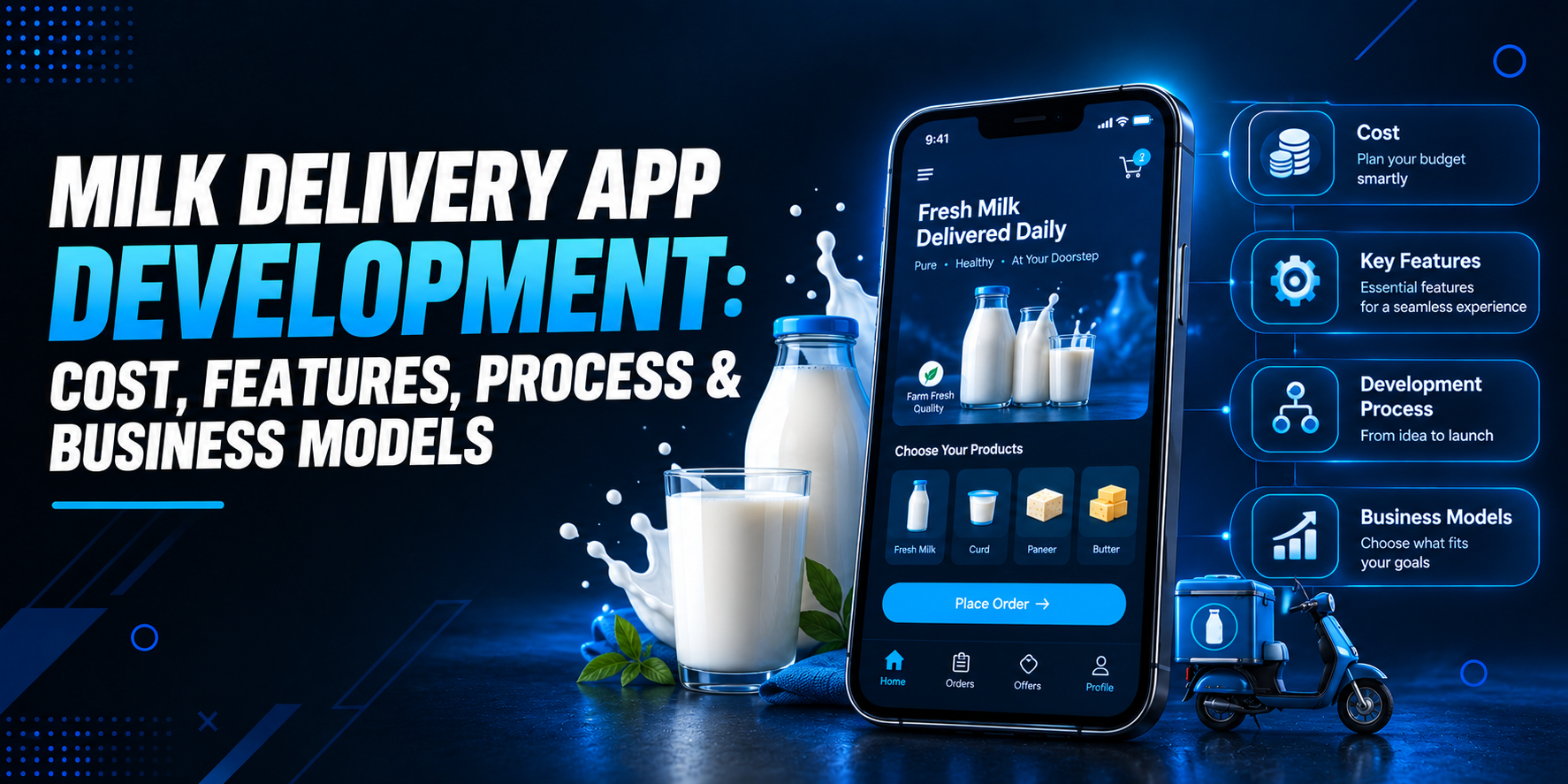
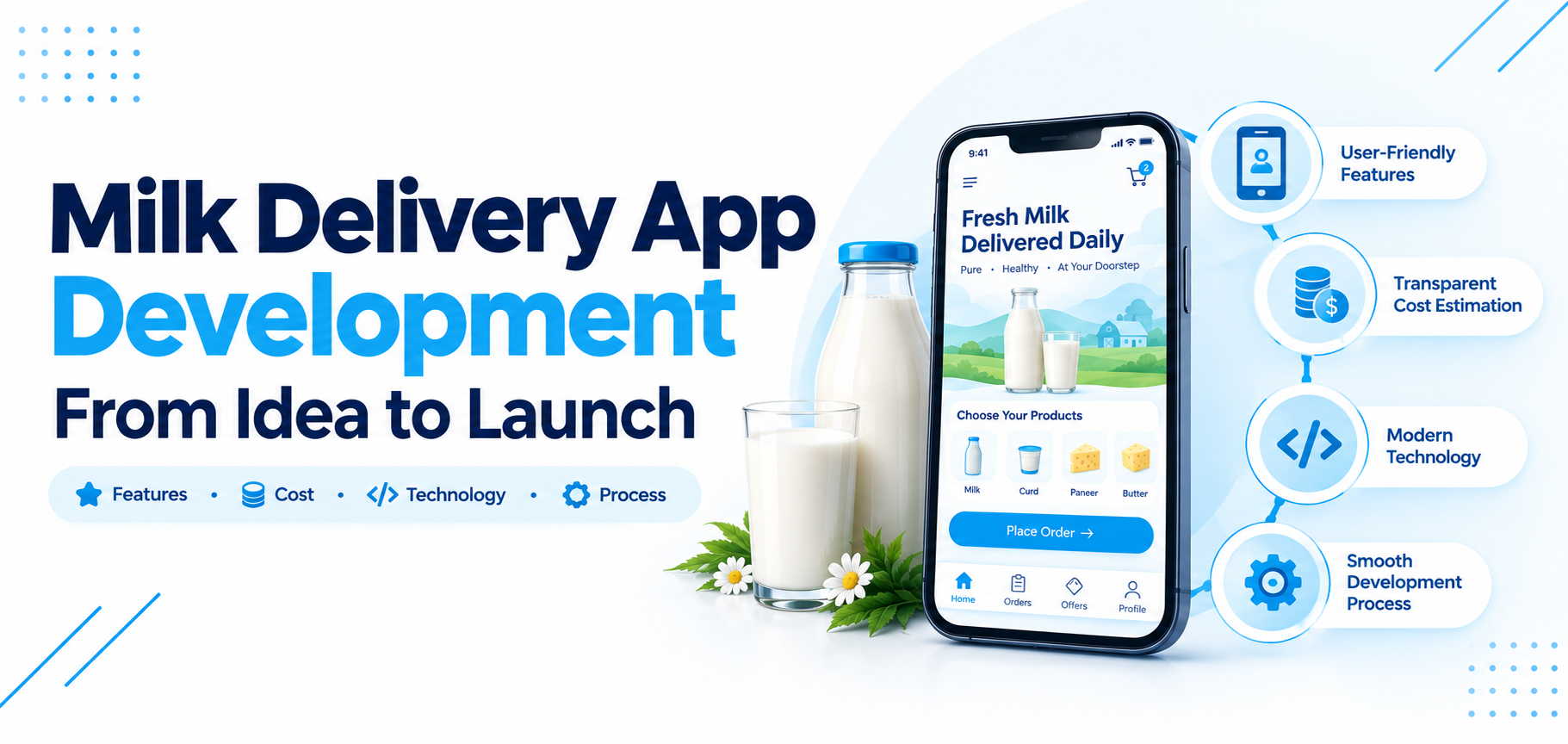
So, today we compiled this guide revolving around Milk Delivery App Development, which helps you to understand what it takes to build a milk delivery app like Milkrun in Australia. We will cover what’s happening in the Australian market right now, the different app models you could build, the essential features it requires, what the process and cost look like, and how to pick the right development partner for it.
Let’s start with what is happening in the Australian Milk Delivery Market right now and what trends and opportunities it creates.
What are the Market Trends and Opportunities in Australia for Milk Delivery App Development?
Australia has a strong culture of grocery purchasing and home delivery, which creates a natural environment for digitally enabled dairy delivery.
A report published by Food Standards Australia New Zealand (FSANZ), 58% of subjects had purchased food or drinks online with the help of various platforms during the days the research was conducted.
Moreover, in Australia, the average milk usage per person per year is 85 liters, as per Dairy Australia.
This combination shows an opportunity which carries a potential to make regular dairy purchases easier and more profitable.
Subscription-Based Milk Delivery
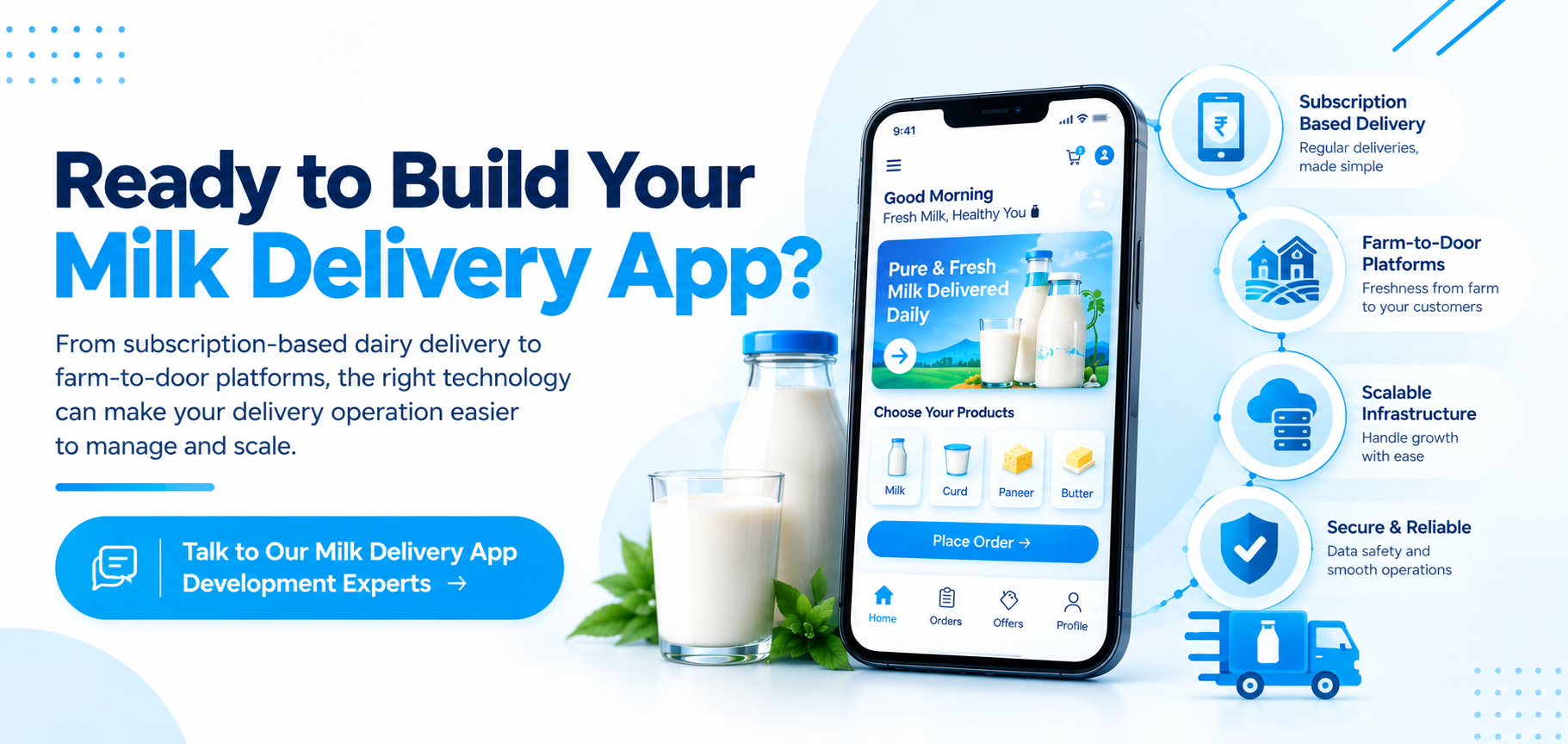
Milk is one of the best products for recurring purchases in the market for dairy delivery app development in Australia. Customers always know roughly how much they consume each week, making subscription-based delivery a logical model. Instead of remembering to order milk every few days, a customer could choose a plan such as:
1 (1000ml) bottle → Everyday of the Week → Morning Delivery
The app automatically generates the order according to the subscription schedule. This is the core opportunity behind dairy subscription app development. Businesses can create predictable recurring revenue while customers get a convenient routine.
Farm-to-Door Dairy Delivery
Consumers are also increasingly interested in where their food comes from. This creates an opportunity for farms and local producers to build direct relationships with customers. A farm-to-door delivery app development model could allow a dairy farm to sell milk, yoghurt, cream, butter and other products directly to households rather than relying entirely on conventional retail channels. The app could also communicate information about the farm, product origin, delivery areas, and available products.
Local and Specialty Dairy Products
Another opportunity lies in serving customers looking for products beyond standard supermarket milk. Depending on the business and applicable food regulations, an app could offer products such as organic dairy, lactose-free products, premium milk, yoghurt, cream, cheese and other locally produced items. The goal is not to compete with supermarkets based on prices; instead, it should be based on convenience, quality, local sourcing and direct customer relationships.
Digital Grocery Delivery Is Becoming Normal
The broader grocery market also supports this shift. ABS data recorded more than $1.4 billion in seasonally adjusted food online sales in April 2025. For dairy businesses, this means the question is increasingly less about whether customers are willing to buy food online and more about whether a specialised delivery experience can offer enough value to make them choose it.
What Are the Types of Milk Delivery Apps?
If you’re thinking of Milk delivery app development, you need to know the types of it including:
Aggregator milk delivery apps
Aggregator milk delivery apps connect multiple dairy suppliers or local stores to customers through one platform. These types of apps are faster to launch since you’re not managing supply yourself, but you’re also more dependent on the suppliers you’re aggregating.
Dedicated milk delivery apps
Dairy delivery app development in Australia is built around a single dairy brand or business controlling its own supply chain end to end. Milkrun is a good example of this model in Australia. It’s more work upfront, but you control quality, pricing, and the customer relationship completely.
FYI: The aggregator vs dedicated app decision really comes down to whether you’re trying to build a marketplace or a direct-to-consumer brand. Both are entirely different business models.
Subscription-based delivery apps
Dairy subscription app development focuses on recurring orders on a set schedule such as daily, every alternate day, or once a week. This tends to be the dominant model in this category since it matches how people actually consume milk.
On-demand delivery apps
Some businesses pursue on-demand delivery app development that lets customers order when they want it rather than committing to a schedule, closer to how companies undertake grocery delivery app development. Some businesses run both models side by side to cover customers who want either.
What Are the Essential Features Involved in Milk Delivery App Development?
There are several milk delivery app features essential to serve the purpose of the business model, such as:
Flexible subscription management
One of the most important milk delivery app features is its subscription handling. Customers need to pause, skip a day, change quantities, or cancel the order without friction. This single feature of dairy subscription app development has a bigger impact on retention than almost anything else on this list, since rigid subscriptions are the fastest way to lose a customer.
Scheduled and recurring delivery logic
The app needs to handle repeat orders automatically, adjusting for holidays, delivery cutoffs, and route timing without someone manually managing it on the backend every day.
Real-time order tracking
Customers want to know when their delivery’s actually arriving, especially for an early-morning delivery window most people are asleep for when it happens.
Route optimisation for delivery staff
On the operations side, smart routing keeps delivery costs down and turnaround times tight, which is more important than in a one-time food delivery app development since these routes repeat daily. Smart AI development services can help here in determining the best possible routes based on traffic, timing, and other conditions.
Multiple payment options, including recurring billing
Since most of the revenue here is subscription-based, the payment system needs to handle recurring charges without any hindrance. There should be a clean payment management interface with multiple payment options. Dairy subscription app development should handle such kinds of recurring payment streams.
Product customisation and add-ons
Beyond plain milk, most successful apps let customers add other dairy products or daily essentials to their regular delivery, which increases order value without adding a separate checkout flow.
Push notifications
Push notifications are essential for these apps because customers expect to know their delivery updates, subscription reminders and so on beforehand and prepare themselves for it.
Admin dashboards
On the business side, real-time visibility into subscriber numbers, delivery performance, and inventory levels is what lets a dairy business run this at scale. So, the app’s backend should be equipped with all the necessary functionalities to support internal management efficiently.
Security, Privacy, and Compliance Requirements for Milk Delivery App Development
In Australia, every app that deals with the personal information of people should follow certain guidelines governed by the authorities. Key considerations include:
Payment data needs proper handling
Given how much of this business runs on recurring billing, payment security isn’t optional. Routing transactions through a properly compliant payment gateway is the safer path rather than building custom billing infrastructure from scratch.
Customer data protection under Australian privacy law
Addresses, delivery preferences, and payment details all count as personal information under the Privacy Act 1988, and the Australian Privacy Principles show how that data gets collected, stored, and used from the very start of the process when the user signs up to your app.
Delivery address and location data security
Since this app knows exactly where someone lives and roughly when they’re not home to receive a delivery, that location data needs tighter access controls than a typical e-commerce app development might require.
Food safety and cold-chain compliance
This one’s specific to the dairy category; depending on how the business manages delivery, there may be food handling and cold-chain regulations to follow on the operational side.
What Is the Milk Delivery App Development Process?
In milk delivery app development, the goal is to build an app that serves the purpose it was actually built for.
Discovery and Requirements
The first stage defines the business model, target users, delivery areas, products, subscription rules, payment flow, and operational requirements. This is also where the team decides whether the product should be a dedicated dairy application, marketplace, farm-to-door platform, or subscription service.
Product Strategy and Architecture
The next step in Dairy delivery app development in Australia is turning those requirements into a technical plan. This includes deciding the application architecture, backend structure, database, APIs, third-party integrations, and administrative workflows.
UI/UX Design
The design should make recurring purchases almost effortless. A customer who buys the same milk every week should not have to navigate through ten screens to repeat the order.
The design process typically covers the customer app, driver interface, and admin dashboard.
Application Development
Developers then build the frontend, backend, APIs, database, and integrations. Depending on the scope, this may include payment gateways, maps, notifications, subscription billing and logistics integrations.
Testing
Once the app has been developed, it gets to the testing pipeline. The testing teams should test payment failures, cancelled subscriptions, unavailable inventory, incorrect addresses, delivery status changes, concurrent orders, authentication, API security, and different device conditions.
Launch and Continuous Improvement
Once the app is thoroughly staged and tested, the launch process begins. And once the app is launched, it becomes essential to look after its maintenance and support services if something goes wrong.
How Much Does a Milk Delivery App Development Cost?
The app development cost depends heavily on whether you’re building a simple ordering app or a full platform with a delivery-driver app and admin dashboard included. Here are the typical cost ranges for different app types:
| App Type | Complexity | Indicative Cost Range (AUD) |
| Basic Ordering App (customer-facing only) | Low-Medium | $15,000 – $45,000 |
| Subscription App with Driver/Delivery App | Medium-High | $50,000 – $90,000 |
| Full Platform (customer app, driver app, admin dashboard) | High | $90,000 – $150,000+ |
| Aggregator Marketplace Model | High | $100,000 – $180,000+ |
How much time does it take for Milk delivery app development?
Similar to the costs, the app development time also depends on some factors such as the app’s complexity, the size of the development team, etc. Here is a typical timeframe of milk delivery apps categorised by major app types.
| App Type | Complexity | Typical Timeframe |
| Basic Ordering App (customer-facing only) | Low-Medium | 8-12 weeks |
| Subscription App with Driver/Delivery App | Medium–High | 12-18 weeks |
| Full Platform (customer app, driver app, admin dashboard) | High | 18-26 weeks |
| Aggregator Marketplace Model | High | 20-28 weeks |
What is the Technology Stack for Milk Delivery App Development?
Development teams use a combination of programming languages, development frameworks, and third-party services like GPS to build and deploy applications. The tech stack for milk delivery app development involves:
Frontend
- React Native
- Flutter
Backend
- Node.js
- Laravel
- Python
Database
- PostgreSQL
- MySQL
- MongoDB
Cloud & Hosting
- AWS
- Google Cloud
- Microsoft Azure
Maps Integration
- Google Maps Platform
- Mapbox
- Apple Maps
Payments Integration
- Stripe
- Apple Pay
- Google Wallet
Notifications
- Firebase Cloud Messaging
- Apple Push Notification Service
AI/ML
- Python
- TensorFlow
- PyTorch
- OpenAI APIs
Authentication & Security
- OAuth 2.0
- OpenID Connect
- JWT
- HTTPS/TLS
If Android is a major part of the target market, businesses can also work with an Android app development company to build and optimise the Android version according to the requirements of the platform. The same consideration applies to iOS. If the target audience includes a significant number of Apple users, working with an iOS app development company with experience in iOS development can help ensure the application performs properly across supported devices.
What are the Monetisation Models for a Milk Delivery App?
There can be multiple monetisation models incorporated in milk delivery app development based on the type of app, such as:
Subscription-Based Model
This model is a natural fit for this category. Customers pay on a recurring schedule for regular deliveries, which matches how people buy milk in the first place.
Delivery Fee Model
Charging a flat or distance-based fee per delivery, either on top of subscriptions or as a standalone model for one-time orders.
Commission-Based Model (Aggregator Apps)
If you’re running an aggregator connecting multiple suppliers, taking a percentage of each transaction is the standard way to monetise without owning the supply chain yourself.
Premium Membership Tiers
Offering perks like free delivery, priority scheduling, or discounted rates for customers who commit to a longer subscription term.
Add-On Product Sales
Since most platforms let customers add extra dairy or grocery items to their regular delivery, this becomes a meaningful secondary revenue stream on top of the core subscription.
What Are Common Challenges in Milk Delivery App Development and How to Overcome Them?
Developing a Milk delivery app involves multiple challenges that need to be addressed promptly in order to sustain in the market for the long run.
Delivery Reliability Is Everything
People build their whole morning around milk showing up when it’s supposed to, so a missed or late delivery hits differently. Getting route planning right early, and being realistic about delivery windows instead of overpromising just to sound good in marketing, saves a lot of angry support tickets down the line.
Flexible Subscriptions Cut Both Ways
Everyone wants the option to skip a delivery when they’re travelling or just don’t need it that week, and they should have that option. But too much flexibility quietly eats into predictable revenue, which is the whole point of a subscription model in the first place. A middle ground, like needing a day’s notice before a skip, usually keeps both sides reasonably happy.
Freshness Isn’t Just a Marketing Word Here
Milk actually goes off if the cold chain breaks somewhere along the route, which isn’t something most delivery categories have to think about seriously. It’s less an app problem and more an operations one, but good route data and accurate timing at least give delivery staff what they need to keep things moving fast enough that it doesn’t become an issue.
Big Grocery Apps Are Always Going to Be There
Apps like Coles, Woolworths, and Milkrun deliver milk as part of a normal grocery order, so trying to beat them purely on convenience is a losing fight. The smarter approach is doubling down on things they genuinely don’t offer, like guaranteed farm-direct sourcing or a subscription that’s built around dairy and so on.
People Cancel Once the Novelty Wears Off
This happens more than most founders expect just a few months after the launch, the initial “this is so convenient” feeling fades, and people start questioning whether they still need it. Loyalty perks and personalisation can help here, but the biggest lever is just keeping the actual product consistently good, since no app feature saves a subscription if the milk itself isn’t great.
How to Choose a Milk Delivery App Development Company?
To choose a Milk Delivery App Development Company, you can consider several factors to end up with a worthwhile choice.
Ask If They’ve Ever Built Subscription Logic Before
A team can have a great-looking portfolio and still have never touched recurring billing or live route optimisation properly. Don’t assume yourself, ask them straight up whether they’ve built exactly that kind of logic flow within a project or not.
Look at Their Past Delivery or Subscription Work
It is not necessary that the development company has built something specifically for daily delivery. Any subscription or delivery-based app shows whether the team understands the patterns this kind of build depends on, like recurring orders and real-time tracking.
Is After Launch Support Included
Since so much depends on deliveries running smoothly and billing processing correctly day after day, it becomes critical to determine whether you get support services or not. Ask directly what post-launch support looks like and whether it’s included or billed separately.
Ask How They’d Handle You Growing Fast
If the business goes from one suburb to citywide in a year, does the app hold up, or does it need a rebuild? Worth asking this before signing your partnership; you can’t afford the mishaps if the app starts breaking when your operations start to scale.
Get Everything in Writing Before Starting
You get everything in writing before signing an agreement for Milk delivery app development. Pricing, timeline, and what happens if requirements shift halfway through the build should all be included in it. It’s the easiest way to avoid the kind of scope disagreements that turn a good working relationship sour halfway through a project.
If the response satisfies all these queries, you may end up making a good decision for a Milk delivery app development company that will be worthwhile for your investment.
Frequently Asked Questions
How much does it cost to develop a milk delivery app in Australia?
Milk delivery app development can cost anywhere from around $15,000 to $180,000+, depending on the business model, features, number of apps, integrations, and overall complexity.
How long does it take to develop a milk delivery app?
A basic milk delivery app can take around 8 – 12 weeks to develop, while a full platform with customer, driver and admin applications may take 18 – 26 weeks or more. The actual timeline depends on the features, integrations, design requirements, and development team.
What features should a milk delivery app have?
Essential milk delivery app features include:
- Product browsing
- One-time ordering
- Subscription management
- Recurring billing
- Delivery scheduling
- Order tracking
- Push notifications
- Route management
- Inventory management
- Admin dashboard.
The feature set should ultimately match the business’s delivery and subscription model.
Should I build an aggregator or dedicated milk delivery app?
It depends on your business model. A dedicated milk delivery app is better suited to a dairy business that controls its own products and delivery operations. An aggregator app connects multiple suppliers and can scale as a marketplace, but it requires additional functionality for supplier management, commissions, inventory, and order coordination.
Can I add subscription-based delivery to a milk delivery app?
Yes. Subscription functionality can allow customers to select products, quantities, and delivery frequencies, while giving them the option to pause, skip, modify, or cancel upcoming deliveries. Recurring billing and automated order generation can then handle the subscription in the background.

Sundeep Mann

Get in touch
We'd love to hear from you.


 +61 42 108-3277

 contact@7pillars.com.au
 Stay Inspired with our