



Let's have a
Quick Chat
with you!
Quick Chat
with you!
You have our ear and we can't wait to hear about your idea! Share your details here and we will make sure to schedule a coffee date with you soon.
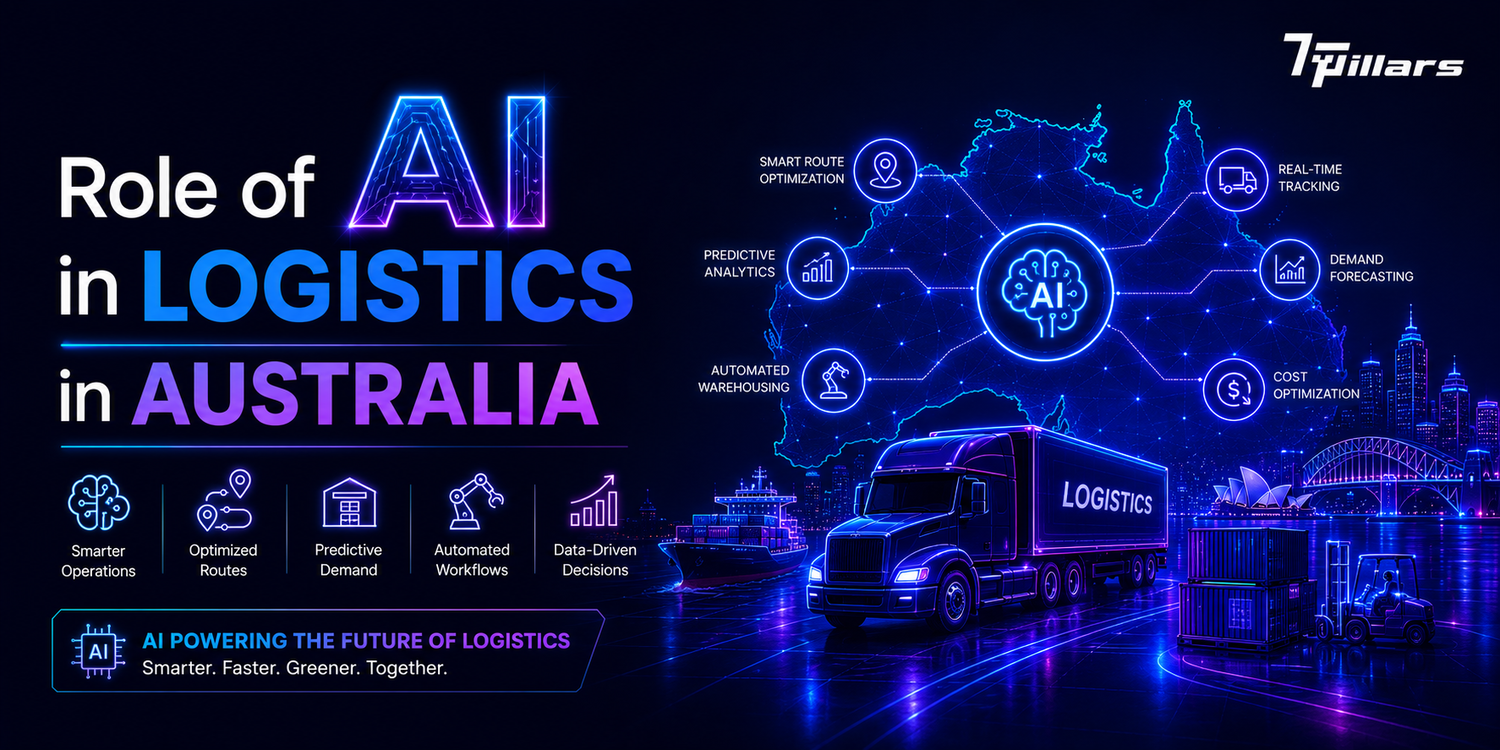
Many logistics businesses in Australia are reaching a point where traditional systems can no longer keep up with growing demand and operational complexity.
As the need for quicker delivery, lower costs and greater handling of large operational volumes increases, logistics organisations are looking at AI in Logistics to improve efficiency. Manual processes and static systems are insufficient in this fast-paced, accurate and dynamic decision-making environment.
Australia requires a transition to smooth operations due to sizable travel distances, regional logistics issues and increased customer demands, leading organisations to develop AI solutions and partner with an app-building or an artificial intelligence mobile app development company.
However, adopting AI in logistics is not just about adding new technology. It requires building systems that can support automation and scalable operations.
This blog breaks down:
If you are planning to build or upgrade logistics systems, this will give you clear direction.
This blog is ideal for:
If your operations rely on manual tracking, disconnected systems, or outdated tools, this becomes highly relevant.
Most businesses reach this stage when:
This is typically when businesses start exploring AI-driven logistics systems. A well-known Flutter mobile application development firm can help you plan your business.
AI in logistics means the automation of tasks and data analysis (in supply chains) with the help of artificial intelligence.
Core Functions:
AI acts as a central intelligence layer that improves efficiency across all logistics processes.
AI transforms logistics by managing rising customer expectations and boosting efficiency to stay competitive in the market.
The Australian logistics network deals with city-to-city transportation over long distances, delivery routes to regions and the servicing of remote areas. Handling this manually usually leads to inefficiencies, making AI in Logistics essential for improving route management.
This results in:
User expectations have been evolving rapidly with time. Business and end users are demanding quicker deliveries, proper timelines and full visibility.
AI enables this by:
Without AI-driven systems, meeting these expectations becomes difficult.
The logistics market is extremely competitive. Even a tiny increase in efficiency can remarkably lead to profit growth.
AI provides advantages by:
Companies that adopt AI early gain a clear edge.
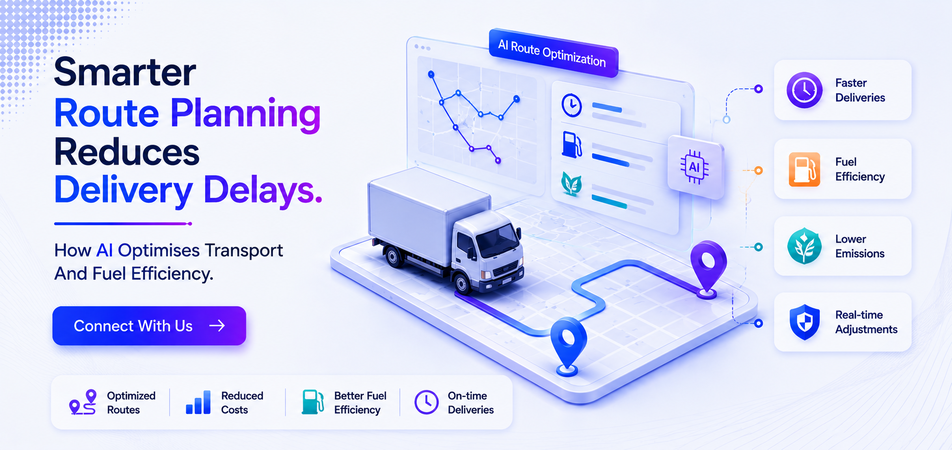
AI in logistics simplifies processes, optimises decision-making, and performance by effectively planning, designing and integrating with systems.
Start by identifying:
Clear requirements ensure the system is aligned with business goals. A top mobile app development company in Australia can help you filter your requirements for app development.
Options include:
Advanced AI Systems
Custom Solutions
Most businesses work with a mobile app development company in Australia to build custom AI systems.
A strong architecture includes:
Poor design can limit scalability and performance.
AI systems depend heavily on data collected from multiple sources, such as GPS tracking, warehouse systems, and delivery records.
Data from different systems must be combined into a unified structure. The insights cannot be reliable without being properly integrated.
Logistics operations require instant decision-making. AI systems must process live data to adjust routes and schedules.
Precise and reliable data is necessary. Ineffective data results in inaccurate forecasting and wasteful practices.
As logistics operations grow, data volume increases. Systems must handle this without slowing down, often using cloud-based infrastructure.
These elements ensure reliable AI performance.
User experience plays a key role in adoption.
Key considerations:
Clear interfaces help teams use the system effectively without extensive training.
Includes:
AI models are trained using historical data to predict outcomes.
AI logistics systems must connect with multiple external platforms:
Data must remain consistent across all systems. Any mismatch can lead to operational errors in AI in Logistics operations.
Different systems have varying API capabilities, requiring custom integration solutions.
Each integration introduces potential vulnerabilities. Secure connections are essential.
A well-designed integration layer ensures smooth communication between systems.
Testing must go beyond basic functionality.
It should include:
Proper testing ensures the system performs well under real conditions.
Best practices include:
This reduces risks during implementation.
AI systems require continuous updates:
Ongoing support ensures long-term success.
Core Features:
Advanced Features:
These features improve efficiency and reduce manual work.
Building AI logistics systems depends on system complexity and data requirements.
Timelines vary based on scope:
More advanced systems require additional time to ensure accuracy and scalability.
AI in logistics can help businesses operate efficiently. However, businesses that want to use AI in their logistics will first have to solve problems.
AI needs clean, reliable data. Poor data leads to weak predictions.
Teams must adopt AI systems smoothly.
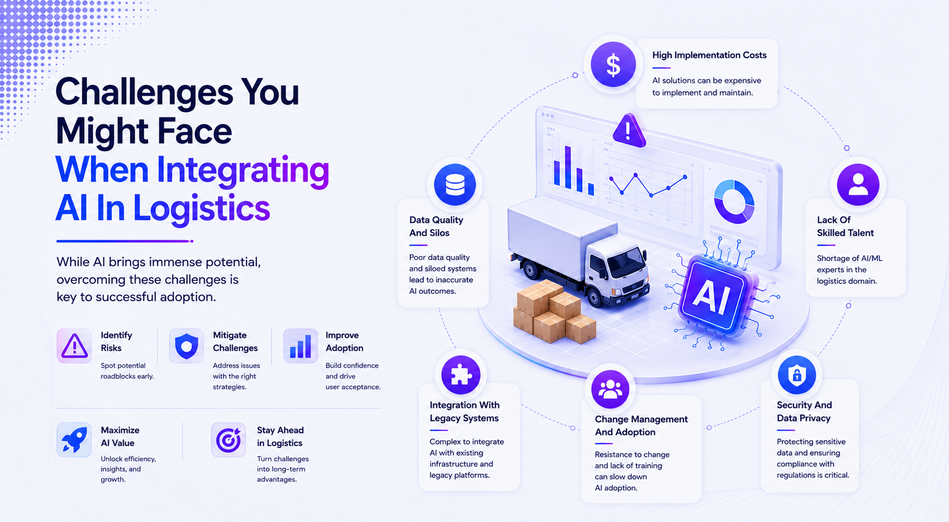 3. System Complexity
AI platforms are technically intricate.
Models must stay up-to-date.
Smart planning and resource use cut AI development expenses. A well-known mobile app development service provider can help you reduce your development cost.
Test ideas quickly with essential features.
Tackle high-impact problems first.
Leverage prebuilt frameworks.
Partnering with skilled professionals helps:
AI makes processes more efficient, cost-effective, and enhances supply chain visibility.
Operational optimisation and cost savings.
Increase speed and accuracy in processes.
Gives total transparency in your supply chain.
AI will increase smartness, efficiency, and connectivity in logistics.
Automation is changing the logistics space.
Predictions help in forecasting.
Take immediate decisions on real-time data.
Connectivity enables integration of ecosystems.
A logistics company handling regional deliveries faced delays and rising costs.
The improvement came from optimising workflows using AI.
AI has transformed Australian logistics through enhanced efficiencies, reduced operational costs and improved decision-making processes. Companies that work with mobile application development companies in Australia can develop new capabilities to support their growing operational needs.
A well-built AI solution supports automation, real time insights, and scalable logistics operations. Skilled mobile app developers in Melbourne help deliver reliable systems. Partner with the best mobile app development company in Australia to build smarter logistics platforms.
Q 1. How is AI used in logistics?
Ans 1. AI helps automate and optimize operations. An app development company can help you understand the role of AI in logistics apps.
Q 2. Is AI expensive to implement?
Ans 2. Costs depend on complexity. An iPhone app development company in Australia can help you implement artificial intelligence technology into your app.
Q 3. Can AI improve delivery efficiency?
Ansc3. Yes, significantly. A well-established on-demand app development company can help you improve your app’s efficiency.
Q 4. Do logistics companies need mobile apps?
Ans 4. Yes, for real-time operations. A well-established app development company in Australia can help you understand whether your app meets the user’s expectations.


Partner with us to bring your vision to life.




 +61 (42) 108-3277
 contact@7pillars.com.au
 294A Station Street,
