











📌 Quick Summary
- Custom web application development in Australia costs roughly $20,000 to $300,000+.
- A basic MVP can cost from $20,000 to $50,000.
- A mid-complexity app (portal, dashboard, SaaS) could go from $50,000 to $150,000.
- Enterprise web application development can go from $150,000 to $300,000+.
- The biggest price drivers are user roles, integrations, hardware, AI, etc.
- After launch, there are hidden costs such as server fees, maintenance, APIs and security.
A web application can become the backbone of how a business operates, from processing orders and managing customers to handling payments and business data. But building one involves more than choosing features and estimating development hours.
According to the Australian Bureau of Statistics (ABS), 32% of Australian businesses received orders online in 2024-25. At the same time, 21% experienced a cybersecurity incident during the same period. These figures highlight two important considerations for businesses investing in digital systems: operational capability and security.
Getting the development budget right means accounting for both. A basic customer portal has very different requirements from a multi-user SaaS platform with payment gateways, third-party integrations and sensitive customer data.
So, how much does custom web app development actually cost in Australia? Depending on the scope, complexity and technical requirements, budgets can range from $20,000 to $300,000 or more.
This guide gives you the market ranges first. Then it shows what actually moves the price, using real projects built by 7 Pillars.
What Does Custom Web Application Development Cost in Australia?
Here are the typical cost ranges in AUD with a typical timeline, so that you can have an idea of how to plan your investments and budget.
| Web app type | Typical cost (AUD) | Typical timeline |
| Simple custom web app or MVP | $20,000 to $50,000 | 2 to 4 months |
| Mid-complexity (portal, dashboard, SaaS) | $50,000 to $150,000 | 4 to 9 months |
| Complex or enterprise web app | $150,000 to $300,000+ | 6 to 12+ months |
You may be wondering why the range is so wide.
Because the real cost sits in specific business requirements and the resources to fulfil those requirements. For instance, a booking tool and a SaaS platform are both web apps, but they are not the same job.
Not sure which tier your web app falls into?
Talk it through with our team and we will place your idea in the right tier.
What Factors Affect the Custom Web App Development Cost?
Most quotes move because of five major factors. Here is how each one showed up in our own projects. We have taken examples of the projects we built, so that you can have a practical idea of how each factor drives cost.
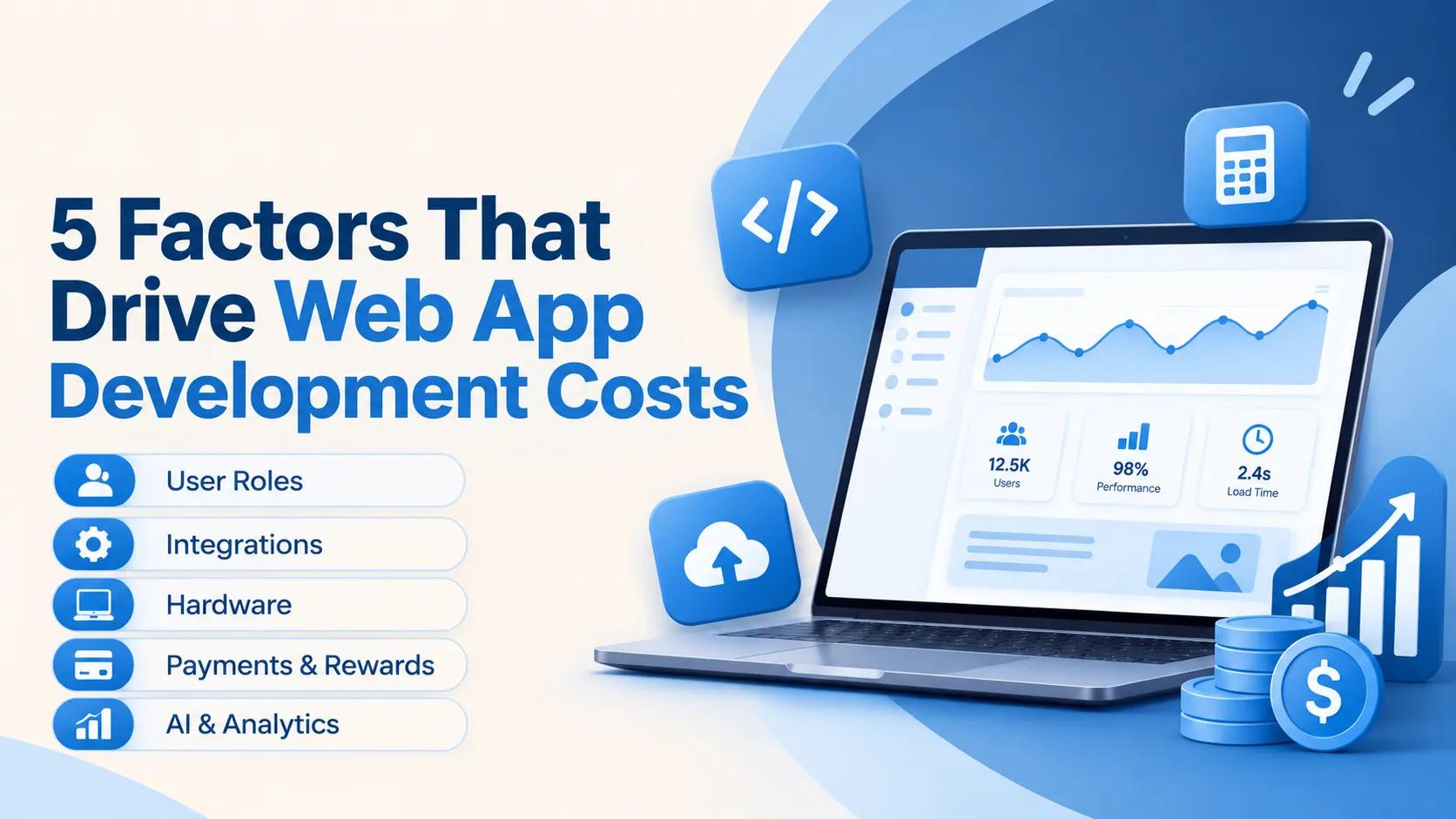
| Cost driver | Why it adds cost | Example from 7 Pillars work |
| Number of user roles | Each role needs its own screens, permissions and testing | Pay4Payments has three portals: Super Admin, Merchant Admin and Store Operator |
| Integrations | Every outside system must be built, tested and monitored | OneRound connects Google Sign-In, Apple Sign-In, Firebase, Twilio and Google Maps API |
| Hardware links | The browser must work with physical devices | Pay4Payments connects barcode scanners, receipt printers, weighing scales and cash drawers |
| Money and rewards logic | Transactions must stay accurate and in sync | OneRound runs rewards, subscriptions and QR code redemption across venues |
| AI and Analytics | Live bank data plus insight logic | Yenom, an Australian personal finance platform we built, links bank accounts and generates spending insights |
These are the factors influencing the web app development cost; you can also explore this detailed guide on Mobile App Development Costs in Australia.
Why Does a “Simple” Idea Often Land in the Mid-tier?
Take Pay4Payments, a web-based point-of-sale and retail management platform. On paper, it is “a billing tool”. In practice, it covers multi-store management, role-based access, inventory, subscriptions, reporting and white-label support. That is a full ecosystem that supports the entire business model.
OneRound, a social rewards and loyalty platform, shows the same pattern. The user app is only one piece. Venues need a vendor panel to manage deals and loyalty programs. Administrators need their own panel to manage users, subscriptions and rewards. Three interfaces mean three sets of features to design and test.
The lesson is simple. Before you ask for a quote, count the people who will use the system and the systems it must talk to. That count tells you more about your tier than any feature list.
How Milestones Keep Cost Visible
Both projects above were delivered in milestones and that’s how we go through the projects from idea to a profit-making product. Pay4Payments ran across four milestones. This matters for your budget. Milestones let you see working software before you fund the next phase. If priorities change, you adjust early instead of discovering a problem at launch.
A right custom web application development company will scope this up front. You can book a discovery call with developers to explore what it takes to build a custom web application. Look for a consultation call, which some agencies do not offer for free, like 7 Pillars.
Planning to develop a web application?
Share your brief. We will map it into milestones and show you where your budget goes, before you commit to anything.
What are the Hidden Costs Involved in Custom Web App Development?
The initial build is a one-off cost. Running, securing and maintaining the application is not. Here are five post-launch expenses business owners should account for:
Hosting and Cloud Infrastructure
Server hosting, cloud storage and computing resources to keep the application running smoothly.
Maintenance and Updates
Ongoing bug fixes, software updates, dependency upgrades and compatibility improvements.
Third-party API and Subscriptions
Recurring charges for payment gateways, CRM integrations, mapping services, authentication tools and other external platforms.
Security and Data Backups
Security monitoring, vulnerability assessments, data backups and recovery systems to protect business information.
Technical Support and Scaling
Developer support, performance optimisation and additional infrastructure as user traffic and application requirements grow.
Local Team or Offshore: What is the Real Cost?
Australian agencies typically charge $80 to $250 an hour to develop a web application. Offshore teams can start at $30 to $60 an hour. The lower rate looks attractive. But the hourly rate is only half the sum. Time zone gaps, unclear requirements and rework add hours, and hours are what you pay for.
A team that understands Australian payment methods, GST and local privacy rules saves you time later. That is worth asking about before you sign.
Budget for Security, Not Just Features
Security is easy to skip in a quote and costly to skip in real life. The Office of the Australian Information Commissioner (OAIC) received 1,205 data breach notifications in 2025. That is the highest since the scheme began in 2018, and 8% more than in 2024. Between January and June 2026, the OAIC logged 667 notifications, with health providers reporting 149 of them.
If your app handles payments, health data, or personal finance, plan for access controls, activity logging, and a security review before launch.
How to Choose a Web Application Development Company in Australia?
Ask every provider the same questions.
- Is the feature list written down, or described in a sentence?
- Is each integration named and priced separately?
- Who owns the source code and hosting account at the end?
- How is testing done, and is there a staging site?
- What support is included after launch?
A quote that answers these questions can be compared fairly. One that does not is only a number.
Why Choose 7 Pillars for Custom Web Application Development Services?
Choosing a development partner is about more than comparing quotes. You need a team that understands your business requirements, identifies potential technical challenges, and gives you clarity on what you’re paying for.
At 7 Pillars, we approach custom web application development with that in mind.
Business-first discovery
We understand your workflows, users and business objectives before recommending a technical solution.
Clear project scope
We define features, integrations, user roles, and deliverables so you know what your budget covers.
Milestone-based development
We break projects into manageable stages, giving you visibility into progress and opportunities to review deliverables.
Built for real-world use
From multi-user portals to payment integrations and complex business workflows, we develop applications around operational requirements.
Support beyond launch
We help with testing, deployment, maintenance and ongoing improvements as your application evolves.
Ready to build a web app that fits how your business actually runs?
Tell us about your users, workflows and budget. Our team will help you shape the scope and show you where every dollar goes.
Frequently Asked Questions
Should I pick a fixed price or an hourly rate for custom web application development services?
It depends on how clear your scope is. A fixed price works when features, user roles and integrations are written down before work starts. Hourly (time and materials) suits projects where requirements will change along the way. Ask every provider which model they use and what happens to the price when scope changes.
When does a custom web app make more sense than off-the-shelf software or low-code?
Choose custom when your workflow is what sets your business apart, or when ready-made tools force you to work around them. Our Pay4Payments platform is an example. It combines multi-store management, role-based access and hardware links to scanners and weighing scales in one system. Off-the-shelf tools rarely combine all of that. MVP is a sensible way to test an idea, but it may not scale to complex needs.
How can I reduce web application development cost without cutting quality?
Cut scope, not quality. Launch with the core workflow first. Remove integrations you do not need on day one. Agree on features in writing before development starts. Reviewing working software at each milestone also helps you catch changes early, when they are cheaper to make.
Can I start with an MVP and expand later?
Yes, and it is a common way to manage budget. A simple MVP sits in the $20,000 to $50,000 tier. OneRound followed this path. Its core platform was delivered through planned milestones, then enhancement phases and add-on features were built as business needs changed.
Is a web app cheaper than a mobile app or a website?
A web app usually costs less than building separate iOS and Android apps, because it runs in a browser from one codebase. A website is a different thing. It mainly shows content. A web app handles logins, user roles and live data, so it costs more than a standard website.\
Read more to explore a detailed overview of website vs. web apps.
Why does enterprise web application development cost so much more?
Enterprise builds combine every cost driver covered above: many user roles, several integrations, stricter security and higher user loads. That pushes budgets into the $150,000 to $300,000+ tier and timelines to 6 to 12+ months.
Does adding payments, bank data or AI change the budget?
Yes. Each one is an outside system to build, test and monitor. Our Australian personal finance platform links bank accounts and generates spending insights. It needed that extra integration and logic work on top of the core app. Ask for each integration to be priced as a separate line.
Can I get tax relief on custom web application development in Australia?
Possibly. The R&D Tax Incentive offers a refundable offset equal to your company tax rate plus 18.5% for eligible companies with aggregated turnover under $20 million. For a company taxed at 25%, that is 43.5%. Not all software work qualifies, because the work must go beyond ordinary development. Speak to a tax adviser before you plan around it.

Sandeep Mann

Get in touch
We'd love to hear from you.


 +61 42 108-3277

 contact@7pillars.com.au
 Stay Inspired with our