Healthcare app development in Australia involves much more than making a regular mobile app. You’re creating a technology that will deal with sensitive patient data, connect with the national health and care services, and will need to meet strict privacy and regulatory requirements.
On the other side of the spectrum, demand for digital healthcare is constantly increasing. Patients expect to be able to book online appointments, talk to and receive healthcare from providers, access and receive their medical information, and be able to track their treatments from their smartphone.
For businesses looking for mHealth app development in Sydney, Melbourne, Brisbane, and other Australian suburbs, this creates significant opportunities. And to take advantage of such lucrative opportunities, it is also important to understand the technical, security, and compliance challenges before investing in healthcare apps.
Therefore, this guide will help you explore everything associated with it. We’ll cover:
- What’s Happening in Australia’s Digital Health Ecosystem?
- Types of Healthcare Apps
- Features of Healthcare Apps (Essential and Advanced)
- Technologies commonly used in Healthcare App Development
- Advanced Technologies used in healthcare app development
- Healthcare Compliance Requirements in Australia
- Healthcare App Development Process
- Cost of building a Healthcare App (Including Hidden Costs)
Let’s first shed light on what’s happening in Australia’s digital health environment.
What’s happening in Australia’s digital health ecosystem currently?
The Australian digital health ecosystem is evolving fast. The Australian Digital Health Agency’s (ADHA) National Healthcare Interoperability Plan 2023 – 2028 outlines 44 actions across five priority areas:
- Identity
- Standards
- Information sharing
- Innovation
- Benefits
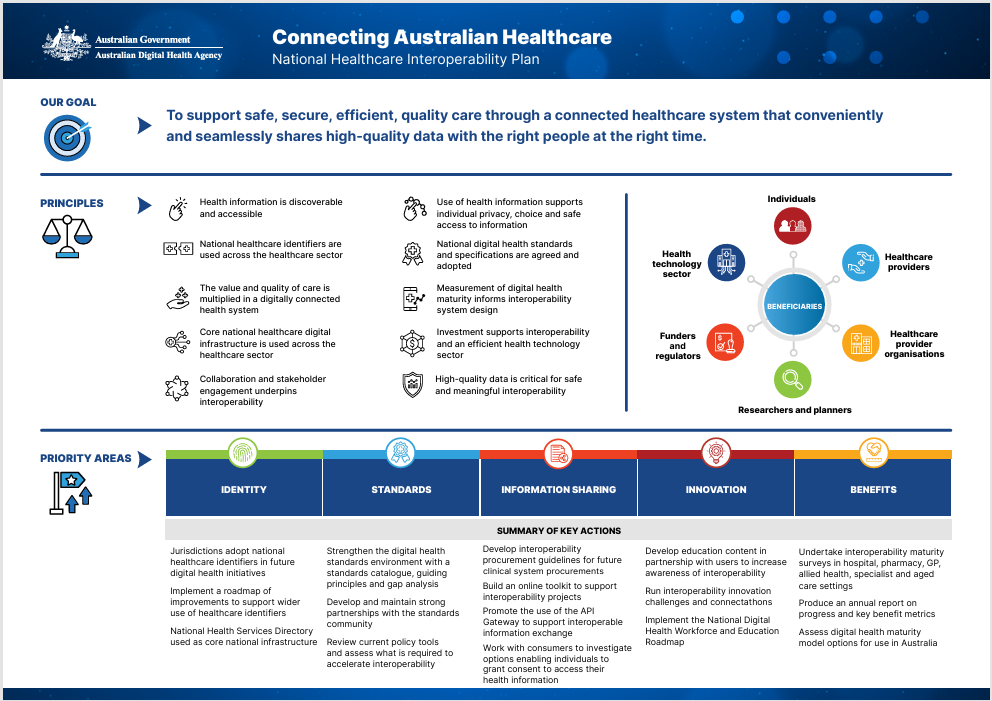
The objective of this plan is to improve how healthcare systems exchange information. For businesses and startups, this sends a clear message: future healthcare apps won’t operate in isolation. They’ll need to integrate with a more connected digital health ecosystem.
As Australia’s healthcare systems become more connected, the demand for digital solutions is also expanding. Patients, healthcare providers, hospitals, and allied health organisations are looking for applications that simplify care delivery while integrating securely with existing healthcare systems. This has led to the rapid growth of several healthcare app categories, each designed to address different clinical and operational needs. So, let’s have a look at the types of apps the Australian healthcare industry demands.
What are the types of Healthcare Apps?
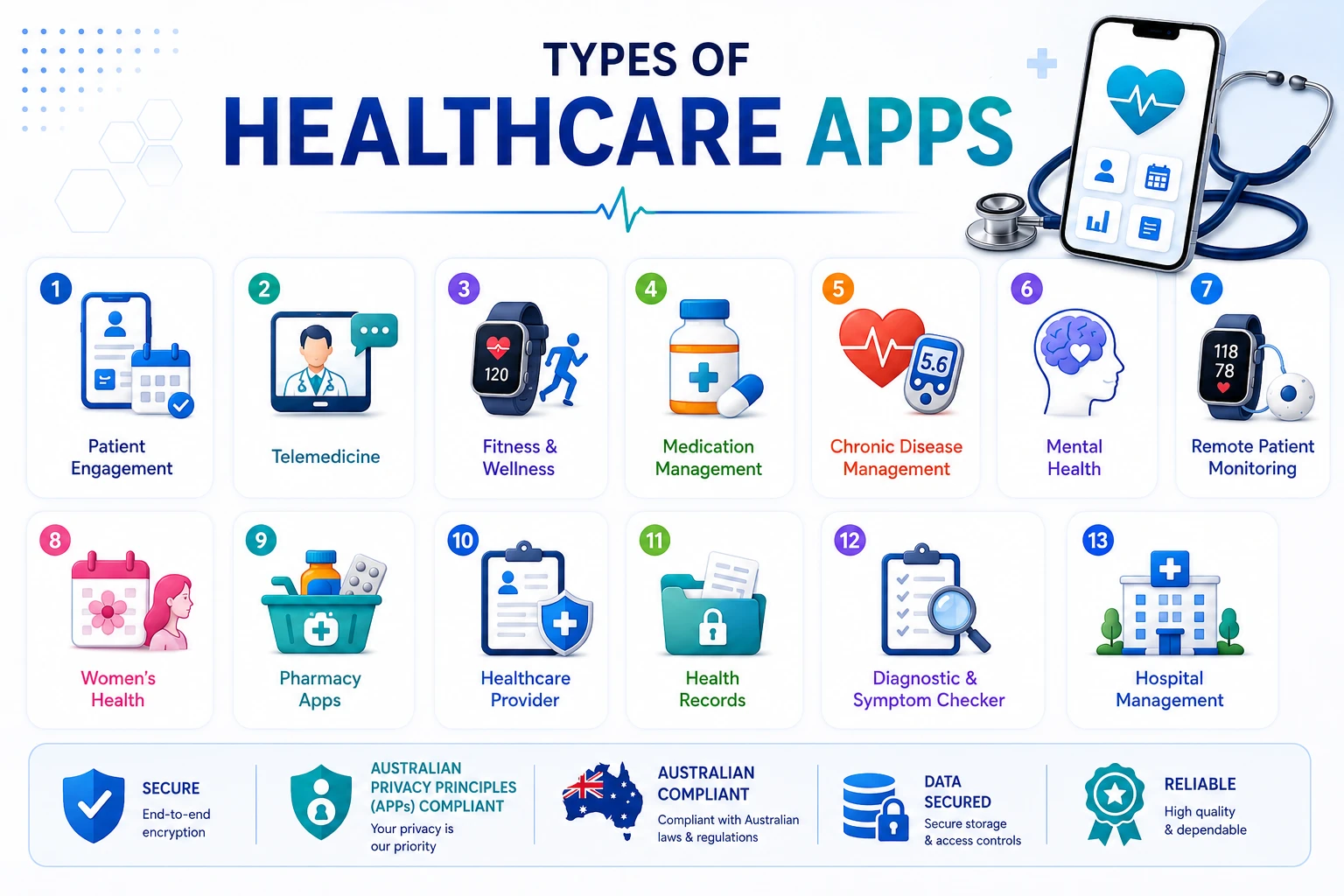
Broadly, healthcare apps split into two main categories: Patient-Centric Apps and Provider-Centric Apps. In addition to both, we also discussed Connected Care & Device-Integrated Apps below:
Patient-Centric Apps
These applications are designed for patient service, such as:
Telehealth platforms
Through telehealth software solutions, patients can receive healthcare services such as video and audio consultations and other medical services straight from their home.
Mental health and wellness apps
Mental health app development helps patients with mood tracking, provides access to CBT-based tools, and manages meditation.
Chronic disease management apps
These apps help patients with chronic diseases such as diabetes to log their insulin intake and other medications.
Fitness and lifestyle trackers
Fitness and wellness tracking apps help in tracking exercises, physical activity, and sleep, etc.
Patient portals
Patient portal app development enables patients to check appointment history and medical records and allows them to communicate with the healthcare providers.
Given how the Australian Institute of Health and Welfare (AIHW) consistently reports high rates of chronic disease across the population, including diabetes, cardiovascular conditions, and respiratory illness, it’s not hard to see why chronic disease management and remote monitoring tools keep attracting investment.
Provider-Centric Apps
These apps are designed for healthcare providers and administration.
EHR/EMR integrations
EHR/EMR integration in Australia helps in sending and receiving structured medical records and clinical data across different systems.
Clinical Decision Support Systems (CDSS)
CDSS apps help clinicians to make data-driven and calculated decisions for patient care, diagnosis, and treatment. It also helps in flagging drug interactions and suggesting diagnostic pathways.
ePrescribing software
Medical billing and e-prescription apps help doctors and physicians to send electronic prescriptions directly to pharmacies.
Staff scheduling and rostering tools
These applications help in managing the staff of medical facilities. From attendance tracking and roster scheduling to inventory tracking, it helps to manage all the resources.
Connected Care & Device-Integrated Apps
This category involves apps that are connected to wearables and IoTs and IoMTs to stream medical data across systems and apps.
Remote Patient Monitoring (RPM) software
Remote Patient Monitoring (RPM) software gathers health data and sends it to healthcare providers for continuous monitoring.
Wearable health integrations
These apps integrate with wearable devices such as smartwatches and fitness trackers to collect health data. This data is then sent to the app for analysis to provide you with insightful metrics.
Internet of Medical Devices (IoMD) applications
IoMD applications interface with smart medical devices such as glucose monitors, ECG devices, blood pressure monitors, and insulin pumps to send and receive clinical data.
Connected hospital and IoT Solutions
These apps assist healthcare organisations in monitoring medical equipment and tracking devices, while also using IoT-integrated apps to support inventory and operational efficiency management.
This outlines the primary categories of healthcare apps in Australia; let’s have a look at the features they’re equipped with.
What are the features required in Healthcare Apps?
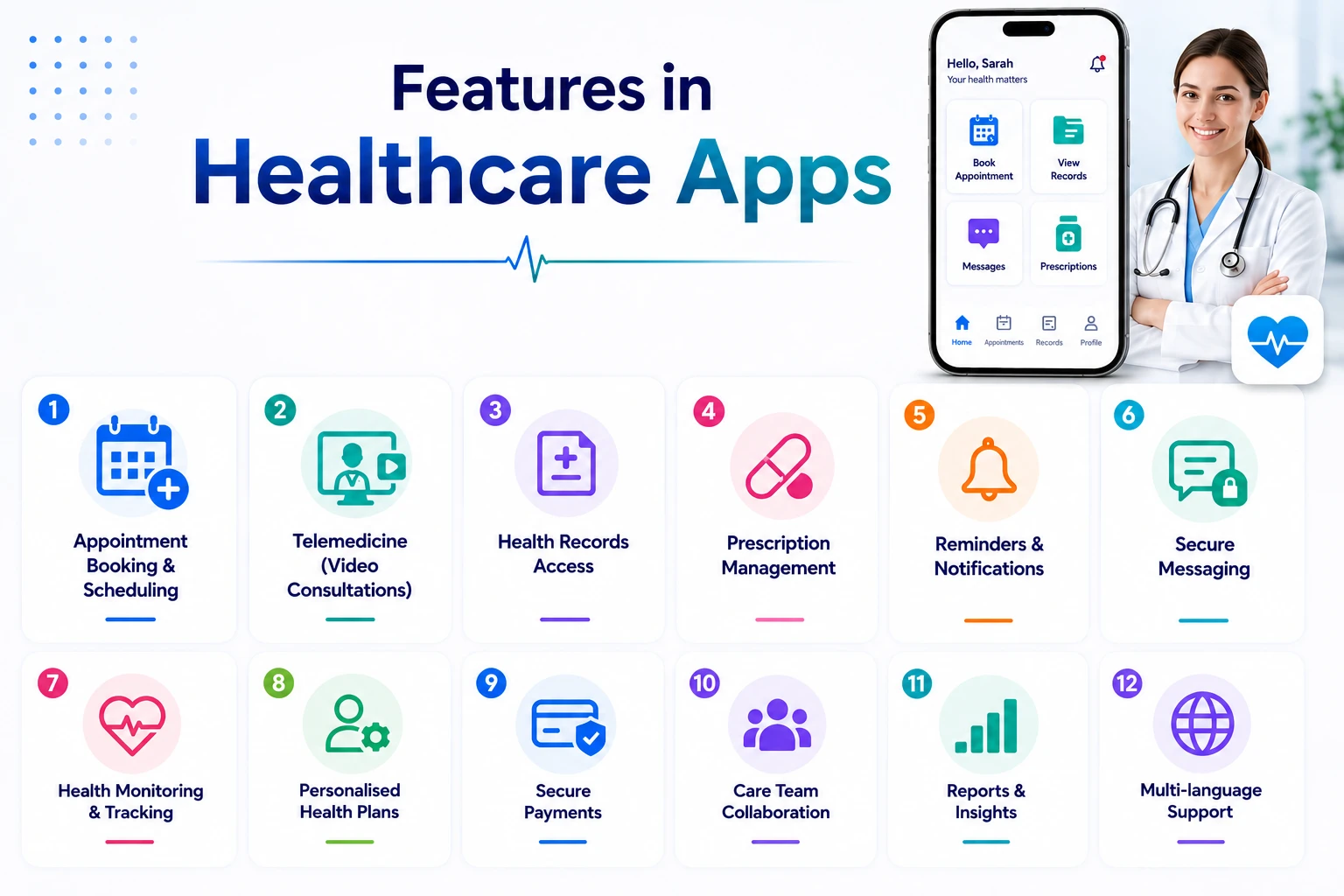
How a healthcare app looks and operates depends greatly on what the app is for and who will be using it. A telehealth app needs completely different functions compared to a chronic disease management app or even a hospital management system. Despite this, some healthcare app features are common, such as:
Secure Authentication of Users
Healthcare apps are required to be highly secure while dealing with sensitive and personal information about healthcare. Features such as multi-factor authentication (MFA), biometric login, and role-based access control (RBAC) in medical apps are some features of security and user account protection that healthcare app development can avail.
Appointment Booking
Appointment scheduling apps for clinics and hospitals enable patients to book appointments remotely. Such features are also equipped with reminders, booking cancellation, and rescheduling of appointments.
Secure Communications
Having a secure in-built messaging system offers patients and healthcare practitioners a secure communication system to use. Secure patient messaging allows patients and practitioners to communicate and share responses and follow-up queries as well as medical documents.
Audio & Video Calls
Various patient-centric and provider-centric apps require features such as audio and video calls to facilitate seamless communication. Audio and video consultation features for telehealth are used for remote consultations, internal team communications, and much more.
EHR/EMR Integration
In order to facilitate effective data sharing, prevent duplicative data entry, and improve the integration of care, a healthcare app development company builds projects integrated with EHR or EMR systems.
Push Notifications
Push notifications for medical reminders are used for alerting patients about appointments, medication, tests, prescriptions, and other health-related notifications.
Payment Gateway Integration
For healthcare providers and clinics, the availability of secure payment options simplifies the management of payments, billing, and consulting in the app.
Analysis and reporting
Healthcare organisations utilise reporting dashboards to assess patient engagement, analyse appointment trends, measure service and application efficiency, and evaluate how the application is being used. This enables them to conduct data-driven business and clinical assessments.
The app’s purpose, its users, and the policies governing its use determine the app’s functionalities. Then, there are some advanced features and technologies actively used in healthcare applications, which are discussed below.
What technologies are commonly used in healthcare app development?
There are various technologies commonly used in healthcare projects. A healthcare app development company utilises a combination of programming languages, frameworks, tools, and platforms to build apps for your needs.
Mobile and Web Frontend
- Flutter
- React Native
- React.js
- Angular
- Next.js
- Vue.js
Backend and API
- Java/Spring Boot
- Node.js
- .NET
- Python
- php/Laravel
- Firebase
- REST API
Third-Party Integrations
- Twilio
- Stripe
- Fitbit APIs
Databases
Cloud Infrastructure
Advanced Technologies
- AI/ML
- IoT/IoMT
- Big Data Analytics
This outlines the tech stack commonly used for Medical app development in Australia; now let’s have a look at the advanced technologies increasingly adopted by the industry.
What advanced technologies are being used in the healthcare industry?
Advancements in technology are fueling almost every sector of the economy. And healthcare is at the forefront of this advancement. However, every healthcare app development project doesn’t need all the advancements. But their significance is sure to grow for businesses hoping to build advanced digital health solutions of the future.
Artificial Intelligence (AI)
AI powers virtual assistants, symptom checkers, and supports predictive analytics and medical imaging. AI-powered digital assistants in healthcare can also assist healthcare providers in the analysis of massive patient datasets and the facilitation of timely and informed decisions.
Internet of Medical Things (IoMT)
IoMT links medical devices to healthcare applications and facilitates the collection of real-time patient data to streamline the care process.
Cloud Computing
A cloud-based framework in healthcare makes the maintenance and management of medical data easier while improving safety and making the system more scalable.
Blockchain
Blockchain technology is used to make medical app development in Australia more secure. The traceability and decentralisation of blockchain are being looked at to improve the exchange of healthcare data.
Digital Therapeutics (DTx)
Digital therapeutic technologies are just one of the methods and interventions that clinically address and manage conditions alongside healthcare.
AR and VR
Immersive digital experiences are quickly spreading in medical settings for education, rehabilitation, and mental health therapies. AR and VR are expanding options to immerse consumers in digital experiences.
Predictive Analytics
Predictive analytics uses historic and present health information to assist in the early detection of health risks, anticipate patient outcomes, and enable timely clinical decisions.
These are the advanced technologies used in the healthcare industry. Now, let’s explore Australian Regulatory Compliance regarding digital healthcare.
What are the Healthcare Compliance Requirements in Australia?
Healthcare app development in Australia means more than simply creating a useful tool for the market. Depending on the functionality of your app and the type of data that it processes, your app may need to comply with Australian healthcare standards, Australian privacy laws, and Australian medical device regulations. The earlier you understand these compliance requirements, the less expensive and time-consuming they will be for you later in your app development process.
Privacy Act 1988 and Australian Privacy Principles
Businesses developing Privacy Act 1988 compliant apps will need to follow the rules of the Privacy Act 1988 as well as the Australian Privacy Principles if it stores personal data. These laws set the requirements regarding the collection, storage, and processing of personal data by your app and provide individuals with greater control over their personal data.
TGA Compliance and Software as a Medical Device (SaMD)
Depending on its intended purpose and functionality, an application may fall under TGA compliance app development requirements. Although not all healthcare apps need approval from the Therapeutic Goods Administration (TGA), if your app performs any of the below medical functions, your app will likely be classified as Software as a Medical Device (SaMD):
- Offers a diagnosis
- Provides a treatment or intervention
- Assists in the clinical decision-making process
If your app falls into this category, it may also have to be listed on the Australian Register of Therapeutic Goods (ARTG) before being made available to users in Australia, based on its classification.
My Health Record and Interoperability
Incorporating My Health Record into your healthcare app may require your app to meet Australia’s interoperability standards and the applicable FHIR integration specifications. Additionally, through My Health Record integration (FHIR API), your app should facilitate the secure transfer of data between the healthcare provider, the patient, and the healthcare system.
Secure Health Data Encryption
Protection of healthcare data must be enforced throughout the data lifecycle. Developers use a combination of technologies such as end-to-end encryption, secure APIs, and multi-factor authentication, as well as role-based access control and audit logs, to protect patient data from unauthorised access.
Australian Healthcare Data Laws
Australian healthcare data laws are essential for every system that handles sensitive data of users and should be considered from the initial phase of development. In the early phases of planning and designing a new healthcare application, incorporating the privacy, security, and interoperability issues, as well as the regulatory requirements, will help make the new application easier to scale and integrate over the long run.
Now, let’s have a look at the Healthcare App Development Process.
What is the Healthcare App Development Process?
Building a healthcare app isn’t a standard software development lifecycle with a compliance checklist at the end. Regulation has to shape the architecture from day one, or you’ll be rebuilding core pieces later at extra cost.
Assessment and Discovery
Healthcare app development lifecycle begins with a discovery phase where the developer understands your requirements and organisational goals. It includes assessing your problems and expectations with the Healthcare app development and understanding your current tech, processes, and culture. This step also outlines the compliance requirements for the application. It helps in avoiding discrepancies in the future.
Strategy Development
A healthcare software development company performs a thorough evaluation and co-creates a development strategy that aligns with your vision. It is a project management outline that includes a clear definition of key milestones, priorities, and KPIs for our development team.
Design and Architecture
The next steps come into the picture when the company wireframes the Healthcare app UI/UX design and develops the required modules for the application. While developing the modules, the development team focuses on performance, scalability, compliance adherence, and security while designing a system.
Staging and Testing
Before going live, the healthcare application that is going to production will be thoroughly staged and tested. This approach is an essential step that helps to ensure performance, security, and compliance. It may also include user testing, adoption, and training if required.
Implementation
Once the application is thoroughly tested, it goes to the implementation pipeline, where engineers make the application go live. During this process, developers ensure implementation through Agile healthcare software development methods to minimise the operational disruption.
Launch & Continuous Optimisation
Once the app becomes functional for end-users, our team deploys it to production and continuously monitors performance. They increase the workload and measure whether the response time fluctuates. It helps to ensure it remains scalable and reliable for a long period.
So, you know how healthcare app development looks behind the scenes. Now let’s explore the costing factors.
How much does it cost to build a Healthcare App in Australia?
The cost to build a healthcare app in Australia goes from $15,000 for a basic application, such as an MVP, to over $300,000 for sophisticated mobile software. However, for most businesses, the objective is not to get a typical price range. They want to determine how much the cost will stretch and what factors influence the final cost. So, here are some common factors that influence the cost of healthcare app development in Australia
Platform Selection
The app development cost is directly impacted by platform selection. For native mobile applications, developers need to develop separate codebases for iOS using Swift and Android using Kotlin, increasing the cost. However, cross-platform apps minimise this duplication of efforts because it uses a single codebase for both platforms using Flutter or React Native.
UI/UX Design
Another factor that considerably impacts the overall app development cost is the app design. Advanced features often require multiple screens to perform various tasks. This requires designers and developers to work together, increasing the effort, which leads to increased development costs.
Required Features
MVP development cost for healthcare apps is lower as it requires minimal features, less time, and effort, so you do not need to spend more money. Similarly, if your app demands more advanced features and complex workflows, the cost eventually goes up the bar.
Integration Requirements
Integration is another important factor that significantly influences the app development cost. Third-party API integration (Google Maps, Payment Gateways, etc) requires less time and effort, so it requires less amount of money.
However, if the app requires integration with custom backend services, hardware, and IoT devices, the developers need to build custom APIs for seamless data transfers, which requires more time and investment.
Maintenance and Support
Once the app is deployed, you are the one who has to look after its maintenance and upkeep. This is because when your app is launched, it will require specific security patches and bug fixes to stay operational and uninterrupted. So, it is advised to include 10% of your budget for healthcare app maintenance costs.
So, these are the primary factors that can have a direct impact on your pocket for app development. But wait, there are some hidden costs involved that most of the business owners often overlook.
What are the Hidden Costs Involved in App Development?
Most businesses in Australia often overlook hidden costs that add to their overall investment. It is not the cost incurred in development. It usually comes after the development of the product. These hidden costs involve:
Server Fees
Server fees involve the charges of hosting your application. Depending on the intricacy of the app’s services and the size of your user base, server expenses might range from $10 to $10,000 per month in Australia. Nonetheless, some businesses have their own in-house server infrastructure, which involves its own support and maintenance costs associated with firmware, hardware, and software.
Developer Accounts
You must have a developer account and be enrolled in the development programs in order to release an app on the App Store and Google Play Store. In Australia, you have to pay an annual subscription charge of around $143 (US$99) for a standard Apple Developer Program. On the other hand, a Google Play Console Developer Account costs you a one-time fee of around $30 – $40 (US$25).
Marketing Expenses
For mobile apps, it doesn’t really matter how advanced your app truly is. It won’t succeed if not marketed properly with specific targeting and appropriate strategies. Consistent posting over social media platforms, AI-focused SEO/AEO optimisations, result-oriented copywriting for paid ads and campaigns, and digital PR raise brand awareness, build user engagement, and increase app user acquisition.
Third-Party Services
Third-party services provide you with the features and services that are too complex to build on your own and require a whole lot of money. While cutting development time and expenses, integrating third-party services will enhance the functionality and user experience of your app. But these integrations come with tokenised charges and subscription fees, which further add to the total cost of your app development.
Wrapping-Up
There are numerous considerations when developing a healthcare application in Australia beyond the technical development of the application. As an example, understanding the regulatory requirements, the evolving Australian digital health system, the category of application, the potential future users and customers, and the methods of system integration are all examples of the considerations that determine the success of an application.
The development of healthcare applications can range from the development of Telehealth applications to enterprise healthcare software solutions. The design of the application before development can also reduce the risks of development and of the compliance requirements of the application and ultimately provide a better user experience to healthcare professionals.
If you want to undertake the development of healthcare applications in Australia, the first step should be to align yourself with a top Healthcare app development company that has an understanding of application development and the Australian healthcare regulatory, compliance, standards, and security requirements. This ensures that the digital healthcare application developed is safe and secure, and also compliant and effective from the initial launch.
Frequently Asked Questions
Q1. Does every healthcare app need approval from the TGA?
Ans: No. Only healthcare apps that perform medical functions such as diagnosis, treatment recommendations, or clinical decision support may be classified as Software as a Medical Device (SaMD) and require TGA assessment. Informational or wellness apps typically have different regulatory requirements.
Q2. Can my healthcare app integrate with My Health Record?
Ans: Yes, provided your application meets the Australian Digital Health Agency’s integration requirements and complies with interoperability standards such as HL7 FHIR, along with the necessary security and privacy obligations.
Q3. Should I build an MVP before developing a full healthcare app?
Ans: In most cases, yes. An MVP helps validate your concept, gather user feedback, and identify compliance or integration challenges before investing in a full-scale healthcare application.
Q4. Can an existing healthcare system be integrated instead of building everything from scratch?
Ans:Absolutely. Many healthcare applications integrate with existing EHR/EMR systems, payment gateways, telehealth platforms, wearable devices, and appointment management software, reducing development time and cost.
Q5. What makes healthcare app development different from standard app development?
Ans: Healthcare applications require additional planning around data privacy, regulatory compliance, interoperability, security, and clinical workflows. These factors significantly influence the architecture, testing, and long-term maintenance of the application.
Q6. How early should compliance be considered during healthcare app development?
Ans: Compliance should be addressed from the planning stage, not after development. Building privacy, security, and regulatory requirements into the architecture early helps avoid expensive redesigns and delays before launch.
Q7. How can I future-proof my healthcare app?
Ans: Design your application with scalability, interoperability, cloud infrastructure, and modular architecture in mind. Supporting standards such as HL7 FHIR and planning for AI or wearable integrations can make future enhancements much easier.












 +61 42 108-3277


 +61 42 108-3277

 contact@7pillars.com.au
 Stay Inspired with our