










The evolution of interactive fitness activities played a significant role in improving how people participate in fitness, as many fitness applications fail to keep users motivated beyond about two to three weeks. With AI as the driver of personalised goals and adaptive challenges, engagement is no longer a guess. Due to increasing demand, most Australian brands are turning to artificial intelligence software to rethink how to develop fitness experiences. Boost your workflows with our custom software development services.
It is a significant change because the Australian digital fitness industry has exploded, and start-ups are willing to work with a proficient app development company to make their apps more interactive and attractive to customers. With competition getting tougher in 2025, Android application development firms have to smarten up and make use of AI features that go beyond basic monitoring and counting.
This blog will discuss intelligent algorithms that drive gamification in fitness apps to increase motivation, retention, and user satisfaction. We will talk about how AI software can enhance reward programs, and how a company can create a fitness application that offers AI-based levels, streaks, leaderboards and challenge modes to make exercise more interesting.
Why AI-Driven Fitness Apps Matter for Australia’s Next Wave of Digital Innovation?
This bit will be of interest to start-ups, founders and businesses in Australia considering the future of intelligent fitness solutions. It will inform your actions if you intend to improve user interactions or create more intelligent workout apps. Enterprises looking to implement AI software development for digital products can discover how AI improves gamification.
It is also worth noting for companies intending to partner with a fitness app development company to actualise. You will also learn how artificial intelligence software development influences current interactions and the importance of selecting the proper fitness app development company.
 How AI-Powered Gamification Is Redefining Australia’s Fitness App Experience?
AI-powered gamification is changing how fitness goes digital in Australia. Mobile wellness apps have transformed what were once boring workouts into personalised, game-like experiences with rewards, streaks, challenges, and adaptive coaching. Due to the rapid uptake, AI’s scope has significantly expanded, and the majority of Australians are now choosing fitness apps that provide enjoyable, interactive, and personalised workout experiences as part of their everyday routines.
- The necessity of introducing AI software-developed intelligent features is still very much there, considering that smartphone penetration (over 90%) and the interest in digital wellness keep increasing.
- Australians are enthusiastic users of healthcare applications that incorporate behavioural psychology, community attributes, and attainable objectives, thereby indicating the need for such instruments to maintain one’s fitness routine.
These trends influence how any Android application development company involved in the fitness app development designs new products, especially those that may venture into blockchain technology to offer secure progress tracking and reward checks. The digital fitness industry is in motion, and fitness app developers are applying levels of AI and intelligent automation to create more personalised and interactive experiences.
Fitness Apps Gamification
85% of Australians are a health-conscious society and own a smartphone. AI-based fitness apps are easily accessible. Data privacy regulations, such as the Privacy Act 1988, are in place to protect user data and promote confidence in health innovation products.
1. Local Success Stories
- Gamification in applications such as Strava, MyFitnessPal and Fitbit is a motivational tool for users.
- The Australian users are sensitive to the social and competitive aspects of making workouts enjoyable.
2. Tech Adoption
- Australians are becoming digital fitness users, with more than 20 million active mobile app users.
- The trends in e-commerce and app use show a willingness to use AI-enabled personalised programs.
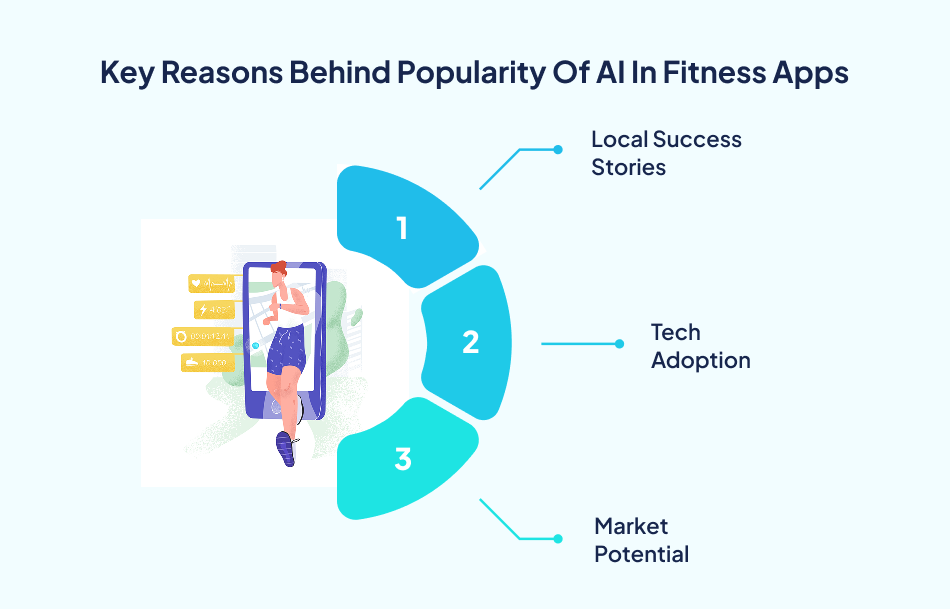 3. Market Potential
- Gamified AI fitness apps will explore the potential of a booming wellness sector, allowing local developers, gyms, and health brands to grow and develop.
How Gamification in Fitness Apps Works with AI?
1. Personalised Challenges
- AI sets the level of difficulty depending on previous performance.
- With sophisticated artificial intelligence, apps can interpret movement patterns, heart rate, and consistency to create goals that appear attainable and satisfying.
2. Reward Systems
- Most current gamified systems use tokens, badges, or level-ups as their main features, making them reusable and usable again.
- Some have gone as far as incorporating blockchain technology to ensure the reward economy.
3. Real-Time Feedback
- With the help of sensors and smart devices, AI is capable of making an instant update and can also introduce new incentives when required.
- It is now an obligatory necessity for any competitive company developing a fitness app in the Australian market.
4. Community and Social Integration
- Fitness app developers are providing their users with leaderboards, team challenges, and virtual workout partners through AI-powered apps to help them stay socially engaged.
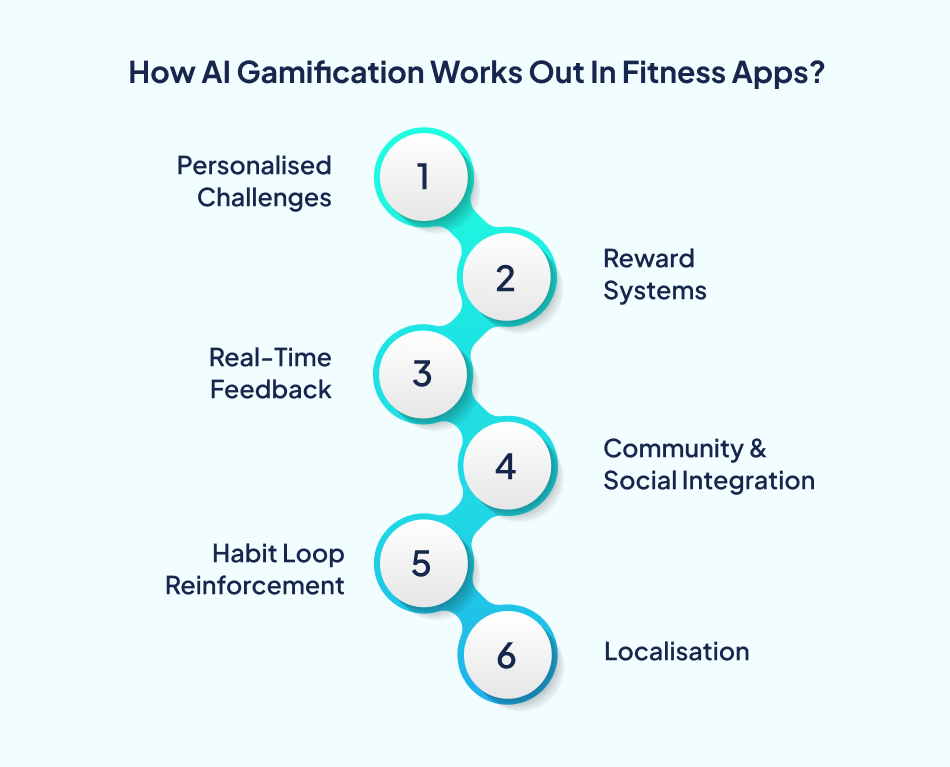 5. Habit Loop Reinforcement
- Apps use more detailed behavioural models that trace AI software development to help them figure out when a user will most probably fall asleep.
- Then, the apps can send a message or a lit-up game button to keep the user awake.
6. Localisation of Australian Users
- The challenges depend on activities that are related to the culture.
- A fitness app development company can have surf training or step contests adapted to Australian cities.
Benefits of Gamification in Fitness Apps
1. Increased Motivation
- Psychological motivators of achievement and competition include elements of gamification, like streaks, badges, and level-ups.
- In artificial intelligence mobile applications, it goes an extra mile to respond dynamically to challenges based on energy levels, past performance and user goals to achieve better results.
2. Personalisation at Scale
- AI-enhanced gamification can enable fitness apps to offer a personalised workout. For instance, an AI application can detect that a user is plateauing and offer mini-challenges to regain the user’s motivation.
- Such an adaptive algorithm is the result of highly sophisticated artificial intelligence software development that sifts through substantial user data to provide insightful information.
3. Improved Engagement and Retention
- Gamification keeps users more engaged by providing an interactive experience through the application of artificial intelligence to help users achieve objectives.
- Users remain motivated to continue their fitness regimens because they visually see the reward of the benefits from their ongoing efforts.
4. Data-Driven Insights
- Through an AI application, apps can gauge things such as heart rate, calorie burn, and sleep patterns and convert them into gamified milestones.
Key Features of Gamified Fitness Apps
Social integration motivates users, and with AI software development, adaptive leaderboards and algorithms apply artificial intelligence to create fair opportunities and dynamic challenges for people of skill.
1. Personalised Challenges
- AI systems can adjust their algorithms dynamically to come up with fitness challenges of any duration, daily, weekly, or monthly, and that can also be different for each user.
- Based on the recent data and performance history, an AI application development company can implement AI-driven exercise suggestions.
2. Reward Systems
- Users are motivated by earning virtual rewards, badges or tokens.
- Individual preference can be instrumental in making rewards more effective through artificial intelligence software development.
3. Feedback and Progress Tracking
- Gamified Fitness apps involve AI to help deliver real-time feedback and insights.
- To illustrate, intelligent alerts may remind the user to continue with more reps, improve form or do another exercise to get the most out of them.
4. Integration with Wearables
- AI applications effortlessly pair with wearable devices to collect real-time biometric data, helping energise gamified experiences that visually showcase the user’s development.
Challenges in Gamifying Fitness with AI
Although the opportunities are enormous, AI and gamification in fitness apps have such drawbacks:
1. Data Privacy Concerns
Those companies that develop artificial intelligence software need to be careful when they collect biometric data that is sensitive because such data requires that strict privacy protocols be observed.
2. Over-Complexity
Too many games can overload users. A balance is one of the most significant factors in successfully developing an AI application. Our AI fitness app developers help brands build intelligent, data-driven fitness platforms.
 3. Behaviour Prediction Limitations
While AI can modify workouts, it is still difficult to understand human motivation. AI programs have to keep learning and update their algorithms based on user interactions.
4. Cost and Resources
You will have to invest a lot of money in the development of AI apps and their frequent servicing if you aim to build a fully gamified, AI-driven fitness app.
The Future of AI-Powered Gamification in Fitness
The AI usage in the fitness app is going to be even more engaging in the future:
1. VR Workouts
Boost training. Imagine the VR-based gamified fitness activities supervised by an AI coach. AI, VR, and gamification in mobile applications powered by artificial intelligence to deliver immersive workouts.
2. Behavioural Predictive Models
High-end AI applications will not just suggest performance in a workout, but also user motivation, providing proactive suggestions and custom challenges.
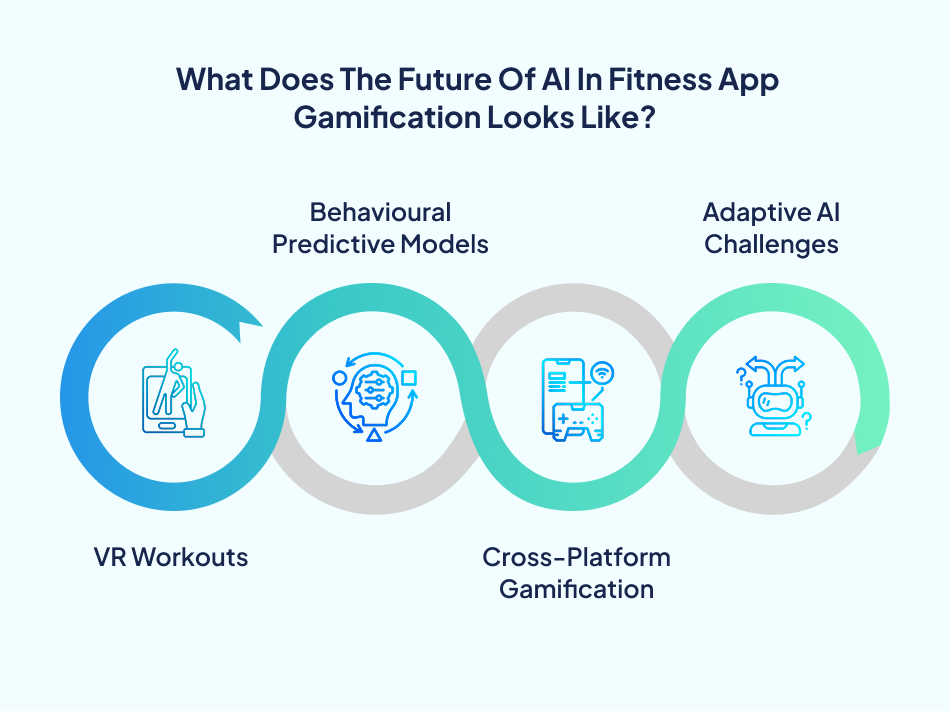 3. Cross-Platform Gamification
One can engage in fitness activities socially as AI creates challenges across devices, wearables, and mobile apps. AI application development companies have initiated these integrations.
4. Adaptive AI Challenges
The next generation of gamified applications would be able to fine-tune the intensity of a particular game and deliver the best ratio of difficulty and reward.
How an Australian Fitness Start-up Boosted Engagement with AI Gamification?
Client Background
A Sydney-based wellness brand wanted to improve the retention of a homegrown fitness app. Numerous people downloaded the app, but the number of daily active users remained small, affecting the community growth and premium conversions.
Challenge
Users were demoralised after the second week. They were no longer interested in or neutral with exercises using traditional obstacles and stationary badges.
AI-based Gamification Solution
The development team created adaptive challenges, real-time feedback, personalised rewards, and enhanced AI icons. The addition of dynamic streaks and community leaderboards has also enhanced competitiveness.
Outcome
The retention rates increased by 47%, exercises doubled, and premium subscriptions rose by 22% which is a strong sign that artificial intelligence-based gamification is an easy-to-understand, quantifiable method of real value.
 Conclusion
Fitness is an example of how innovative ideas and artificial intelligence combine to develop workout experiences that offer fun, excitement, and the opportunity for users to create their fitness skills and capabilities. Personalised obstacles, configurable prizes, and community choices motivate people to continue improvement and reach beyond their current state of physicality. The transformation is also compelling businesses to collaborate with on-demand app developers to create interactive fitness applications.
Businesses using AI-powered gamification will be the winners that keep up the pace as the market expands. The best way to ensure your fitness application is attractive, future-proofed, and competitive is by working with a team of on-demand app developers. If you have a digital fitness product, we would be happy to create a manifesting user experience for your product.
FAQS
Q 1. What is machine learning in restaurant inventory management?
Ans 1- Machine learning forecasts sales patterns, buyer behaviours, and supplier patterns to ensure the right amount of stock is available, reassuring that restaurants do not run out of stock.
Q 2. Why engage iOS app developers to integrate POS software in these solutions?
Ans 2- Professional iOS application developers create high-quality applications that operate effectively on Apple devices and provide a convenient user interface, secure data processing, and stable artificial intelligence.
Q 3. Can AI-controlled inventory management work effectively in a busy chain of restaurants?
Ans 3- Yes, it simplifies the stock coordination across multiple outlets by offering real-time data and automatic forecasting for each location.
Q 4. What do you think a restaurant needs in an AI inventory app?
Ans 4- The key features are fully automated stock updates, demand forecasting, low-stock notifications, and POS software integration, developed by experienced iOS app developers.

Sundeep Mann

Get in touch
We'd love to hear from you.




 +61 42 108-3277

 contact@7pillars.com.au
 Stay Inspired with our