









📌 Key Takeaways
- Developing a dating app like Hinge can cost anywhere between $15,000 and over $300,000.
- Hinge-like dating app development time can range from 14 weeks to 12+ months.
- App complexity, platform choice, AI features, etc. can affect the overall development cost.
- Hosting, moderation, APIs, security, compliance, support, and post-launch updates can add ongoing expenses.
- Starting with an MVP, considering one platform, and choosing the right technology stack can help initially to reduce dating app development costs.
With the rise of tech-driven societies, online dating is one of the biggest trends right now. According to Relationships Australia, 60% of people have used online dating apps and websites. And this trend is more likely to increase in the upcoming years.
For startups, entrepreneurs and businesses looking to develop a dating app like Hinge, this creates a huge opportunity. But if you have decided to enter this market, the top question that comes to mind is “how much does it cost to build a dating app like Hinge?”
So, in this blog today, we will get you through the information you should know about dating app development costs in Australia. But before getting into the cost factors, let’s learn how dating apps like Hinge got successful.
Why build a dating app like Hinge?
Before you build a Hinge-type dating app, explore why Hinge works in a category where plenty of competitors are struggling. Here are the core reasons why Hinge was successful.
It Rejected Swipe Culture
Hinge relaunched in its current form in 2016 and positioned itself as the alternative to swipe-heavy apps. It leans on a minimalist interface and curated prompts, which pushes people toward actual conversation instead of a numbers game.
Prompts Make Profiles Worth Reading
Instead of a photo and a short bio, users answer prompts that give matches something real to respond to. Conversation starters and AI-driven prompt feedback have been added on top of that to help people write better profiles and open better chats.
Small Product Details Solve Real Problems
Take Match Note, a private message that lets users share sensitive details or dealbreakers after a match but before a conversation begins. It was built with input from the trans community, yet it helps everyone. That kind of thinking is hard to copy from a feature list.
The Numbers Back It Up
As per the Business of Apps, Hinge generated $689 million in revenue in 2025, a 25% jump from the year before. Over the same stretch, Bumble’s revenue fell 14.3% in the final quarter of 2025 while Hinge grew 26%. Moreover, a Knot’s Survey suggests that 36% of newly engaged couples who met on an app used Hinge.
Hinge’s Tagline Matches Its Business Model
Hinge calls itself “designed to be deleted”, and its leadership says daters succeeding is what drives the business. That sounds backwards for an app, but it builds trust with people who are tired of apps that seem built to keep them scrolling.
The takeaway for anyone planning a similar build: Hinge didn’t win on features alone. It won by being clear about what it is for, and every product decision follows from that. If you’re planning to create a dating app that stands out, the same principle applies: differentiation needs to be built into the product strategy from the start. Our guide on how to create a dating app that stands out explores this in more detail.
Now, you may be wondering what features you need to develop a dating app like Hinge; let’s explore.
Which Hinge-like features can increase dating app development price?
Hinge doesn’t win on swiping. It wins because the whole experience is built to get two people actually talking. So the feature list needs to follow that same thinking. Additionally, these features carry the most weight when it comes to the overall dating app development costs.
Detailed Profiles With Prompts
This is the heart of a Hinge dating app. Instead of a photo and a short bio, users answer conversation prompts and add several photos, which gives the other person something real to react to. Without this, the app just feels like every other swipe app.
Like and Comment on Specific Content
On Hinge, you don’t just like a person; you like a particular photo or prompt answer and can add a comment with it. It changes the first message from a bland “hey” into something with context, and it’s a big reason conversations actually start.
Smart Matching and Daily Recommendations
Users expect suggestions that reflect their preferences and behaviour, not just age and distance. Start with solid rules-based matching, then build up to something smarter once you have real user data to work from.
Real-Time Chat With Conversation Nudges
Chat has to be fast and reliable, obviously. But the feature that really sets this style apart is the gentle reminders that keep a conversation from going quiet, since a match that never turns into a chat helps nobody.
Verification and Safety Tools
Photo verification, reporting, blocking, and content moderation aren’t extras in this category. Users need to trust that the person they’re talking to is real, and on Australian platforms, handling that personal data properly under the Privacy Act is part of the same conversation.
Planning a dating app?
Get a clear estimate based on your features, platform and development requirements.
Now, let’s get back to the focus of today’s topic – Dating App Development Cost.
How much does it cost to build a dating app like Hinge?
Long answer short, Hinge-like dating app development costs anywhere between $15,000 and over $300,000, depending on whether you want to roll out a basic MVP or a fully-featured platform.
To bring it into perspective, a basic dating app with features like profiles, basic matching, chat, and location through a dating app development company can cost somewhere between $15,000 and $40,000. Push into medium complexity territory, and you’re looking at $40,000 to $150,000. Go all in on the full Hinge-style experience, deep matching logic, polished UX, and you’re past $300,000.
Where you land really comes down to how close you’re actually trying to get to a dating app like Hinge’s actual feature set. Let’s have a look at this table for indicative price ranges as per the app type and its development complexity.
| App Type | Complexity | Indicative Cost Range (AUD) |
| Basic Dating App (profiles, swipe, chat) | Low to Medium | $15,000 to $40,000 |
| Local Agency Basic Build | Medium | $40,000 to $150,000 |
| Medium Complexity Hinge Style App | Medium to High | $150,000 to $280,000 |
| Advanced AI Matchmaking Platform | High | $200,000 to $300,000+ |
Let’s go deep and explore what factors affect the development costs.
What factors affect dating app development cost?
When we talk about how much does it cost to build a dating app like Hinge, you probably get an answer stating costs in the form of a range of numbers. But it is also important to know what factors affect these costs.
Let’s have a look:
App Complexity and Feature Set
A basic swipe and chat app is one job. An app like Hinge with detailed profiles and smarter matching logic is a completely different one. The more thought dating app developers put into how matches actually get made, the more development cost and time it eats up.
AI Matchmaking
This is probably the single biggest cost driver on the list right now. Building matching that learns from user behaviour, instead of just filtering by age and location, needs real data science work behind it, which requires effort and time, and so does the money. The more sophisticated the AI matchmaking system, the higher the development and maintenance costs. For a deeper breakdown, see our guide to AI dating app pricing.
Platform Choice
Building native for iOS and Android separately doubles frontend work compared to going cross-platform app development with something like Flutter. Plenty of Hinge-style apps launch on one platform first just to keep dating app development costs down early.
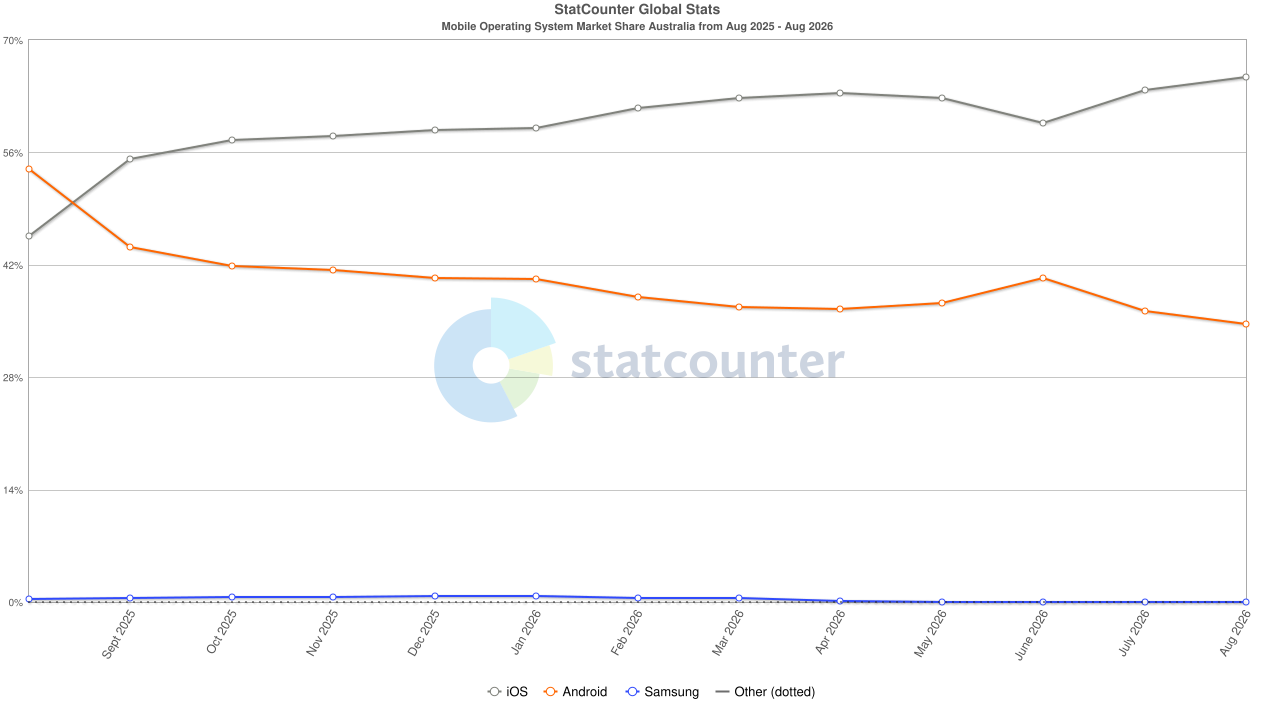
Quick Tip: In Australia, Apple’s iOS dominates the smartphone market share with 65.2%, while Google’s Android just accounts for 34.8%. So, if you are limited on budget, consider iOS app development for your dating platform first. (Source)
Verification and Safety Features
Photo verification, ID checks, and in-app reporting, features like these add development time, but skipping them isn’t really an option anymore given how much users now expect a dating app to actually be safe.
Backend and Matching Infrastructure
The backend needs to handle real-time messaging, location-based matching, and a growing user base without falling over. For a dating mobile app development company, this is one area where cutting corners early tends to get expensive later.
Third-Party Integrations
Payment processing, push notifications, identity verification services, and video calling, each one adds build time and sometimes ongoing fees layered on top of the base cost of building an app like Hinge.
Design and UX
Hinge’s whole appeal is that it feels less like a numbers game than most dating apps. Getting that feeling right takes proper UX work, not a template with a different colour scheme.
Development Team Location
An Australian team costs more per hour than an offshore one, but usually comes with a better understanding of local privacy law and compliance requirements, which matters a lot in this category specifically.
So, these are the factors that directly affect the dating app development cost. And there are hidden costs involved that nobody tells you upfront. Let’s have a look.
What are the hidden costs in dating app development?
In addition to dating app development costs, there are certain costs that show up only when you deploy the app into production. Being aware of such costs beforehand, you can make effective and efficient budget plans and reduce the chances of sudden surprises.
Ongoing Content Moderation
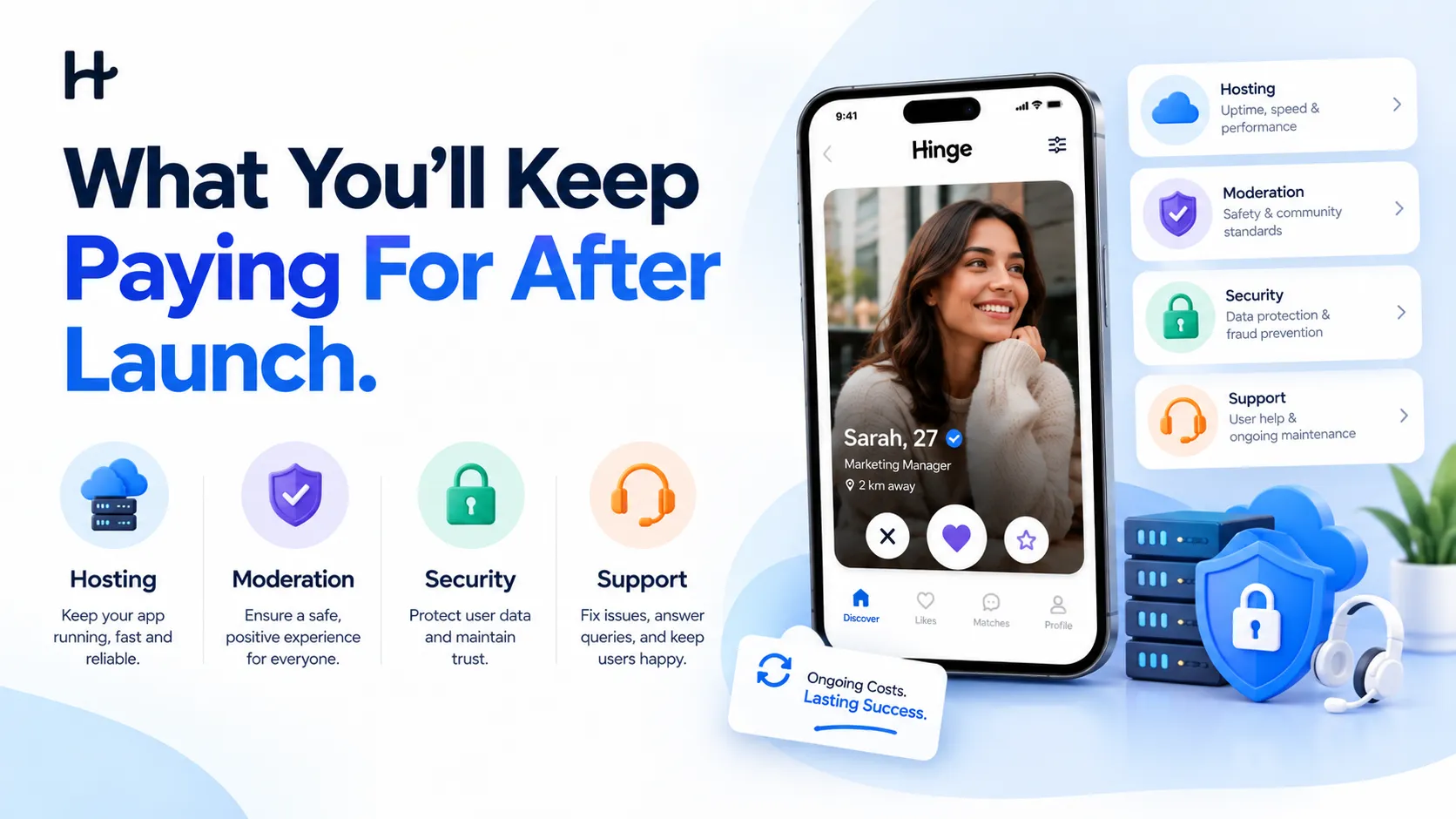
Fake profiles, inappropriate content, and abusive users don’t stop showing up after launch. Moderation, whether it’s a team or AI-assisted, is an ongoing cost most people underestimate at the planning stage.
Server and Hosting Costs
Real-time chat and location-based matching are both resource-heavy, and hosting costs climb as your user base grows, which is a strange kind of problem to have but a real one.
App Store Fees
Apple and Google both take a cut of subscription and in-app purchase revenue, and that’s a permanent line item, which should be added to overall dating app development costs.
Compliance and Legal Review
Privacy Act obligations, age verification requirements, data handling rules, these need ongoing legal attention as regulations shift, not a single compliance check before launch.
Customer Support
Reports of harassment, account issues, billing questions, all of this generates support volume that needs people or systems behind it, and that cost tends to catch founders off guard once the app actually has real users.
Third-Party API Costs
Identity verification services and payment gateways often run on usage based pricing. The more your app grows, the more these quietly add up in the background.
Security Updates
Dating apps hold some of the most sensitive personal data out there, so ongoing security patching isn’t optional, even though it’s easy to forget about once the app’s been stable for a while.
Feature Updates Post Launch
User expectations shift fast in this category. What launches as competitive can look dated within a year if new features and improvements aren’t budgeted in as an ongoing cost.
So, these are the hidden costs involved in dating app development. Now, let’s discuss how you can reduce your development expenses.
How to reduce dating app development costs?
To reduce your dating app development costs, you can follow some proven strategies. These strategies focus more on utilising your investment efficiently instead of cutting costs by making compromises.
Start With an MVP
Launch with the core loop, such as profiles, matching, and chat, before adding everything else you can imagine. A leaner first version gets real user feedback before you spend on features nobody ends up using anyway.
Also Read: How much does it cost to build an MVP?
Prioritise Must-Have Features
Video calls and advanced filters can wait. Solid matching and a smooth chat experience can’t. Ranking features this way keeps the first build focused instead of trying to be Hinge on day one. You can consult with dating app developers to discuss what features you should prioritise initially in this process.
Launch on One Platform First
As we discussed above, developing separate apps for iOS and Android just doubles the front-end development time, effort and resources. And as Statcounter shows, iOS has almost double the market share compared to Android OS in smartphone OS in Australia. So, you can start with iOS first and move to Android later when the brand is established in the market.
Use Available APIs
Identity verification, payment processing, and push notifications are all already solved problems. Developing on-demand app versions instead of integrating a proven service adds cost and risk for very little benefit.
Phase in AI Matchmaking
Full behavioural matching is expensive to build properly. Launching with simpler rules-based matching first, then developing AI features once there’s actual user data to train it on, tends to work out better anyway.
Choose a Tech Stack That Fits the Actual Build
The newest framework isn’t automatically the right one. Picking a stack your team already knows well avoids paying for a learning curve on something that didn’t need to be that advanced.
Work With a Team That’s Built Dating Apps Before
A general app development company can build almost anything, but matching logic, real-time chat, and moderation systems have their own specific challenges. A team that’s solved these before avoids expensive trial and error on your budget.
How does development time affect the dating app development cost?
Similar to the dating app development cost, the development time is closely related to its complexity and scope. This is because the higher the complexity of features, the more time is required for its development.
Likewise, the higher the time required to build something, the higher the development costs you have to bear for it. To give you an overview of the average timeline, have a look at this table:
| Build Type | Complexity | Typical Timeframe |
| Basic MVP (profiles, swipe, chat) | Low to Medium | 14 to 16 weeks |
| Mid-Level App (matching, subscriptions, admin panel) | Medium | 5 to 8 months |
| Full Hinge Style App (AI matchmaking, video, analytics) | High | 9 to 12 months or more |
Now, you have an idea of how long does it take to build a dating app like Hinge; let’s have a look at how a dating app development company can help you build it.
How can a dating app development company help control development costs?
Building a dating app like Hinge needs careful planning and consideration. It’s about understanding what actually makes matching feel meaningful instead of just another swipe, then building that in a way that fits your budget and your timeline.
That’s the approach 7 Pillars brings to dating app development like Hinge. Rather than quoting every feature under the sun, the process starts with figuring out what your app actually needs first, whether that’s a lean MVP to validate the concept or a fuller build with AI matchmaking baked in from the start because that’s genuinely core to your positioning.
Lastly, the dating app development cost control stays practical throughout too. Cross-platform builds where they make sense, phased AI rollout instead of everything at once, and using third-party APIs that are already available in the market. Budget goes toward what shapes the user experience. And support services such as moderation needs, security patching, and feature updates stay part of our relationship, because a dating app that feels current at launch needs to keep evolving to stay that way.
Ready to plan your dating app?
Talk to our team about your app idea, development scope and expected budget.
Frequently Asked Questions
How much does it cost to build a dating app like Hinge?
The cost depends on features, platforms, design and integrations. A basic MVP can cost less, while an advanced Hinge-like app with sophisticated matching, chat, subscriptions and moderation requires a larger development budget.
How long does dating mobile app development take?
Dating mobile app development can take around 3 – 12+ months, depending on the app’s complexity, number of platforms, features, integrations and testing requirements. So, it can be said that the timeline closely influences the overall dating app development costs.
How do I choose the right dating app development company?
Look for a dating app development company with experience in mobile development, real-time chat, matching systems, payment integrations, security and scalable backend architecture.
What should I look for while selecting the right dating app developers?
Experienced dating app developers should understand user profiles, matching algorithms, messaging, location services, subscriptions, moderation, security and App Store and Google Play requirements.
Can a dating mobile app development company build an MVP first?
Yes. A dating mobile app development company can build an MVP with essential features such as registration, profiles, matching, messaging and notifications, allowing you to validate the concept before investing in advanced functionality.

Sundeep Mann

Get in touch
We'd love to hear from you.


 +61 42 108-3277

 contact@7pillars.com.au
 Stay Inspired with our