










Have you ever been irritated by a “five-minute” delivery that took too long to be delivered? Inaccurate ETA estimates continue to frustrate many consumers when they use on-demand applications. Reliability was once a mere added benefit of on-demand services; now, with Australia’s on-demand industry expected to exceed AUD 95 billion by 2026, it has become an essential business requirement. Businesses increasingly rely on mobile application development services to build scalable, AI-powered on-demand platforms.
On-demand app developers utilize AI algorithms to detect real-time traffic information, driver actions, and weather conditions, which improves arrival time predictions. Service providers gain two fundamental advantages from this technology, enabling them to deliver better customer experiences and establish trust that sustains their customer base in the competitive market.
The following blog will detail how AI-based application development enables on-demand mobile app developers to create advanced ETA systems, lower customer churn, increase operational efficiencies and support enterprise and start-up businesses providing seamless, data-driven experiences for their users in 2026.
Maximising Value with AI Technology ETA Predictions
This topic will be valuable for businesses wanting to improve user experience and efficiency. Australian on-demand app builders and start-ups in logistics, ride-sharing, and delivery can get insights into the practical application of AI to transform service reliability. As the competition in the market continues to increase, proper predictions are no longer a luxury; they are necessary to win customers’ confidence.
The blog is for entrepreneurs, technology founders, and companies in artificial intelligence software development, streamlining operations and forecasting accurate outcomes. On-demand app builders can use artificial intelligence software development to outperform in either refining user journeys or scaling delivery solutions.
Growth Of AI Technology in ETA Predictions for On-Demand Apps?
The rapid growth of the digital economy has paved the way for AI-driven ETA prediction systems to help provide on-demand apps with accurate, transparent, and trustworthy customer experiences.
- By 2026, Australian consumers will desire instant, accurate ETA from their food delivery, ride-hailing, logistics, and healthcare apps.
- As a result, this trend is promoting the innovation of artificial intelligence software development.
- AI software development creates estimated time of arrival (ETA) predictions by analysing real-time and historical data.
- AI systems can interpret and evaluate the current traffic flow, weather conditions, driver behaviour, and the customer’s location.
- The penetration rate for smartphones in Australia has reached approximately 92%. Moreover, the majority (over 80%) of urban users in Australia use on-demand apps at least once per week.
- AI-specific estimation accuracy has now become the standard for on-demand platforms.
Android app development will heavily rely on AI-driven ETA prediction technology through 2026.
Why Is AI In ETA Predictions Popular in On-Demand Apps?
1. AI Technology is Transforming Key Sectors
- Australia’s growing desire for greater efficiency has accelerated the application of artificial intelligence across the transport, retail, and logistics sectors.
- According to the prediction, more than three-quarters of Australian companies will use AI as part of their key operational systems by 2026.
- Real-time analytics and improved decision-making are among the key benefits of AI software development.
2. Smarter App Experiences
- For on-demand app developers, AI can allow your platform to learn from both real-time and historical data.
- It means that if traffic hinders movement in the CBD of Sydney during peak periods, the AI will proactively adjust ETA expectations based on its predictive model.
- Traditional logistics and food delivery apps are powered by self-learning AI, providing an inclusive user experience.
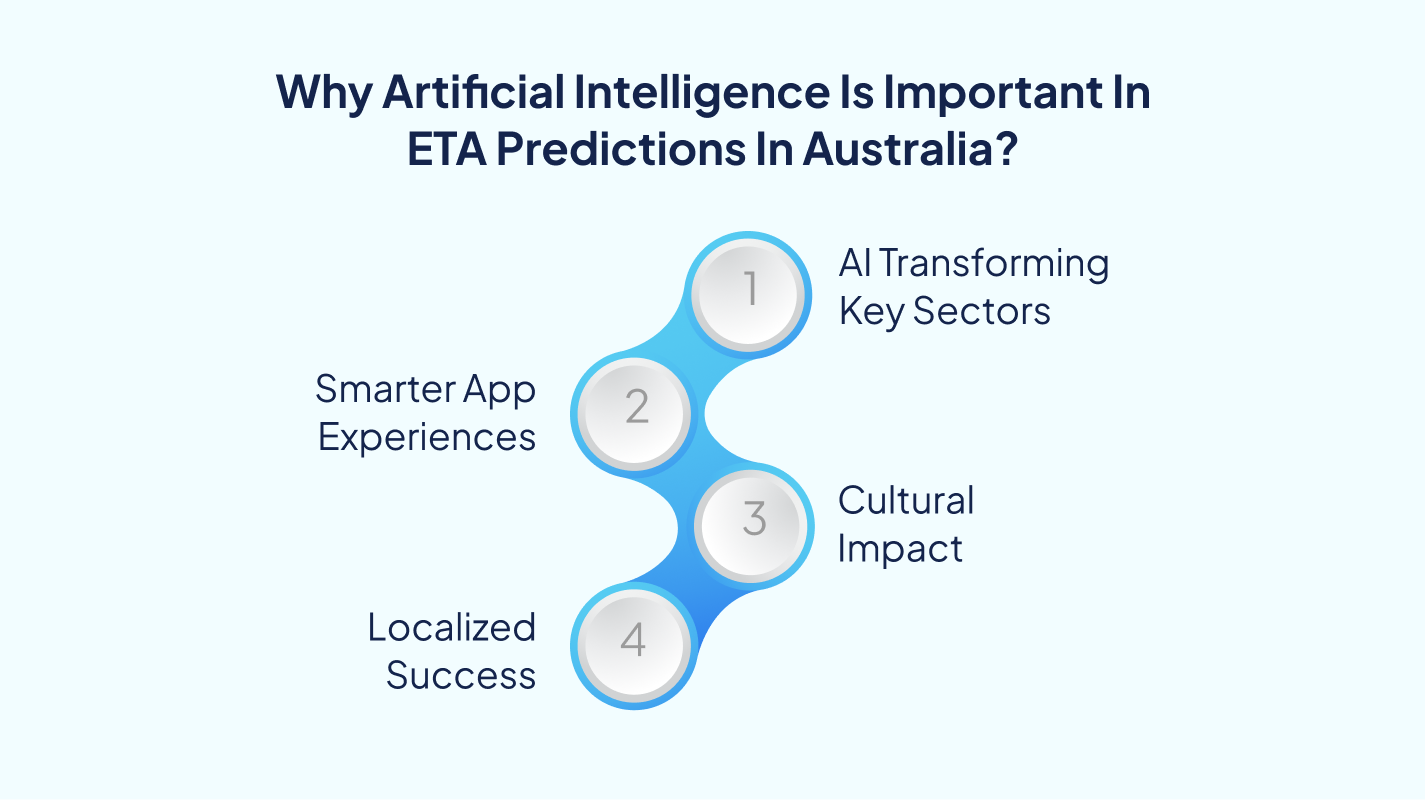
3. Improve over time
AI uses historical data to improve predictions for similar routes, times, and conditions.
4. Connect with IoT devices
Connected vehicles and devices provide AI applications with constant data, meaning predictions can become more contextual.
This type of AI-based model is implemented in more advanced artificial intelligence mobile app development architectures, where ETAs tune to a level of accuracy that was barely possible just a few years ago, in companies like Uber and DoorDash.
Key Features AI Technology Brings to On-Demand Apps
By incorporating artificial intelligence (AI) applications into their platforms, developers of on-demand apps can provide features beyond the black box known as ETA (estimated time of arrival), which are as follows:
1. Real-Time Adaptive ETAs
The ETA updates automatically as outside factors develop, such as traffic spikes, road detours, or weather changes.
2. Predictive Dispatching With AI Technology
AI intelligently dispatches the appropriate driver or courier based on their distance, estimated speed, and previous performance, lowering operational costs between pickup and drop-off.
3. Context-Aware Notifications
AI applications intelligently push notifications to the customer during their ride or delivery to notify them if their ride or order is late, as well as hold up if the service is running faster than expected.
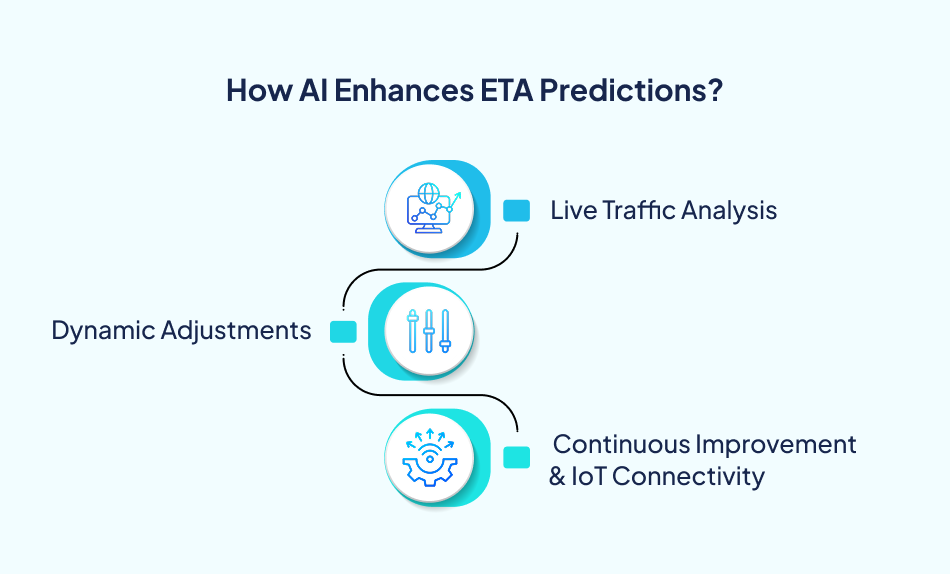 3. Improve over time
AI uses historical data to improve predictions for similar routes, times, and conditions.
4. Connect with IoT devices
Connected vehicles and devices provide AI applications with constant data, meaning predictions can become more contextual.
This type of AI-based model is implemented in more advanced artificial intelligence mobile app development architectures, where ETAs tune to a level of accuracy that was barely possible just a few years ago, in companies like Uber and DoorDash.
Key Features AI Technology Brings to On-Demand Apps
By incorporating artificial intelligence (AI) applications into their platforms, developers of on-demand apps can provide features beyond the black box known as ETA (estimated time of arrival), which are as follows:
1. Real-Time Adaptive ETAs
The ETA updates automatically as outside factors develop, such as traffic spikes, road detours, or weather changes.
2. Predictive Dispatching With AI Technology
AI intelligently dispatches the proper driver or courier based on their distance, estimated speed, and previous performance. The distance between the pickup and drop-off operational costs is lowered.
3. Context-Aware Notifications
AI applications intelligently push notifications to the customer during their ride or delivery to notify them if their ride or order is late, as well as hold up if the service is running faster than expected.
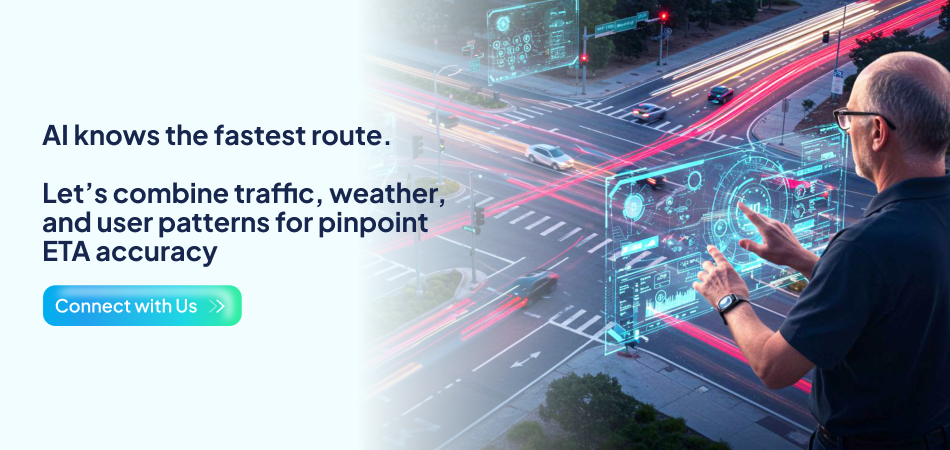
4. Advanced Route Optimization With AI Technology
Artificial intelligence mobile app development enables apps to coordinate the most efficient routes, predictive modelling, and live analytics. Route optimization using AI helps delivery companies reduce travel time and improve efficiency.
5. Continuous Learning
AI systems never stop learning, and every single completed ride or delivery pushes the algorithm closer to an accurate prediction of the next ETA.
These features demonstrate the power of programming an AI software development dedicated to the user experience and efficiency.
AI-Powered ETA Predictions vs Traditional Systems
| Aspect | Traditional ETA Systems | AI-Powered ETA Systems |
| Data Usage | Limited, Static Inputs | Real-Time + Historical Data |
| Adaptability | Fixed Rules | Dynamic, Self-Learning |
| Traffic Handling | Delayed Updates | Instant Recalculations |
| Weather Impact | Manual Adjustments | Automatic Predictions |
| Driver Behaviour | Not Considered | Behaviour-Aware Models |
| Scalability | Struggles At Scale | Handles Millions Of Requests |
| Accuracy Over Time | Remains Static | Improves Continuously |
| User Trust | Inconsistent | High Transparency |
| Operational Cost | Higher Wastage | Optimized Resources |
| 2026 Readiness | Outdated | Future-Proof |
How AI Technology Works In ETA Predictions in On-Demand Apps?
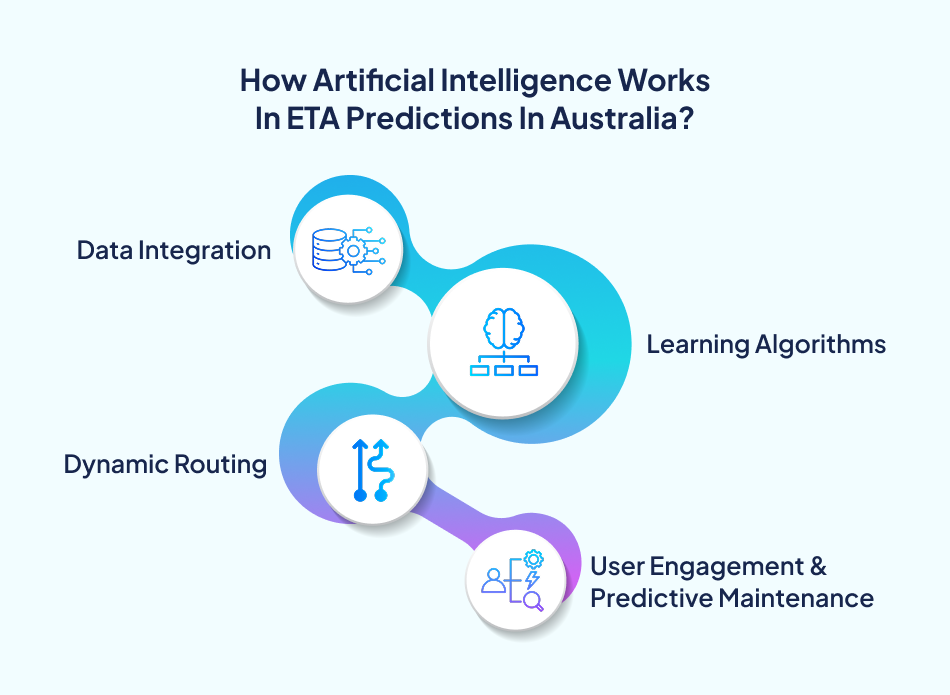
1. Collection and Merging of Data
- The AI software development process starts with the collection of both historical and real-time data from GPS technologies, weather APIs, and traffic sensors.
- The on-demand app builder will merge and integrate all of this data into cloud systems, so that the AI models receive regular, relevant, and accurate information.
2. Maintenance Learning Algorithms
- Predictive algorithms can recognize patterns.
- For example, throughout the course of Android application development, developers can train their AI models to understand how long specific named delivery drivers typically take to reach a suburb, under similar conditions.
- Recognizing patterns is an AI application for route enhancement.
3. Changeable, Dynamic Routes With AI Technology
- AI systems are recalculating the expected arrival time when conditions change. Cross-platform app development companies can develop apps that support multiple platforms.
- They have an app that continuously recalculates ETAs for delivery drivers and suggests new routes.
4. User Engagement
- Artificial intelligence software development is another way to ensure accuracy and enhance transparency for users in real-time.
- When a delay occurs, AI chatbots can notify the user of the delay.
- This approval-like responsiveness from the service helps build trust in the application.
5. Predictive maintenance and efficiency With AI Technology
- AI software development will not only provide an accurate ETA, but it can also help predict when a vehicle and driver will not perform at their capability, which will aid in scheduling.
Benefits of AI-Powered ETA Predictions
Companies that will accept the principles of strategic AI mobile app development and collaborate with established on-demand development services will achieve high benefits:
1. Unmatched Accuracy
More accurate forecasts lead to reduced missed expectations.
2. Customer Trust
Transparency through improved loyalty with real-time updates.
3. Reduced Costs
Sophisticated routing conserves fuel, time and resources.
4. Scalable Systems With AI Technology
Millions of requests in different geographic areas can be processed by AI applications.
A combination of effective data pipelines and advanced artificial intelligence applications developed by iOS app developers creates a beneficial ecosystem for businesses.
Trends Shaping AI-Powered ETA Predictions in On-Demand Apps
| Trend | How It Enhances ETA Accuracy? | Value For On-Demand Apps |
| Edge AI Processing | Faster Local ETA Updates | Reduced Latency |
| Hyperlocal Traffic Intelligence | Street-Level Predictions | Higher Accuracy |
| Behavioural AI Models | Predicts Driver Habits | Consistent ETAs |
| Weather-Aware AI Forecasting | Adjusts For Weather | Fewer Delays |
| IoT & Smart Infrastructure Integration | Uses Live Device Data | Smarter Routing |
| Explainable AI (XAI) | Explains ETA Changes | Builds Trust |
| Predictive Delay Alerts | Flags Delays Early | Fewer complaints |
| Sustainability-Driven Routing | Optimizes Fuel Usage | Lower Costs |
| Privacy-First AI Models | Compliance By Design | Data Safety |
| Multi-Modal ETA Prediction | Supports Bikes, Cars | Scalable Delivery |
Challenges in Implementing AI for ETA Predictions
1. Data Quality With AI Technology
Prediction quality can be affected by issues like poor GPS accuracy or missing data points.
2. Model Drift
User behaviour and traffic patterns can change over time, meaning that retraining will become necessary.
3. Latency Issues With AI Technology
Predictions must be made in milliseconds, meaning that systems need to be connected.
4. Integration Complexity
To build scalable pipelines in artificial intelligence, mobile app development requires coordination of expertise across teams.
To address these challenges, on-demand development services often enable artificial intelligence by partnering with POS software development agencies that have experience in scalable AIs and privacy-first data systems.
Enhancing Delivery Accuracy with AI
Client Background
To improve delivery precision and customer satisfaction, a food delivery start-up in Melbourne is partnering with a POS software development company.
Challenge
Incessant traffic congestion and inaccurate ETA led to situations where orders were cancelled, and account ratings were reduced .
Solution
With sophisticated AI software development, the team used artificial intelligence applications that processed real-time traffic, driver route, and weather data.
Results
In just three months, the accuracy of ETA increased by 42%, on-time delivery increased by 30%, and complaints reduced by 25%. Success had brought the brand to the list of most dependable on-demand app developers in Australia.
Conclusion
Predictions of ETA driven by AI technology are transforming the way businesses can provide convenience, trust and transparency in Australia’s digital marketplace. The combination of AI software development with real-time data analytics has made on-demand app developers able to create faster and more intelligent service experiences for brands. The transformation enables businesses to trust their users while maintaining loyalty and achieving better operational results.
Your business can boost delivery accuracy and customer satisfaction, making iOS app developers a crucial partner to consider. Let us help you integrate state-of-the-art AI models into your app and transform the definition of timely service for your customers starting today.
FAQS
Q 1. How does AI make ETA predictions more accurate?
Ans 1- AI draws on real-time traffic, weather, and driving behaviour data to optimize arrival estimates. It learns from history, enabling on-demand app providers to get more accurate and reliable predictions for users.
Q 2. Is AI capable of adjusting to abrupt route deviations?
Ans 2- Yes, AI also recalculates ETAs immediately when there are delays, diversions, or traffic congestion, thus giving delivery delays fewer chances to happen.
Q 3. What are the benefits of AI-based ETA predictions for companies?
Ans 3- AI reduces delivery delays and improves customer utilizations and satisfaction with its intelligent AI software development solutions.
Q 4. Are AI-based ETA systems appropriate for all on-demand applications?
Ans 4- Yes, they improve dependability and performance for delivery, transportation, logistics, and service-oriented applications.

Sandeep Mann

Get in touch
We'd love to hear from you.




 +61 42 108-3277

 contact@7pillars.com.au
 Stay Inspired with our