










📌 Key Takeaways
- iOS app builds in Australia range from AUD 20,000 for a basic MVP to over AUD 300,000 for a complex product.
- Local iOS developers charge AUD 80 to AUD 250 an hour, while cheaper offshore rates often lead to costly rework.
- Agencies calculate quotes by multiplying total development and overhead hours by a blended team rate.
- Your budget must also cover the US$99 annual App Store fee, monthly hosting, third-party services, and marketing.
- Set aside at least 10% of your build budget every year for maintenance and new iOS updates.
- You can cut costs without losing quality by starting with an MVP, using existing APIs, and running a discovery phase first.
Apple’s iOS holds 62.59% of the mobile market in Australia, while Android holds 37.4%, according to Statcounter. For a business owner planning to launch an app here, that split makes iOS the first platform to price. It is also why iOS app development cost is one of the first questions owners ask.
Across all platforms, app projects in Australia run from about AUD 20,000 for a basic app to more than AUD 300,000 for a complex product. An iOS build sits somewhere inside that range, and the final figure depends on features, design, integrations, and the team you hire. Apple also charges US$99 a year (about AUD 143) for the developer account needed to publish on the App Store. Many businesses leave this fee out of their budget.
This blog explains what drives the cost to develop an iOS app and which expenses appear after launch. It also covers how to choose an iOS app development company in Australia that gives clear quotes and supports the app once it is live.
How Do Agencies Estimate the Cost to Develop an iOS App?
iOS app Development agencies in Australia price an iOS project by effort. The team works out how many hours design, build, and testing will take, then applies an hourly rate to that total. Most agencies reach the final figure through the same three steps.
Step 1: Discovery Phase
Everything starts with a conversation. The iOS app development company asks who will use the app, what it must do on launch day, and which iPhone models need support. It also checks the business goal behind the project. Answers given here carry a lot of weight, since a change requested after development begins can cost far more than a change made on paper.
Step 2: Feature Breakdown
The project is then split into modules, and each module receives a list of features.
For example: A Simple iOS MVP for a Booking App
| Modules | Features to Develop |
| Authentication | Sign up, log in, Face ID |
| User Account | Edit profile, upload photo |
| Booking | Search, schedule, cancel |
| Payments | Apple Pay, Stripe |
| Notifications | Push notifications, reminders |
Step 3: Estimate Development Hours
Every feature gets an hour count. These numbers come from earlier projects we delivered, so they rest on records from real work.
For example:
| Features | Estimated Development Hours |
| User Sign-up (database integration) | 10 |
| User Login (Face ID authentication) | 15 |
| UI/UX Design | 35 |
| Booking Module | 50 |
| Backend APIs | 50 |
| Payment Integration (Apple Pay) | 35 |
| Testing on iPhone Models | 30 |
| App Store Submission | 10 |
| TOTAL HOURS | 235 |
A blended hourly rate is then applied to the total. It merges the pay of developers, designers, testers, and project managers into one figure.
Overhead hours come on top. Debugging, client calls, and feedback rounds always take time, and no plan predicts them exactly. Apple’s App Store review adds to this, because a rejected build must be fixed and submitted again. Put simply, development hours cover the writing of code, and overhead hours cover getting that code to run without errors. Add the two together, and you have the closest estimate for your iOS app development cost.
Want an Accurate iOS App Estimate?
Start with a discovery phase to scope your features, compliance points, and fixed price before coding begins.
What Factors Influence iOS App Development Cost?
Some of these factors come up in the first meeting with an iOS app development company. Others only show once the work is underway.
Platform Selection
iOS mobile app development is Swift-based, and those apps run only on Apple devices. They work closely with Apple features and are fast on iPhones. For Android, expect price changes because Android Developers need a separate Kotlin codebase, testing, and more.
For a different route, Flutter and React Native Development offer the use of a single codebase for both Android and iOS, so many businesses opt for it if Apple-exclusive features are not needed.
The range of devices is also important. An iPhone-only app is more affordable than an app that supports iPad, as an iPad app needs separate layouts, which eventually increases iOS app development costs.
UI/UX Design
The number of screens drives design cost. iOS mobile app development with 10 screens takes less time than developing an app with 30 screens. A role-based interface, animations, and dashboards further add to the time because UI/UX designers and developers need to work together for their implementation.
Apple has guidelines known as the Human Interface Guidelines (HIG) for app designers. Adhering to these guidelines makes the app’s interface similar to that of iPhone, and this familiarity takes less time to develop. Designing an interface completely different from these guidelines takes more time to develop and test.
Required Features
A small feature set means a lower price. Real-time data, multi-step bookings, and similar workflows need much more effort, which adds to the cost. Many apps also require AI features, such as chatbots or customer support assistants, which increase development expenses.
Businesses planning advanced AI capabilities may work with an AI Development Company to identify the right features, integrations, and infrastructure before setting their budget.
Growth plans matter as well. If thousands of users are expected within a year, the backend must be built for that load from the start. Building scalable systems early costs less than rebuilding later.
Integration Requirements
Several iOS apps incorporate Apple Pay, Face ID, and push notifications. Testing and integrating each of these features takes a significant amount of time.
On the other hand, integrating third-party APIs like payment gateways or Maps takes less time and costs. Custom backends and hardware/IoT integrations require custom APIs, thus increasing the effort, as well as the time and cost.
Maintenance and Support
Apple releases a new version of iOS every year, so the app needs updates to stay compatible, and this increases the iPhone app development costs. Security patches and bug fixes follow after launch too. 7 Pillars also provides support and maintenance as per your requirements, so ask every company on your shortlist what its quote covers.
PRO TIP: Keep at least 10% of the iOS app development budget for maintenance and support. It pays for the yearly iOS updates and for changes that come from user feedback.
How much do iOS app developers in Australia charge?
Most iOS developers in Australia charge between AUD 80 and AUD 250 an hour. These hourly rates depend on the experience and location of the developer. Below is an overview of local rates in Australia.
| Developer type | Hourly rate (AUD) | Where it fits |
| Junior developer | $80 to $120 | Simple apps with close supervision |
| Mid-level developer | $120 to $180 | Standard business apps |
| Senior developer or agency team | $150 to $250 | Enterprise Projects |
| Offshore Teams (South Asia, Eastern Europe, Latin America) | $20 to $60 | Small projects with a fixed scope |
These are average rates for iOS app developers in Australia. However, offshore pricing looks like a big saving. Whether it actually saves money depends on how well the project is going.
Time zones slow things down. A question asked at 4 pm in Brisbane could take until the next day to get a reply. Misreading requirements is not uncommon. This can mean a screen gets built more than once. That additional build is usually not included in the first estimate of your iPhone app development costs.
Agencies don’t usually quote based on a single developer’s rate. They blend rates of developers, designers, testers, PMs, etc to get an average rate. A quote of AUD 150 an hour therefore covers the whole team.
Here is what the rate does to a real budget. The booking app from the earlier section took 235 hours.
| Team level | Rate (AUD) | Cost for 235 hours (AUD) |
| Mid-level | $120 to $180 | $28,200 to $42,300 |
| Senior or agency | $150 to $250 | $35,250 to $58,750 |
Both totals leave out overhead hours for debugging and review rounds, so the final bill will be higher.
The rate is only half of the price, because hours matter just as much. A team at AU$120 an hour that needs 400 hours costs AU$48,000. A team at AU$180 an hour that needs 200 hours costs AU$36,000. Read the hours in each quote before you compare the rates.
Now, let’s explore what hidden costs are involved in iOS app development in Australia.
What are the Additional Costs of Building an iOS App?
The development quote pays for the build. It does not pay for what happens around it, and that is where many owners get caught out. Some of these costs are small and fixed. Others grow with the app.
| Cost | Typical Amount (AUD) | How often |
| Apple Developer Program | $143 to $149 | Every year |
| Hosting and servers | $10 to $10,000 | Every month |
| Third-party services | Depends on usage | Every month |
| Maintenance and updates | At least 10% of build cost | Every year |
| Marketing | Depends on the plan | Ongoing |
Here’s a detailed breakdown of each of these charges:
App Store
You cannot publish on the App Store without a paid Apple membership. It costs US$99 a year, translating to roughly AUD 143 to AUD 149. Check the exact amount when you enroll, since the exchange rate keeps fluctuating.
This fee does buy something useful. TestFlight comes with the membership, and it lets you send a test version of your app to as many as 10,000 outside testers before release.
Hosting
An app needs a server to store user data and respond to user requests. Hosting costs for smaller applications can be as low as AU$10 a month. Data-heavy applications can cost up to AU$10,000 a month, based on usage. As more users adopt an application, the data and requests also increase, which eventually drives up the overall iOS app development costs.
Third-Party Services
Many applications use external services for payments, notifications, and maps. These services usually charge as per usage and bill you directly. Apple also charges a commission for services when an application sells digital goods and subscriptions.
Privacy and Security
Applications that deal with health, financial, and personal data need to comply with relevant privacy requirements, including the Australian Privacy Act where applicable. This means developers must implement appropriate security mechanisms and data protection measures, which can increase iOS development costs and timelines. For businesses planning a digital health product, Healthcare App Development also requires careful consideration of patient data handling, access controls, and any applicable healthcare regulations.
Maintenance and iOS updates
Apple releases a new iOS version each year. Apps, especially games, glitch on newer iOS versions, and users eventually stop using them due to security issues. Setting aside at least 10% of your development budget for maintenance each year is advisable. For a AU$50,000 app, this would mean setting aside AU$5,000 each year.
Marketing
People can not download apps they’ve never heard of. How much you should spend on marketing depends on the industry and how you’ll reach your audience. Most first-time app owners don’t account for this carefully and end up with cost overruns.
How Can You Reduce iOS App Development Costs Without Compromising Quality?
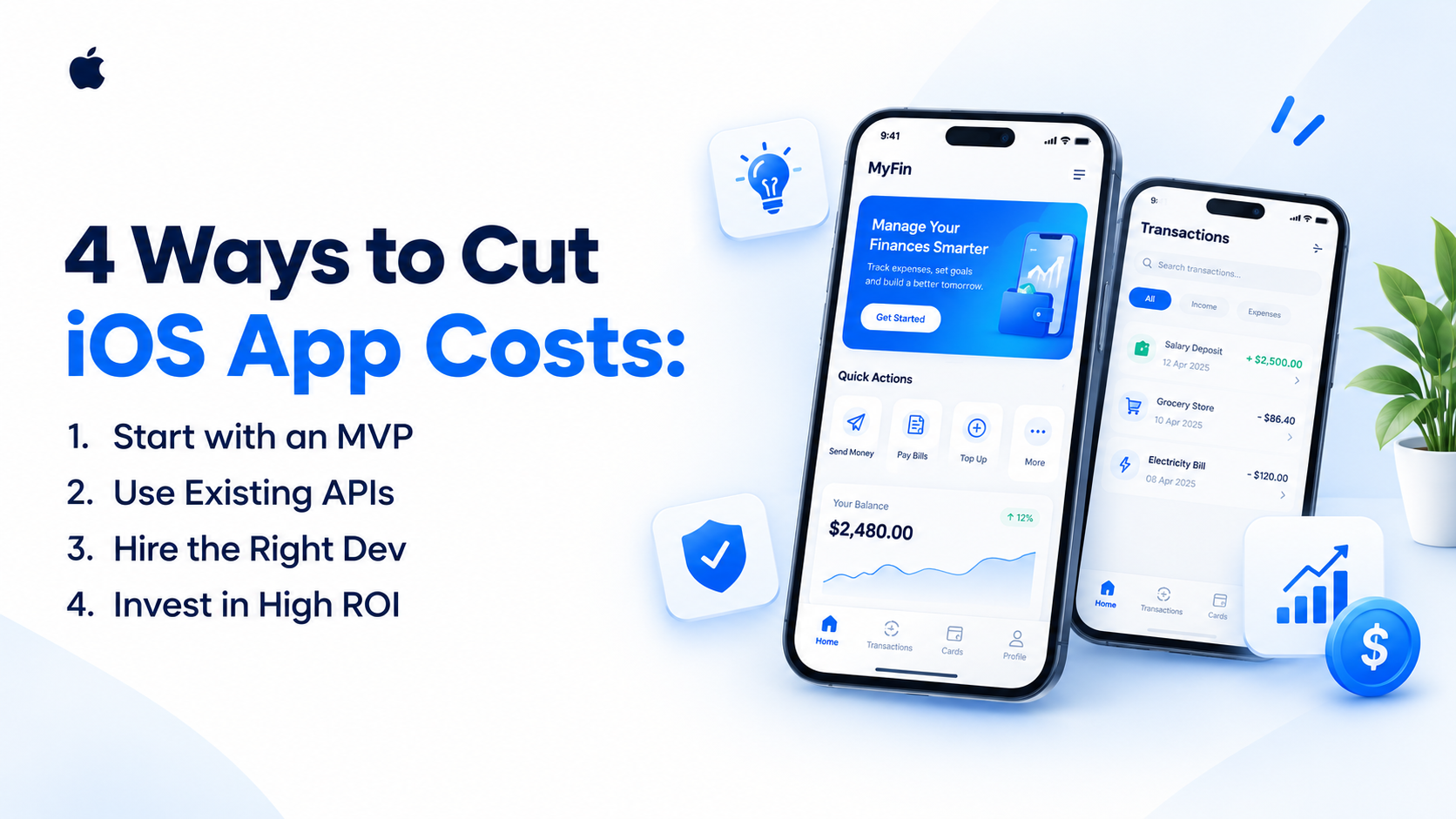
Most of the savings come from choices made before anyone writes code. Once the build starts, each change takes more hours, and the bill follows.
Start with an MVP
7 Pillars puts a basic MVP at about AU$20,000, while a complex product can pass AU$300,000. That gap is mostly based on the features. A first release with only the core features lets real users show you what to build next, so you stop paying for guesses. Ideas that can wait go into a second release. For a detailed breakdown, explore everything you need to know about MVP costs.
Use Available APIs
Things like Apple Pay, Stripe, and Maps already exist. Connecting their APIs to do what we need takes far fewer hours than building the functionality ourselves, and the savings show up on the quote. Integrations to older and custom systems cost more, so list them at the beginning of the project, not midway through.
Choose the Right Developer
A low hourly rate can be more expensive in the end. Offshore teams can charge as little as AU$20 to AU$60 an hour. But the time zone differences and requirement misunderstandings can increase costs due to rework. A local iOS development company can be more expensive hourly, but may be less expensive overall due to rework savings.
When you compare iOS app developers in Australia, request an itemised quote and ask for a list of their past work for iOS app development in Australia. Ask what kind of support, if any, they provide after the app has launched.
ROI Spending
There are costs worth paying. Spending on things like the Discovery Phase to help catch flawed ideas early and User Acceptance Testing (UAT) to catch bugs before they get to the users can help save costs in the long run.
How Do You Get an Accurate App Development Quote in Australia?
A vague brief gets a vague quote. If you describe your app in one sentence, the agency fills in the gaps with its own guesses, and you pay for them later. Here’s what you have to take care of in order to get accurate estimates.
| What to bring | Why it matters |
| Launch day features | Only these are priced in the first release |
| Ideas that can wait | Left out of the quote, added after launch |
| User types | Each role adds screens |
| Outside systems | Payments or accounting tools need extra setup |
| Devices and user numbers | They affect testing and hosting costs |
Keep the must-haves and the wishes on separate lists. Many founders send one long list, and the agency prices every line of it.
Ask for a short discovery phase before the build starts. The team reviews your brief and comes back with a scoped plan and a fixed price. It is also the cheapest time to change your mind. A mistake on paper costs hours, but the same mistake in a half-built app can cost weeks.
When quotes arrive, ask for an itemised breakdown. Compare them on the same scope, and check what support is included after launch.
Why Choose 7 Pillars for Custom iOS App Development?
7 Pillars has positioned itself as one of the best iOS app development companies in Australia. This is because of our emphasis on client-centricity, customisation, industry expertise, and commitment to app success, all at affordable rates. Here are the reasons Aussie businesses trust 7 Pillars.
Experience Across Industries
Over the years, we’ve developed apps for healthcare, fintech, e-commerce, and entertainment. Different industries have different user expectations, integrations, and technical requirements.
For example, Dating App Development may involve user profiles, matching algorithms, real-time messaging, and subscription payments, all of which can affect the overall development cost. Our experience across industries helps us understand these requirements before estimating a project’s scope.
A Cost You Can Plan For
Prior to writing a line of code, we set up a face-to-face meeting to go over your ideas, goals, and users. We also go over the features you need or want. Following this meeting, iOS mobile app developers provide you with a Scope of Delivery, an Estimated Cost Structure, and a list of compliance points that apply to your App. Changes during the development process increase the overall cost, so we’re thorough the first time.
Post Launch Support
After a new version of iOS is released, Apple supports it for a year. During this year, bugs are often found by real users, and support calls spike. We provide you with complete support and maintenance within our iOS app development services to help with any bugs found after launch.
Benefits Beyond the Code
A working app is the absolute minimum. We measure our work by the benefits it brings to your business, such as improved processes, more customers, and higher profits. We aim to build something your customers keep using and get value from it.
Ready to Plan Your Custom iOS App?
Meet with 7 Pillars to get a clear Scope of Delivery and estimated cost structure.
FAQs
How much does it cost to develop an iOS app in Australia?
App projects in Australia run from about $20,000 for a basic MVP to more than $300,000 for a complex product. An iOS app falls inside that range. Features, design, integrations, and the team you hire decide where it lands.
Is iOS app development more expensive than Android?
The cost per platform is broadly similar. The price for iOS app development services rises when you build both as separate native apps, because each one needs its own code and testing. A cross-platform framework avoids that duplication.
How long does it take to develop an iOS app?
A simple app (MVP) takes about 4 to 12 weeks, and a medium-sized business app takes 3 to 6 months. A complex app can take 6 to 12 months or more. A clear brief and a discovery phase shorten the timeline.
How much do iOS app developers charge per hour in Australia?
iOS mobile app developers in the junior category charge about $80 to $120, and mid-level developers charge $120 to $180. Senior developers and agency teams charge $150 to $250 for iOS app development services. Offshore teams quote $20 to $60, though time zone gaps can lead to rework.
Is native iOS development better than cross-platform development?
It depends on the project. Native iOS uses Swift and gives full access to Apple features and strong performance. Flutter or React Native serves iOS and Android from one codebase, which suits a business that needs both platforms.
What are the ongoing costs of an iOS app?
Apple charges US$99 a year for its developer membership. Hosting costs $10 to $10,000 a month, and third-party services bill by usage. Maintenance needs at least 10% of the build budget each year, and some agencies advise 15% to 25%.
How do I choose an iOS app development company in Australia?
Shortlist five to seven companies and check that each has built two or three apps in your category. Read client reviews on Google or Clutch, starting with the negative ones. Confirm what support comes after launch. Good iOS app development service providers keep communication transparent.

Sandeep Mann

Get in touch
We'd love to hear from you.



 +61 42 108-3277

 contact@7pillars.com.au
 Stay Inspired with our