










📌Quick Summary
- A website presents information to visitors; a web app lets users log in and complete tasks like booking, paying or managing data.
- A website shares information, like your services, pricing and contact details, and every visitor sees the same content. A web app lets people log in, book, pay or track something, and each user sees their own personalised data.
When is a website enough?
- If you only need to explain what you do and get found on Google, a website does the job.
When does a web app pay back more?
- If customers or your team need to log in, make bookings, send payments, manage records or see reports, a web app is the stronger investment. It runs the process for you instead of adding to your workload.
- Let’s be upfront. A web app costs more at the start. It earns that money back when your business needs logins, workflows or data, because it cuts manual work and gives customers a reason to come back.
Most businesses don’t lose money on the build. They lose it on the rebuild.
A company picks a website because the quote looks smaller. A year later, customers want to log in, book, and pay online. The site can’t do it, so the project starts again from zero.
That’s the real cost of choosing between a web app and a website.
This guide helps you decide before you spend. At 7 Pillars, a Melbourne-based web app development company, we help businesses across Australia make this choice every week. We explain the difference in plain terms, show where a web app earns its cost back, and walk through OneRound, a Brisbane-based rewards platform we built.
Web App vs Website: What’s the Difference?
Both a website and a web app are accessed through a web browser, but a web app is more interactive and has more functions. Let’s explore.
What is a website?
A website is a collection of public web pages that tells visitors who a business is, what it offers and how to get in touch. Every visitor sees the same content, and interaction is usually limited to forms, search and navigation.
What is a web app?
A web app is software that runs in a browser and lets users log in, enter data and complete tasks such as booking, paying or tracking orders. Each user sees their own information. Gmail, Canva and Xero are everyday examples.
The Line of Difference
A key difference in both platforms is what they have been designed to do. A website is created to help a user (or potential customer) access info about products or services. A web app allows a user to perform a task, access info, or edit data. Both may have interactive features, but a web app usually puts functionality at the centre of the experience.
Here’s a breakdown:
| Factor | Website | Web app |
| Primary purpose | Present information and attract visitors | Help users complete tasks and interact with systems |
| Interaction | Forms, navigation, search and other features | Workflows, data management and task execution |
| Users | Primarily visitors and potential customers | Customers, employees, partners or administrators |
| Data | Content and visitor-submitted information | Data that users can create, access, update and manage |
| Business logic | Usually limited to presentation and basic interactions | Often includes application rules, workflows and automation |
| Development | Often simpler, depending on requirements | Usually more complex, depending on functionality |
| Growth | Expand pages, content and features | Extend functionality, integrations and workflows |
| SEO | Public pages can be indexed | Public-facing pages can be indexed; private authenticated areas generally cannot |
| Typical cost (AUD) | AUD $3,000 – AUD $15,000 for a small-to-medium business website | AUD $15,000 – AUD $100,000+ depending on features and complexity |
| Build timeline | 2–8 weeks | 2–6 months or longer |
| Ongoing maintenance | Lower maintenance costs; typically includes hosting, security updates, backups and content updates | Higher maintenance costs; includes server management, bug fixes, security, database maintenance and feature updates |
| Examples | Business websites, blogs, portfolio websites and informational websites | Online banking platforms, project management tools, customer portals and SaaS platforms |
A well-built web app keeps a fast, search-friendly public layer, so you can be found on Google and still be useful to your users. A web application development company can build both together. Before you decide, be clear on what you need now and what you’ll need as you grow. That keeps the scope right and the budget under control.
Still not sure which one your business needs?
Tell us what your customers need to do online. 7 Pillars, a Melbourne-based web app development company, will tell you which one fits and why, in one free call.
When is a Web App More Beneficial?
Return on investment will look different for every business. But for many, a web app can make good financial sense. Here are four situations when the numbers can work in a web app’s favour.
As a rough Australian development benchmark, a professional business website costs around AUD $3,000– AUD $15,000 and takes 2–8 weeks to build. A custom web application can cost AUD $15,000–AUD $100,000+ and take 2–6 months or longer. The actual cost depends on functionality, integrations and complexity.
Service Businesses: Bookings and Quotes
Admin time can eat into your profits when your team spends hours taking bookings and preparing quotes through phone calls and emails. A web app can automate bookings, quote requests, availability checks and payments.
The Australian Government’s Small Business Digital Taskforce reported that the average Australian small business spends around one-third of its time on administration. Although this is a 2018 estimate, it highlights the potential value of reducing manual work.
Hospitality and Retail: Repeat Visits
A website can display your menu, but a web app can support loyalty accounts, rewards and personalised offers. OneRound, which we cover later, uses a web app to reward customers for purchases and encourage repeat visits.
B2B Companies: Client Portals
Emails get lost in inbox threads. A client portal gives customers one place to access documents, track project progress, submit requests and manage account information. This reduces repetitive communication and makes information easier to manage.
Multi-location or Partner-based Businesses: One Dashboard
Businesses operating across multiple locations need consistent reporting and oversight. A web app can bring sales data, reports, staff activity and operational information into one dashboard, with access permissions tailored to each office, employee or partner.
A web app also gives businesses room to expand. New features, integrations and user roles can be added as operational requirements change, without rebuilding the entire platform.
Think You Only Need a Website? Read This First
Be honest about the brief. A simple site with five pages and a contact form is fine for some businesses. If that’s you, a website will serve you well.
But if you need features like online bookings, payments or customer accounts, consider a hybrid approach. You could start with a public-facing website and add a secure web app for customer interactions as your needs grow.
A Progressive Web App (PWA) is another option. It combines a website’s accessibility with app-like features, such as home-screen installation and offline access where supported.
There’s a middle path.
Develop a web app with fast, search-friendly public pages. You get a site that can be found on Google and a system that does the work behind it. One build, one team, room to grow. Let’s have a look at one of our projects below.
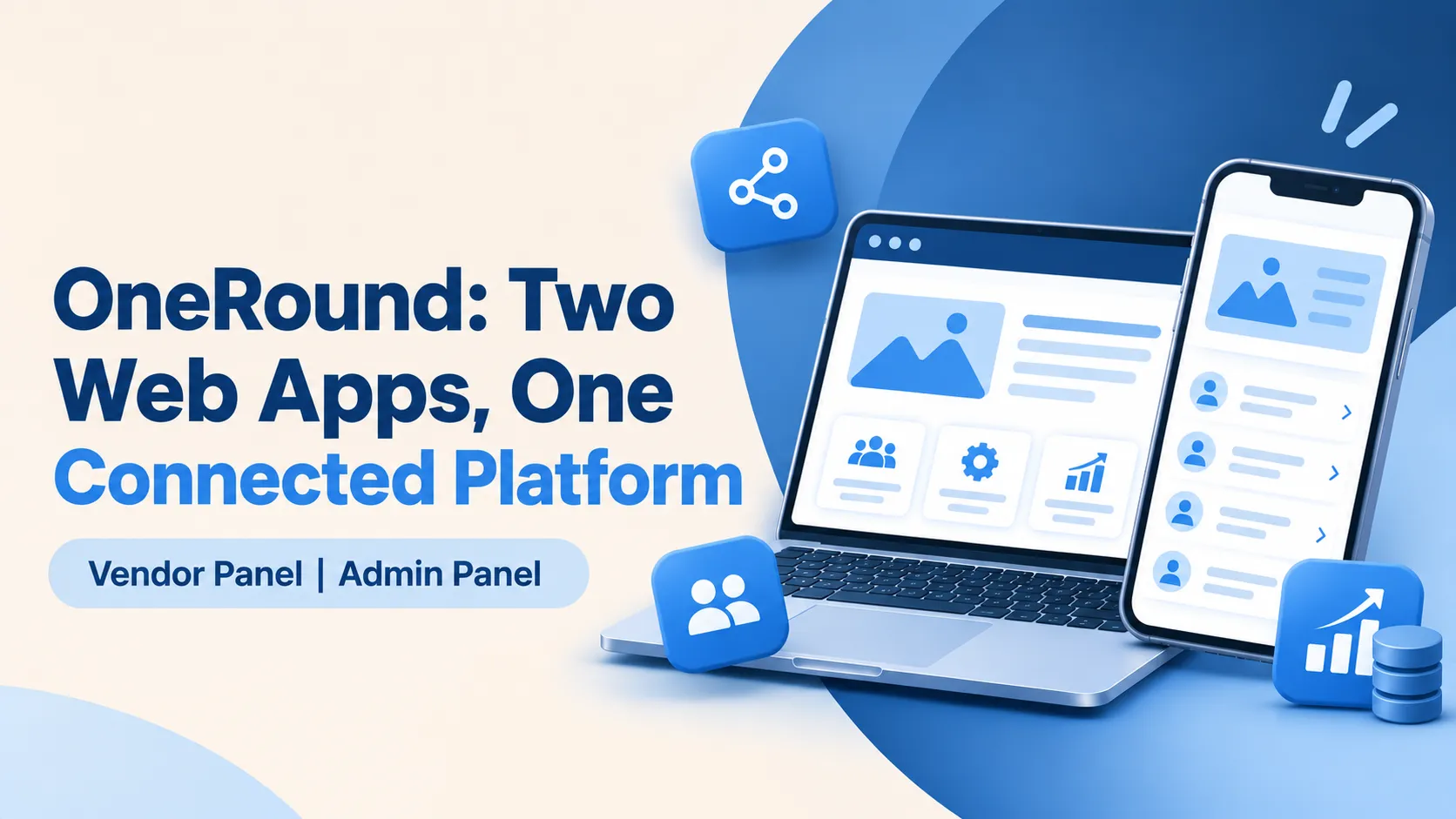
OneRound: Two Web Apps Powering a Connected Rewards Platform
The Problem
OneRound needed to connect customers with participating venues while giving venue owners and administrators control over loyalty programs, rewards, and platform operations. Managing these activities required more than a conventional website could offer.
What We Built
OneRound is a Brisbane-based nightlife discovery and rewards platform. Users discover venues, collect Roundies (OneRound’s reward points) and redeem offers using QR codes. Behind the customer experience, we developed two web applications:
Vendor Panel
Venues can create deals, manage loyalty programmes, handle QR redemptions, manage subscriptions, and access reports.
Admin Panel
The OneRound team can manage users, venues, rewards, content and notifications, with role-based access for different team members.
How We Built It
We started with discovery to understand how venues and administrators operate. Then we developed the applications in milestones, testing each stage before moving forward.
The Business Value
OneRound now has a centralised system for managing venue activities and platform operations. Its web applications support the wider Android and iOS apps and promotional website, allowing the platform to evolve as business requirements grow.
“Having a technology partner you can trust to take ownership of the technical side makes a huge difference.”
Joe Thyne, Founder, OneRound
Building a platform with more than one type of user?
Get the same technology partner OneRound trusts. 7 Pillars, a Melbourne-based web app development company, will map your users, workflows and integrations with you in a free discovery call, so you know what to build before you spend.
Quick Check: Does Your Business Need a Web App?
Not every business needs a web app. But if your employees or customers access data or perform tasks or processes online, a website may not fully meet your needs.
Answer the following questions to determine what your project may require.
1. Do users need to access their own accounts, records, or personalised information?
Examples may include users checking their own account balances, order histories, or shipping information.
2. Do users need to create, update or manage information?
This may include users completing a form or adding information to a database.
3. Do you need to automate business processes?
For example, do you need to automate notifications, approvals, reporting or workflows?
4. Does your platform need to connect multiple systems and exchange data?
For example, do you need to connect your CRM with your accounting system, payment gateways, or shipping systems?
5. Do you need integration with third-party applications?
For example, do you need to integrate a payment processor or a mail provider on your site?
6. Do different users require access to various features, dashboards or reports?
Example: Administrators managing operations vs. customers tracking activity vs. employees accessing role-specific information.
How to interpret your answers
If you answered yes to 2 or more questions, especially 1, 2 or 6, you need a web app. If you answered yes to none or only 5, a website will do.
A website, on the other hand, should be sufficient if the requirement is to merely display your business, publish information, generate enquiries, or process simple contact requests.
There are some cases that fall in the middle. In such cases, a website with some select interactive features or a public-facing website with a web application may be the better options.
The right option is the one that best suits the needs of your business, not the one that gives you the maximum number of features.
Answered yes to two or more questions?
You probably need more than a website. Send us your answers and our Melbourne based team will tell you, in a free 30 minute call, whether a website, a web app or something in between fits your business, with a ballpark budget and timeline. No obligation, no jargon.
Why Choose 7 Pillars for Web App Development?
Choosing a web app development company is a big decision. You’re trusting a team with something your business will rely on every day. 7 Pillars is a Melbourne-based digital product and AI partner, building web apps, mobile apps and software for businesses across Australia and globally. Here’s how we work.
We Plan Before We Build
Every project starts with discovery. We want to learn how the business works. Who will use the product and what are the specific tasks each of those users performs? Understanding how the business works and what’s required of the users helps design a product that is easily integrated into a user’s workflow. We did this with OneRound, and mapped how venues work.
We Deliver in Milestones
Large projects can become overwhelming when waiting on a large deliverable at the end. We approach large projects by breaking down the work into smaller components, or milestones. Each of these smaller components is designed, built, and tested by our QA team, and then signed off on, before starting work on the next component. This approach enables our clients to see and experience the product being developed throughout the project.
We Build for Growth
Growth of an organisation is continuous, and our custom web app development services include building a backend that can adapt to changes. OneRound, for example, is live, and we continue to add to it.
You’ll work directly with a Project Manager who is assisted by QA, Development, and Design teams.
Don’t pay for your website twice.
Tell us what your customers and team need online. Get a clear recommendation, indicative AUD budget and milestone plan before committing.
FAQs
In the web app vs website debate, which gives a better return?
A web app gives a better return when your customers need to log in, book, pay or track something. If they only need to read about you, a website is enough. A web app pays for itself by automating manual work like bookings, invoices and reminders. It also gives customers a reason to come back, through things like a client portal or order tracking.
Is web application development always more expensive than a website?
Usually, at the start. In Australia, a business website typically costs AUD AUD $3,000–AUD $15,000, while a custom web app starts around AUD AUD $15,000 and can exceed AUD $100,000. Apps cost more because they require user accounts, databases and business logic. However, automation and time savings can justify the higher investment.
Do general web development services include web apps?
Not always. Most web development services focus on brochure sites and online stores built on platforms like WordPress, Wix or Shopify. Web apps need custom development. So before you sign, ask the team three questions: Have you built logins, dashboards and workflows? Can you show me live examples? Who supports the app after launch?
Should I hire a web development company or a custom web app development company?
Hire a web development company if you need an information site or a simple online store. Hire a custom web app development company if your project involves user accounts, payments, business data or automation. That work needs different skills, like database design, security, testing and ongoing support. If you’re not sure which you need, a short discovery session will tell you before you spend money on a build.
Can I start with a website and move to a web app later?
Yes, and it can be a smart way to test demand first. The catch is that you may end up paying for two builds if the first site isn’t designed to grow. If you already know you’ll need logins or payments, plan the web app from the start and launch the public pages first. That way you get online quickly and don’t have to rebuild later.
What should I prepare before talking to a web app development team?
Prepare four things:
(1) who will use the product,
(2) what each person needs to do,
(3) which tools it must connect to, such as Xero, Stripe or your CRM, and
(4) your budget range and target launch date.
Rough notes are fine. They help the team scope the work and give you a more accurate quote. Screenshots of apps you like are useful too.
Is a web app a website?
Not exactly. Both open in a web browser, but a website mainly shares information, while a web app lets users log in and get things done, like booking, paying or managing data. Many businesses have both: a public website for marketing and a web app behind it for customers or staff.
What are examples of web apps?
Gmail, Canva, Xero and Google Docs are all web apps. You open them in a browser, log in and do work rather than just read. Business examples include booking systems, client portals, online quoting tools, staff dashboards and loyalty platforms, like the vendor and admin panels we built for OneRound.
Web app vs mobile app: which do I need?
Choose a web app if your users mainly work on a computer, or you want one product that runs on any device without app store downloads. Choose a mobile app if users need it on the go, with push notifications, camera, GPS or offline access. Many platforms use both. OneRound, for example, has iOS and Android apps for customers and web apps for venues and admins.
What is a PWA?
A PWA, or progressive web app, is a web app that behaves like a mobile app. Users can add it to their home screen, get notifications and use some features offline, without downloading anything from an app store. It is a cost effective middle ground when you need mobile reach on a tighter budget.
How much does a web app cost in Australia?
In Australia, a custom web app typically starts at AUD AUD $15,000, while larger platforms with multiple user types, payments and integrations can cost AUD AUD $100,000 or more. The biggest cost drivers are functionality, integrations and project complexity. A discovery session helps determine the right scope and budget for your project.
Related Blog: iOS App Development Cost Guide
How long does it take to build a web app?
A simple website typically takes 2–8 weeks to build, while a custom web app usually takes 2–6 months or longer. Timelines depend on features, integrations and project complexity. Building in milestones helps deliver and test working features throughout development.

Sandeep Mann

Get in touch
We'd love to hear from you.


 +61 42 108-3277

 contact@7pillars.com.au
 Stay Inspired with our