














The difficulty in fintech app development in Australia lies in balancing between high build costs and stringent regulatory and infrastructure demands. One can resolve this by instituting development in a well-planned manner. The fintech app development cost to create an app similar to Up will be between AUD 150,000 and 400,000, and enterprise platforms should be over AUD 800,000 due to compliance issues.
The Australian digital payments ecosystem is expanding fast — the New Payments Platform alone processed more than 1.3 billion transactions worth over $1.5 trillion in a single year, according to Reserve Bank of Australia data. Fintechs are obligated to meet the requirements of AUSTRAC, KYC and AML. Mobile app developers in Melbourne generally focus on secure architectures that align with regulatory standards and operational stability.
The cost drivers mentioned in this blog include: back-end systems, compliance processes, and third-party integrations. It further describes how an Australian mobile app development firm tackles fintech builds. The input of mobile application developers in Melbourne has identified practical solutions to complexity management, compliance, and the production of stable, production-ready platforms.
Planning Fintech App Investment With Clarity
Australian Fintech projects rarely start with code that they plan on regulation, risk, and long-term sustainability. Most businesses in Melbourne seek the services of on-demand app developers before any build to influence technical direction, clarify integrations, and develop grounded cost expectations based on the reality of regulated financial environments.
For businesses that introduce a financial platform, the quality of execution directly influences its cost and schedule. Collaborating with the leading mobile app development firm in Australia will help in organising delivery, aligning compliance, and minimising uncertainty. An effective technical strategy can help reduce rework, establish a budget discipline, and optimise the fintech app development cost, producing fintech products that perform effectively in actual market conditions.
 The Rise of Smart Banking in Australia
Up is an Australian digital neobank that provides real-time views on spending, smart budgeting and convenient payments to redefine how users manage money by delivering mobile-first banking experiences.
- Australians widely use mobile banking, making user experience and trust essential.
- Mobile internet use in Australia is now nearly universal, with 97% of adults accessing the internet via mobile phone, according to ACMA’s 2026 research — creating high demand alongside high competition for fintech apps.
- Fintech applications must be adhered to with rigour, and on many occasions.
- The pace of development is not an assurance of product success in the long run.
- Speed of development does not guarantee long-term product success.
- Ineffective planning results in more failures than technical problems.
- Early validation greatly eliminates product and market risk.
This is the gap. Building is achievable. The challenge is maintaining trust and engagement.
Fintech Rewiring Australia
The future of Australian banking is transformed by fintech, as banking ceases to be a traditional system and shifts to fast, digital-first, user-centred experiences in all aspects of daily transactions.
1. Complexity of Regulations and Trust.
- Australia has stringent financial laws, making compliance with the AUSTRAC and ASIC mandatory.
- Security, data privacy, and fraud prevention have a huge influence on the development scope.
- An experienced mobile app development company makes compliance part of the undercarriage.
2. Evolving User Expectations
- Australians demand instant payment, real-time insights, and UX.
- The popularity of smartphones can lead to 24/7 support in banking applications.
- A skilled app development company in Australia aligns products with such expectations.
3. Rapid Fintech Adoption
- Use of digital banking is on the rise in Australia.
- App-based financial management is more accessible to users than the old banking methods.
- On-demand app developers are essential for scalable fintech solutions.
4. Competitive Start-up Landscape
- Fintech start-ups are flooding the Australian market.
- The differentiation currently relies on UX, automation, and intelligent financial tools.
- Experts develop mobile apps that prioritise retention-based product experiences.
5. Local Innovation & Growth
- Sydney is a fintech leader with access to funding.
- Several start-ups engage the services of a Fintech app development company in Sydney to speed up launch.
- Collaborating with mobile app developers in Sydney would ensure that it aligns with market demands.
Why Build a Fintech App Like Up?
With the emergence of digital banking, customers are shifting to applications that offer real-time control and easier management of money. One such fintech application is Up, which mirrors the increasing popularity of digital financial services in Australia.
1. Ups Market Success
- Up is a digital-only Australian-based bank.
- Offers live transaction and expenditure information.
- Focuses on a simplified and consistent user interface
- Functions without reliance on physical branches
- Represents a shift towards app-based banking services
2. Scalable Fintech Model
- Supports payments, savings, and transaction tracking
- Integrates with banking systems and APIs
- Can be extended with additional financial features
- Suitable for both new and established fintech products
- Built to handle increasing user activity
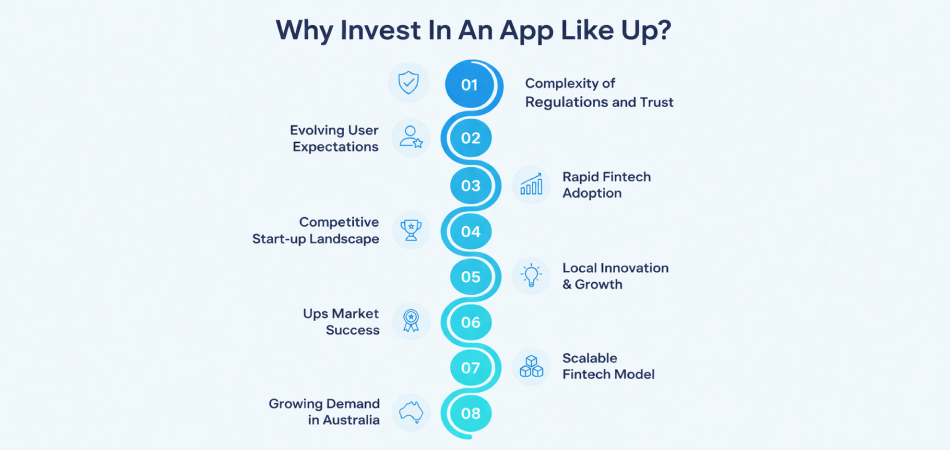 3. Growing Demand in Australia
- Mobile banking usage continues to increase.
- Widely used digital payments across the country.
- Smartphone access supports app-based financial services.
- Users are shifting away from branch-based banking.
- Creates conditions for fintech product growth
Why Is Up Popular in Australia?
Up has gained traction in Australia by simplifying everyday banking and giving users immediate, clear control over their finances.
- The interface remains clean and easy to navigate.
- Transactions appear instantly without delay.
- Display spending in a clear and structured way.
- Features are simple and do not overwhelm users.
- Built specifically for consistent mobile use
Key Features of a Fintech App
To develop an application similar to Up, one requires features that guarantee security, usability, and real-time functionality. The key factors of a successful fintech application are listed below.
1. User Registration & Profiles
Enable users to create and control accounts safely. Transaction history, preferences, and financial behaviour should be stored in profiles to customise the experience.
2. Instantaneous Transaction Tracking
Transactions should be visible to users with categorisation and insights in real time. It is an essential feature that can help gain trust and enhance financial awareness.
3. Payment & Transfer Systems
Ease fast and secure transfers, bill payments and peer-to-peer payments. An Australian mobile app development company will provide smooth integration with banking infrastructure and payment gateways.
4. Budgeting & Smart Insights
Offer integrated budgeting systems and expenditure. These functionalities allow users to monitor costs and financial performance.
5. Security & Compliance
There should be advanced encryption, multi-factor authentication, and regulatory compliance. Well-established security systems guarantee confidence and sustainability of the platform for users.
6. Notifications & Alerts
Live transaction, spending, and account alerts keep the users updated and entertained.
7. API & Banking Integrations
The API and financial service integration enable easy data sharing, increase app functionality, and make the platform more scalable.
Cost To Build An App Like Up
Fintech app development in Australia is a multiphase process with each phase contributing to the overall cost. For a full breakdown of how these estimates are actually calculated, see our guide on how app development cost is actually calculated.
1. Discovery & Planning
In this phase, we define the requirements for the product that will support the user journeys and the technical architecture necessary to design a fintech app.
- We take into account regulatory compliance with AUSTRAC, data protection requirements and risk assessment planning.
- A proper plan minimises rework and avoids future cost overruns during development.
- This phase normally costs a mobile app development company in Australia between AUD 10,000 and 25,000.
2. UI/UX Design
The design will strive to create a convenient and secure interface that will instil confidence in users.
- Includes onboarding processes, transaction screens and financial data visualisation, contributing to the overall fintech app development cost.
- The use must be uniform to grow usability and modify long-term interaction.
- Experienced mobile app developers cost AUD 15,000+ at this stage.
3. Application Development (Core Features)
Includes account development, payment development, transaction development, and administrative dashboards.
- It requires robust coordination of the frontend and back-end systems for a quick response.
- The processing complexity of features and real-time processing affect development time
- The average cost of an app development firm in Australia is AUD 80,000-250,000+, based on Flutter mobile application frameworks to streamline the delivery.
 4. Back-end & Integrations
Manages banking APIs, payment gateways and data security layers.
- Composed of authentication infrastructure, encryption and real-time transaction infrastructure.
- The complexity of integration makes it more expensive and complex.
- The cost of this stage typically begins from AUD 30,000, depending on client requirements.
5. Testing, Launch & Maintenance
Testing ensures the performance, security and compliance of devices.
- Launch involves deployment, monitoring and troubleshooting of initial problems.
- Constant upgrades are needed to ensure compliance.
- The phase costs AUD 15,000-50,000+, with the services getting charged separately.
Factors Influencing The Cost to Build a Fintech App Like Up
The creation of an app, such as Up, does not involve ordinary development. Real-time banking capabilities, compliance layers and system reliability requirements influence costs in the Australian fintech landscape.
1. Infrastructure Real-Time Banking
- Apps such as Up need real-time processing and inter-systems synchronisation.
- Real-time processing of data makes the back-end more complex and expensive.
- It requires high-availability systems to prevent downtime during the financial activity.
- A scalable architecture helps accommodate increasing user transactions.
2. Financial Intelligence And Robotics
- Spending categorisation and insights need an ordered processing of data.
- Budgeting and savings tools are examples of automation, which increase the development effort.
- Customised insights add complexity and logic layers to systems.
- These characteristics need to be optimised and updated constantly.
These AI-driven features are becoming a core part of modern fintech products — see our guide to AI development and integration, or our complete guide to AI app development cost for a deeper look at budgeting for these features specifically.
3. User Interface And User Experience
- Up-style apps rely on minimal design, which demands UX planning.
- The financial information should be in a concise form.
- The interface design should be regular to navigate smoothly through the features.
- To work on usability and interaction flows, user testing is necessary.
4. Security & Regulatory Compliance
- Fintech applications are required to satisfy the Australian financial standards and regulations.
- Encryption and authentication are security features that expand the scope of development.
- Compliance requirements change, and they have to be updated continuously.
- Noncompliance may result in expensive rework, significantly increasing the fintech app development cost.
5. Scalability And Technology Stack
- Technological selection influences the rates of development and performance in the long term.
- It needs scalable systems to manage the growing volumes of transactions.
- A cross-platform framework can help minimise the time for initial building.
- Advanced fintech capabilities are likely to require custom solutions.
Why Select A Fintech App Development Company In Australia?
Collaborating with a local fintech development company ensures compliance with regulations, facilitates communication, and supports the applications.
1. Local Knowledge
- An Australian-based mobile application development company specialising in fintechs is aware of local regulations and banking, as well as the compliance needs.
- It helps in product matching with the expectations of Australian users and minimises the risks of regulation.
2. Faster Communication
- The same time zone helps coordination and speed of decision-making.
- Live collaboration removes time wastage and reduces misunderstanding during the development process.
3. Post-Launch Support
- The local teams ensure continuous maintenance, making the app secure, updated and compliant.
- Problems are solved more quickly, because they are accessible and with follow-up.
How To Know The Right Mobile App Development Company?
It is important to select the best development partner to achieve quality delivery, compliance, and scalability.
1. Portfolio
- Analyse previous projects to evaluate experience in fintech or other applications.
- An effective portfolio reflects the ability to work with complex financial systems.
 2. Reviews And Testimonials
- Client feedback provides user insight into the reliability and delivery standards.
- Regular affirmative feedback reflects a stable and qualified staff.
3. Post-Launch Support
- Ensure that the team offers post-launch care, upgrades and performance optimisation.
- Continuous monitoring helps in security compliance.
With the right team and knowledge of the cost elements, businesses will be confident to invest in fintech.
How To Reduce Costs?
Considering the cost of developing fintech apps should be planned carefully, prioritised, and not performed at the expense of security, compliance, or scalability.
1. Minimal viable Product Approach
- To minimise initial build, start with the basic features, i.e. onboarding, transactions, and simple payments.
- Postpone advanced capabilities, such as automation, analytics, and user validation.
2. Use Pre-Built Integrations
- Rely on pre-existing banking APIs, payment makers and authentication systems rather than creating new ones.
- It minimises development time, complexity and maintenance.
3. Maximise Development Strategy
- Use cross-platform frameworks where appropriate to eliminate the need to develop iOS and Android apps.
- The development of plans in stages to regulate the budget and reduce unwarranted revisions.
Creating A Fintech App similar to Up
An Australian fintech company seeking to develop a more streamlined banking application revolving around real-time spending data and frictionless interactions with younger customers.
Approach & Strategy
- Onboarding, transaction tracking and simple payments were introduced as a minimum viable product to keep the start-up expenses low.
- To match user expectations, they focused on clean UX and high speed.
Development Outcome
- The app had consistent performance with a scalable back-end infrastructure that supports real-time updates.
- Budgeting tools helped after launch in monitoring user behaviour and feedback.
Conclusion
To create a fintech application similar to Up, a systematic strategy is necessary that strikes a balance between compliance, performance, and user experience. Collaborating with an experienced start-up app development company ensures that there will be adequate planning, scalable architecture and effective implementation that meet the financial requirements and market expectations of Australian companies while optimising the fintech app development cost.
The long-term success of any business requires the staged development, improvement, and design that is user-centric. Collaborating with an experienced start-up app development company will simplify risk and cost management, offering a competitive, secure, and flexible fintech product.
FAQS
Q 1. Is it possible for a fintech application to connect to its current banking institution?
Ans 1. Yes. Fintech apps typically connect to existing banking infrastructure through secure Open Banking APIs under Australia’s Consumer Data Right (CDR) framework, which governs how financial data can be shared between institutions with customer consent. Integration timelines depend on which banks and payment rails are involved, and securing CDR accreditation can add several weeks to a project if it isn’t already in place.
Q 2. Should React Native be used in fintech apps?
Ans 2. React Native works well for fintech apps that need to launch quickly across iOS and Android from a single codebase, and it’s suitable for most standard banking features like account views, transfers, and notifications. For highly sensitive functions such as biometric authentication or advanced encryption, native modules are often still required to meet performance and security expectations, which most React Native fintech builds account for from the start.
Q 3. Can we develop a fintech application within a start-up budget?
Ans 3. Yes, though a start-up budget typically means starting with a Minimum Viable Product covering core functions like onboarding, transaction tracking, and simple payments, rather than the full feature set. This approach validates real user demand before investing in advanced features like automated budgeting or AI-driven insights, which can be added once the product proves it has traction.
Q 4. What are the security features required in fintech applications?
Ans 4. Core requirements include end-to-end encryption for data in transit and at rest, multi-factor authentication for account access, and real-time fraud detection systems that flag unusual transaction patterns. Australian fintech apps also need to align with AUSTRAC’s AML/CTF obligations and maintain audit trails for regulatory reporting, which shapes how these security features are actually implemented, not just whether they exist.

Sundeep Mann

Get in touch
We'd love to hear from you.





 +61 42 108-3277

 contact@7pillars.com.au
 Stay Inspired with our